 Guide On Map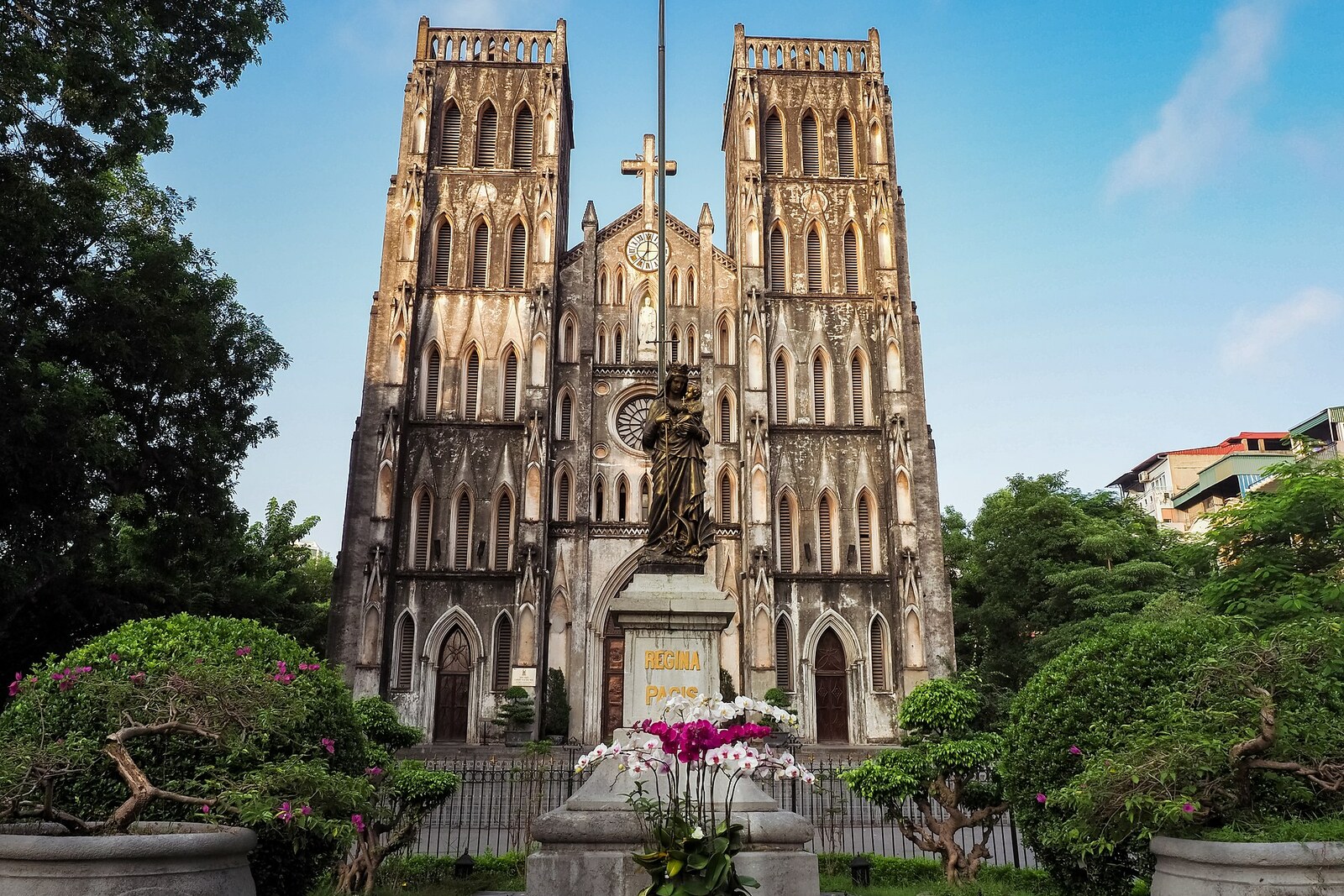
Look around first
What to notice
- Two square bell towers
- Brick nave
- Main facade
The story of the place
A pair of bell towers at the edges of the facade frames the church's long brick volume. Its walls and roof were paid for by two lotteries: each ticket offered a chance to win, and the money collected went toward construction. The land had previously belonged to the Buddhist monastery of Bao Thien Pagoda, founded in the eleventh century; after a great fire at the end of the eighteenth century, monks abandoned the decaying monastery. Inside is the cathedra of the Archbishop of Hanoi, so important services of the Archdiocese are held here, and an ordinary parish carries on with baptisms and weddings.
Paul-François Puginier ordered this cathedral built after Hanoi's Catholics lost their former church. Puginier was the bishop in charge of the Apostolic Vicariate of West Tonkin, directing the Catholic mission in northern Vietnam. He needed a permanent church in Hanoi, but at first the community had a small church built in eighteen seventy-six in the Nha Chung quarter. Several Catholic families lived around it, along with priests, students from the church school, and children from the orphanage.
In May eighteen eighty-three, the Black Flag Army attacked this quarter—a Chinese armed formation that fought alongside the Vietnamese court against the French advance. Local Christians were considered allies of the French. Father Lande, the parish priest of Hanoi, organized the church's defense. The first attack was repelled. Three days later, the Black Flag Army occupied the quarter, burned down the church, and carried off a statue of the Virgin Mary. The community was left without a church, and Lande was unable to save the building for which he had entered the fight.
Puginier decided to replace the burned church with a large, sturdy cathedral. By then, French troops had captured Hanoi, and he was given a neighboring plot from the former Buddhist monastery of Bao Thien Pagoda for construction. The monastery had been founded as early as the eleventh century under Ly Thanh Tong. Its famous tower had perished several centuries before the cathedral was built, and after a great fire at the end of the eighteenth century, the monks abandoned the deteriorating complex. In eighteen eighty-three, at the demand of the French resident Raoul Bonnal, Governor Nguyen Huu Do transferred this land to the Catholic mission. This is how Puginier obtained a site for the community's new center right here.
The mission did not have enough money for the planned building. Puginier organized two lotteries. For the first, Amédée Courbet authorized the printing of ten thousand tickets; for the second, the French resident-general Paul Bert approved another six thousand. A ticket cost one Indochinese piastre. Buyers paid for a chance to win, and Puginier turned the proceeds into bricks, roofing, and two bell towers. Construction began in eighteen eighty-four. On December twenty-fourth, eighteen eighty-six, the first Mass was celebrated in the new church; the official opening took place the following year.
Puginier chose the name not after a French patron. Saint Joseph was the husband of the Virgin Mary and, according to the Gospel, took her into his home and raised Jesus as his son. Catholics venerate him as the guardian of the family and the church. As early as sixteen seventy, the missionary bishop Pierre Lambert de la Motte asked for Joseph to be recognized as the patron of the Catholic community of northern Vietnam. Three years later, Pope Clement X approved this decision. Puginier himself dedicated his mission to Saint Joseph every year, so the main church received his name as well.
The word “cathedral” indicates the building's purpose: it contains the cathedra of the Archbishop of Hanoi, who leads the principal services of the Archdiocese of Hanoi. An ordinary parish operates at the cathedral; Masses are celebrated here, and people are baptized and married. Vietnamese people more often call it Nha Tho Lon—the Great Church.
Nothing remains of Father Lande's burned church in the Nha Chung quarter, nor of the statue that was carried away. Its successor stands on the land of Bao Thien Pagoda: a brick nave, two square bell towers, and an altar where the first community gathered for Mass on Christmas Eve, eighteen eighty-six.
Useful on site
Open urban space; choose a viewing point that does not obstruct pedestrian flow.
Checked: date not specified. Check the official source before visiting.You can listen to the story from the square. If you go inside, speak quietly, do not disturb the service, and follow the dress rules customary for the church.