 Guide On Map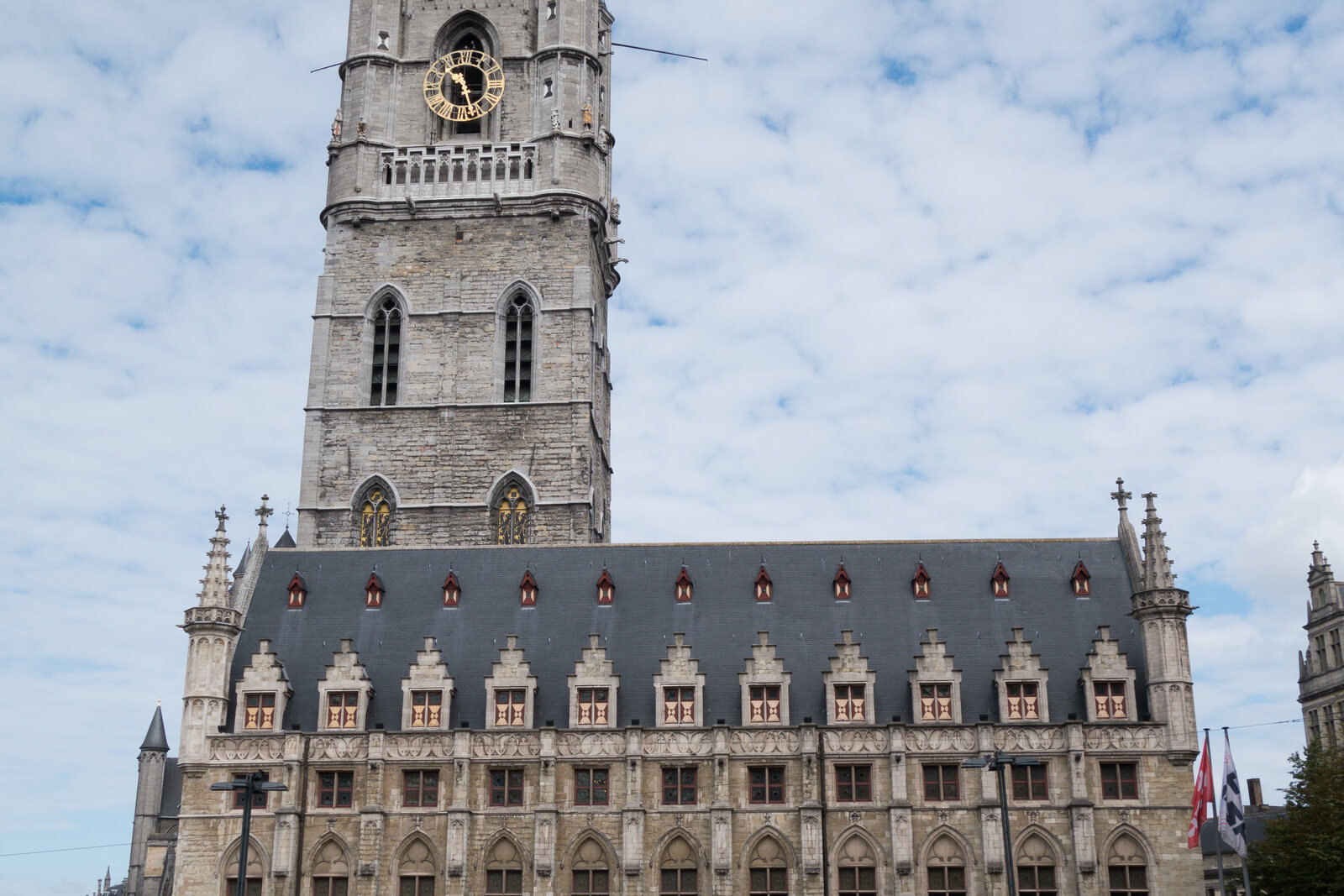
Look around first
What to notice
- Belfry of Ghent tower
- Cloth Hall
- Roeland Bell on a separate support
The story of the place
Cloth provided a livelihood for weavers, merchants, and many craft corporations, so its route through the city was strictly organized: wool and finished cloth were brought here for inspection, appraisal, and sale. The Cloth Hall, where these transactions took place and where the people whose rules governed guild work met, adjoins the tall civic belfry of the Belfry of Ghent. By St Nicholas' Church, on a separate support, stands the cracked Roeland Bell, the former great bell; another now hangs above the hall.
Three people came to the Belfry of Ghent, each with a key of his own: the bailiff, an official of the sovereign, and two senior aldermen, members of the city court and council. They could open the chest chained to the floor only together. From fourteen oh eight onward, it held the charters—documents recording Ghent's rights.
These papers lay above the Cloth Hall. It was added to the tower in fourteen twenty-five. Wool and finished cloth were brought here: the goods were inspected, appraised, and sold. Weavers, merchants, and dozens of craft corporations made their living from this. Their representatives sat on the city council, chose their own guild elders, and defended their rules with the charters from the tower chest. The great alarm bell, Roeland Bell, summoned the townspeople whenever they needed to gather.
In fifteen thirty-seven, Emperor Charles V, Ghent's ruler, demanded that its inhabitants contribute a share of a new levy for his wars. The cloth trade was already declining by then, while the people expected to pay were losing their former livelihoods. Ghent's representatives refused. After unsuccessful legal proceedings, several guilds demanded the right to choose their elders independently again. In August fifteen thirty-nine, craftsmen armed themselves, seized control of the city, and arrested some of the aldermen.
Charles V sought unconditional submission. In February of the following year, he entered Ghent with an army of more than five thousand men. The participants in the revolt did not dare to fight. Twenty-five leaders were executed. On May third, a penitential procession set out from the town hall: aldermen, townspeople, three hundred eighteen members of the small guilds, and fifty weavers walked barefoot. Last came fifty day laborers in white shirts, with nooses around their necks. The noose showed what sentence the emperor could choose for them; the men were forced to beg for mercy.
Charles V then took the city's charters, ordered Roeland Bell removed from the Belfry of Ghent, and deprived the guilds of the right to choose their leaders independently. Fifty-three corporations were reduced to twenty-one, and their elders came to be appointed by officials. The weavers and craftsmen kept their occupations, but lost the place in government that the documents in the tower had secured for them.
The great bell on a separate support by St Nicholas' Church did not witness that procession. The first Roeland Bell, removed on Charles V's order, was later returned and, in sixteen fifty-nine, melted down for a new set of forty bells. The largest was given its old name. It was this second Roeland Bell that cracked in nineteen fourteen and now stands below; another bell now hangs above the Cloth Hall.
Useful on site
Exterior viewing around the clock; interior access varies by the current week on the official page
Checked: June 27, 2026. Check the official source before visiting.The tower and hall can be viewed from the square; access to the ascent and interior spaces requires a separate check.