 Guide On Map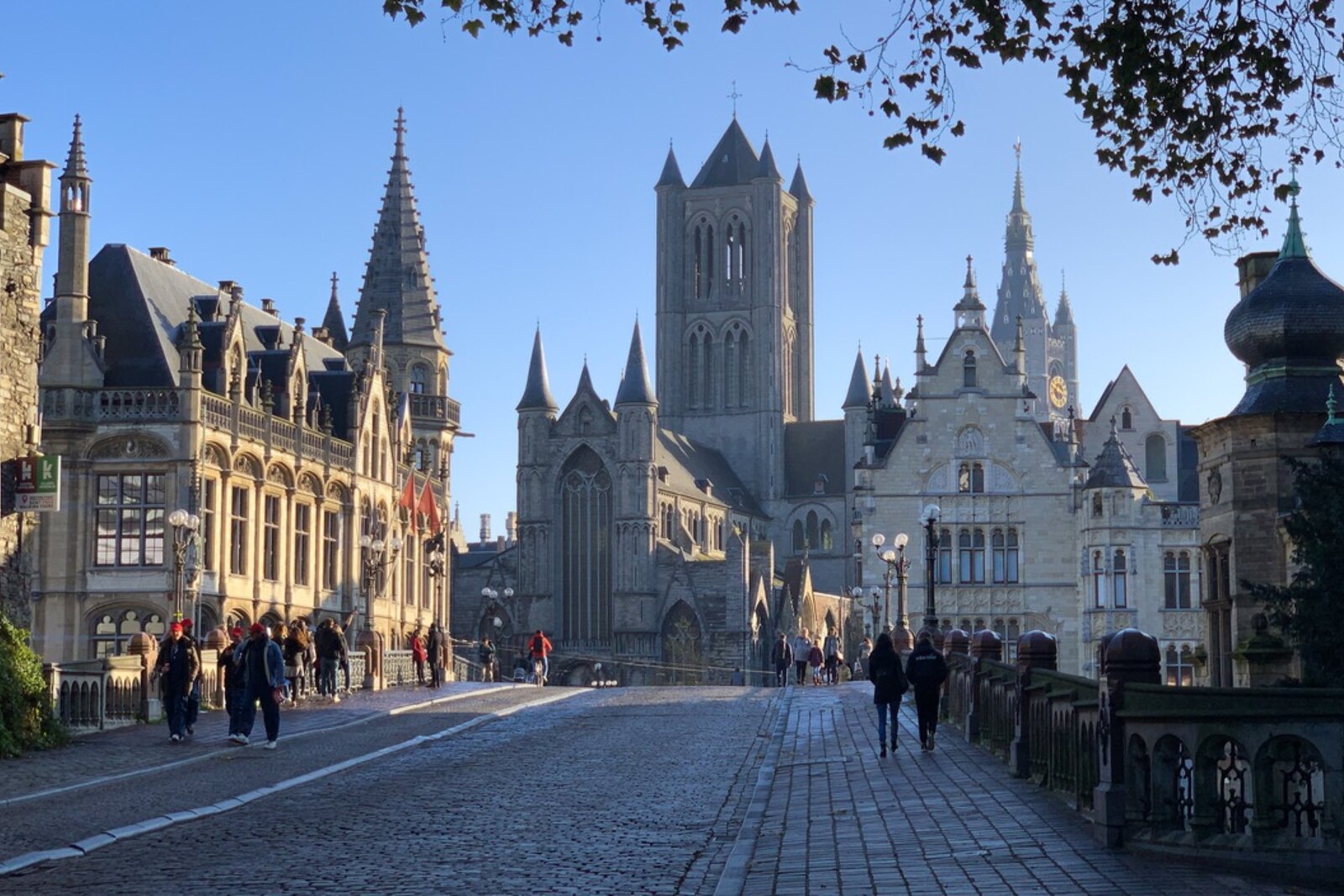
Look around first
What to notice
- The tower of St Nicholas' Church
- Korenmarkt by the church wall
- The Belfry of Ghent behind the church
The story of the place
City guards kept watch in the central tower of St Nicholas' Church; bells also hung here. Korenmarkt comes right up to the church wall: in the last century, rows of grain and seeds still stood along it. After the Belfry of Ghent was completed, the guards began keeping watch there, the bells were moved there as well, and the wharf in front of the church disappeared.
Korenmarkt means “Grain Market.” Its early name, Korenard, meant “Grain Wharf”: archaeologists consider it possible that a branch of the Lys or a canal connected to the river once reached almost this far.
Medieval city authorities turned this advantageous location into a strictly controlled market. After the middle of the fourteenth century, they officially secured Ghent's right of staple for grain. Wheat and rye brought along the Lys and the Scheldt from France had to be put up for sale right here. Up to a quarter of the grain that passed through the city was reserved for Ghent residents; a merchant who bought it could no longer take the purchase farther on.
Three stapelheren—city officials in charge of the grain storehouse—oversaw enforcement. They took samples from ship cargoes, checked the quality, and ordered how much grain was to be sent to storage. For a skipper, this meant a delay and compulsory sale where Ghent had designated. For a city with more than sixty thousand residents in the fourteenth century, it meant a supply of wheat and rye for bread and porridge. For local merchants, it meant a flow of goods that could not bypass them.
From the early Middle Ages, these merchants collected money for their parish church. At the beginning of the thirteenth century, they began building the present structure, while the guilds paid for their own chapels and undertook to maintain them. That is why the church stands directly beside the place of transaction, rather than apart from it.
The merchants chose Saint Nicholas of Myra as the parish's patron—the bishop of Myra in Asia Minor, about whom little is reliably known. His association with grain and carriers comes from legend. According to it, during a famine Nicholas appeared in a skipper's dream, gave him three gold coins, and told him to deliver a cargo of grain to Myra. Waking with the coins in his hand, the skipper fulfilled the request. Thanks to such stories, Nicholas was honored as the patron of merchants, sailors, and bakers. Here, his name reflected the occupation of the people beyond the church wall.
The merchants also paid for the church's central tower. The city's aldermen made use of its position: they stationed city guards at the top and hung bells there. This tower served Ghent as a watchtower and belfry until the Belfry of Ghent was completed for the same purposes.
Grain rows remained on Korenmarkt until the twentieth century; trade in grain and seeds ended only around the Second World War. The wharf in front of the church is gone, the stapelheren no longer inspect ship cargoes, and the city bells have been moved. Two names remain: Grain Market and St Nicholas' Church—the market and the patron chosen by its merchants.
Useful on site
Korenmarkt around the clock; the church opens according to the current weekly schedule, free admission
Checked: June 27, 2026. Check the official source before visiting.The square is busy, so step away from the main flows of people; entry to the church depends on services and the current schedule.