 Guide On Map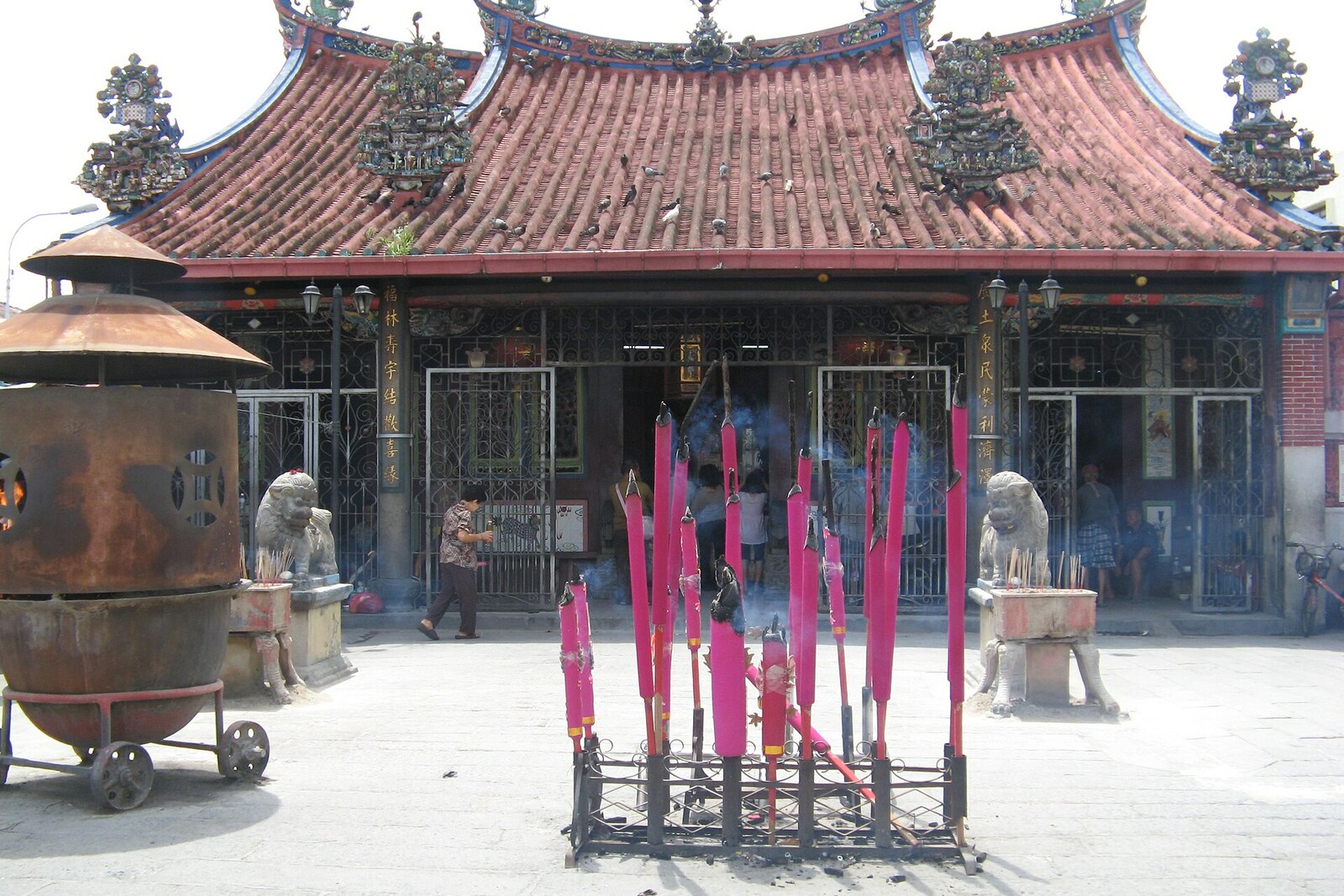
Look around first
What to notice
- Bamboo cylinders with sticks
- Guanyin's main altar
- Incense burners
- Paper offerings
The story of the place
The main altar at the back of the hall belongs to a temple jointly maintained by settlers from Guangdong and Fujian. Merchants and seafarers who had made the crossing of the South China Sea raised money for it and also worshipped Mazu, the patroness of seafarers, here. Later, the public affairs of the two communities were moved to a separate hall next door. The official name Goddess of Mercy Temple still preserves the memory of their old alliance.
Worshippers shake a bamboo cylinder before the altar until a single numbered stick falls out. They use its number to find a prediction—an answer to a question about illness, family, or an upcoming undertaking. Here they also offer incense, bring flowers, and burn paper offerings for their ancestors. They turn to Guanyin for advice: the Buddhist bodhisattva of compassion, revered in the local tradition in female form and called the goddess of mercy.
The temple has retained another, official name—Goddess of Mercy Temple. It means the temple of the communities of Guangdong and Fujian. The foundation stone is dated eighteen hundred. Merchants and seafarers from the two Chinese provinces jointly raised money for the shrine. They made their living through maritime trade and arrived in Penang after a dangerous crossing of the South China Sea, so Mazu, the patroness of seafarers, was among the deities worshipped here. Sources disagree over whether the main altar originally belonged to Mazu or Guanyin. But as early as eighteen oh three, the temple received a plaque in honor of Guanyin, and later she took the central place.
The people of Guangdong and Fujian established a joint council at the temple, with equal representation. It settled disputes, administered donations, and served as a court for the Chinese people of George Town. There was no longer a Chinese official recognized by everyone here, and the settlers did not want to approach the colonial administration over every commercial conflict. So contracts, debts, and quarrels were brought to the same people responsible for the altars.
One of the temple's major donors was the merchant Khoo Thean Teik. He led the Kian Teik Tong secret society—an association that gave its members work and protection, and demanded obedience in return. Its leaders' main income came from the opium trade and labor contracting. The colonial administration leased out opium sales: an entrepreneur paid for the monopoly and then profited from all trade on the island.
In the spring of eighteen sixty-seven, rivals from Ghee Hin Kongsi outbid Khoo and obtained the Penang opium monopoly. Khoo sought to regain this source of income. He mobilized thousands of Kian Teik Tong members and made an alliance with the Red Flag Society. Ghee Hin Kongsi was supported by the White Flag Society. It would be inaccurate to reduce this clash to hostility between two Chinese regional communities: both camps also included Malays and Indians, while their leaders fought over trade monopolies, workers, and money.
In August, armed detachments fought in the streets of George Town for ten days and set houses on fire. The lists of temple directors and donors included people from both camps. The council created to reconcile the communities could not reconcile its own patrons. Colonial troops stopped the fighting. Khoo Thean Teik was arrested the following year and sentenced to death; the sentence was commuted to life imprisonment, and he was released seven years later. Ghee Hin Kongsi's opium monopoly was also taken away and put up for lease again.
After further clashes around tin mines, Chinese merchants separated public affairs from temple affairs. In eighteen eighty-one, they established the Penang Chinese Town Hall next door; its first board again consisted of seven representatives from Fujian and seven from Guangdong. The new building was completed in eighteen eighty-six, and the court and mediation were moved there.
Goddess of Mercy Temple retained the old alliance of the two communities in its official name, while its everyday name, Goddess of Mercy Temple—“Guanyin Pavilion”—fixed upon it the activity that remained here after the court moved away. Now a personal question is settled before the altar by the stick that falls out, while the institution for shared disputes stands on the neighboring plot.
Useful on site
daily 7:00–19:00
Checked: June 17, 2026. Check the official source before visiting.Do not disturb worshippers or pass between a person and the altar; if the hall is closed, the main architectural details can be seen from outside.