 Guide On Map
George Town's Port Communities: Temples and Shops
From the Goddess of Mercy Temple to Little India
Guide On Map on your phone
Open the walk like a regular app
It takes about 10 seconds to install. No app store needed.
The whole path
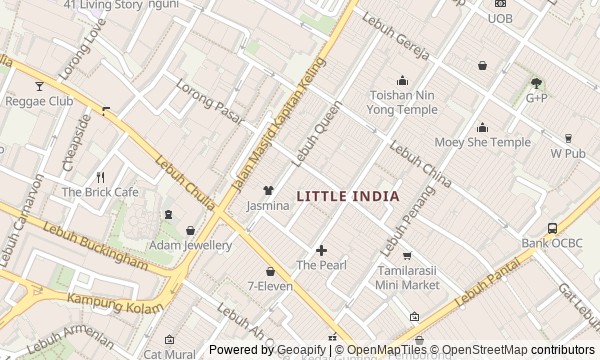
Route map
About the walk
You will walk through George Town's old port district, from the Chinese temple on Chulia Street to Muslim shrines, King Street, and the shops of Little India.
The community will change at almost every intersection, but the question will remain the same. Everywhere, migrants faced one task: how to organize justice, prayer, work, and mutual support far from the shore they had left behind.
Along the way, you will encounter a fortune-telling stick, a land grant with no trustee's name, a shrine decorated like a ship, and a pedal-powered printing press. Each object raises a question, and its answer comes at the stop itself. The story stays with specific human choices and carefully separates documents from legend.
By the end, you will be able to read these neighboring streets not as a ready-made “harmony of religions,” but as a district that people from Guangdong and Fujian, along with Tamil sailors, dockworkers, and merchants, assembled for their own lives.
Why this order
First, the shared Chinese temple poses the route's central question: how did migrants arrange their affairs without the institutions they once knew? The same street leads to a mosque, where another form of community governance emerged alongside prayer. From there, Chulia Street takes you to Nagore Durgha Sheriff: after a permanent city institution, the district's ties to ports beyond the Bay of Bengal come into view. The shrine stands at the corner of King Street, so the next turn shifts the story from sea routes to the work of boatmen and dockworkers who settled the district. The northern stretch of the same street adds Chinese regional associations; then, returning along Chulia Street to the neighboring Hindu temple shows how the Tamil community expanded its own shrine. The final turn onto Market Street ends with shops and a printing press: religious and community institutions give way to the everyday trade for which the port district grew.
Those who want to understand George Town as a city of port communities Those who care about human stories behind temple facades Those who enjoy short walks and a dense urban route
Those expecting an overview walk through the city's main sights Those who prefer 1 major monument to a sequence of smaller places Those uninterested in the history of trade, communities, and religious institutions
Before you go
These are active shrines, not scenery: choose clothing that covers your shoulders and knees, follow instructions at the entrance, and remove your shoes where required. Do not enter prayer spaces during services, and ask permission before photographing people, altars, or rituals. Indoor access may be limited, especially at the mosque and smaller religious buildings, so expect to see some stops only from the street. Keep your hands free for the market: the passageways are busy with goods and everyday trade.
When to go
Walk the route in daylight, when it is easier to see facade sculptures, inscriptions, parapets, and old shophouses. If you want to catch the market at its liveliest, do not leave the final section until late evening. At religious stops, do not rush your visit, and be prepared to wait a little if prayer or a ceremony is underway.
Backup plan
A closed door does not cancel a stop. At the Chinese and Hindu temples, focus on the lions, columns, and gateway tower; at the mosque, on the overall composition of the complex; at the durgha, on the minarets, parapet, and Indian decorative forms. On King Street, the story can be read directly from the facades and house numbers of the clan buildings. If an individual market shop is closed, walk the full stretch of Market Street and Queen Street: textiles, spices, household goods, printing, and jewelry-making are spread across the district rather than gathered in 1 place.
Route conditions
Surface. Paved — 636 m (data covers 71% of the route)
Facilities. Drinking water — 1
Elevation. Ascent — 3 m; descent — 7 m
OpenStreetMap extract of June 18, 2026: database data, not a check on the ground. Data © OpenStreetMap contributors, ODbL licence
Walk plan
Open in maps ↗- 1
Goddess of Mercy Temple
Here, the route begins with an institution where the altar and the community court shared one roof. - 2
Kapitan Keling Mosque
This stop will show how a permanent mosque became the center of a community and why hereditary management did not endure. - 3
Nagore Durgha Sheriff
Here, maritime trade will link a local shrine with a revered tomb on the other side of the bay. - 4
King Street (King Street)
The street links the port work of the southern section with the Chinese temples and community associations of the northern section. - 5
Arulmigu Sri Mahamariamman Temple
Here you will see how worshippers expanded their shared shrine along with the neighborhood itself. - 6
Little India at Pasar Market
The finale will shift the conversation from temples to the tools of trade and Tamil printing.
Route features
Everything you need stays in the browser
Progress, saves and your trip plan are stored on this device.
Add Guide On Map to your home screen so the walk opens outside the browser.
How we handle sources, maps and corrections: our editorial standards