 Guide On Map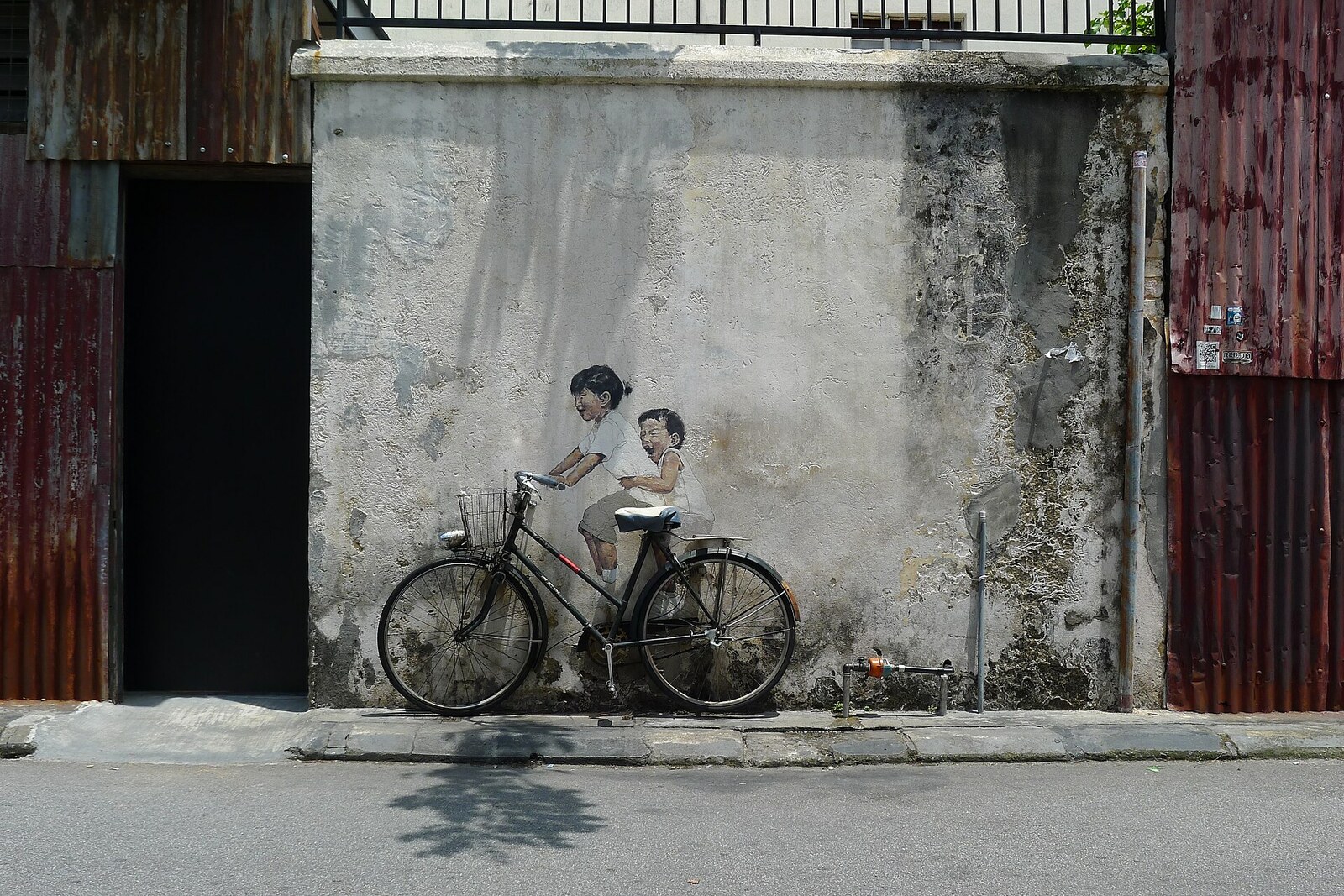
Look around first
What to notice
- The figures of two children
- A real bicycle
- The wall of a shophouse
- Faded old plaster
The story of the place
Two children are painted on the faded plaster of a shophouse wall, with a real bicycle attached below them. The work grew from a festival series of portraits of city residents, placed on old houses by choosing walls that could become part of the image. Here, the paint continues the real frame, handlebars, and rear rack, and the figures are scaled to fit the metal, so the whole scene rests at once on the wall and on the bicycle.
The girl's name is Tan Yi, and the boy behind her is Tan Kern, her younger brother. The artwork has no official title; it was city residents who began calling it “Children on a Bicycle.” The artist Ernest Zacharevic worked from a photograph of real children.
The photograph came about by chance in two thousand twelve. Tan Yi and Tan Kern's parents were taking part in an outing by a community of urban sketchers near the Goddess of Mercy Temple. Zacharevic arrived there on a large red bicycle. The children started climbing onto it, although they could not reach the pedals. The artist photographed them as they played. Later, he asked their father, Adrian Tan, for permission to transfer the image onto a city wall. Their father agreed, expecting no particular consequences.
At the time, Zacharevic lived in George Town and worked without a studio. He proposed a series of portraits of ordinary residents on old buildings for a city festival. It was his first major project in public space. The organizers helped obtain the house owners' consent, while the artist looked for walls that could form a single scene with the image.
The photograph of the children was taken in another part of the city. It was here that Zacharevic turned it into a street installation: he painted the figures on the wall of a shophouse and attached a real bicycle beneath them. Tan Yi was positioned above the frame, and Tan Kern on the rear rack. The painted children and the metal bicycle are on the same scale, so passersby can hold the handlebars or position themselves beside it. Today's queue for photographs grew out of this simple arrangement.
Success came almost immediately. By the summer of two thousand twelve, people were searching all over George Town for the six festival murals, and waiting their turn at this wall. The image appeared on postcards, bags, and mugs. Armenian Street became part of the main tourist route.
Seven years later, Zacharevic acknowledged an unpleasant consequence of his own work. He recalled a quiet street where residents sold antiques or offered a six-ringgit haircut on the ground floor of their family home. Many such places were replaced by souvenir shops, restaurants, and stores designed for a tourist's short visit. The artist wrote that he had considered painting over the children, hoping to stop the frenzy. But by then the figures had almost faded, and people continued to line up anyway: the painting had already changed the function of this part of the street.
In two thousand twenty-four, Zacharevic returned here. He repaired the bicycle, prepared the wall, and restored the paint from a photograph of the original work. After the repairs were completed, the artist, Tan Yi, and Tan Kern—now teenagers—met at the mural. They were photographed beside their childhood figures. On the wall, Tan Yi still cannot reach the pedals, Tan Kern holds tightly onto his sister, and beneath them is the bicycle attached to the wall that they once climbed onto with no intention at all of becoming the faces of George Town.
Useful on site
free access around the clock
Checked: date not specified. Check the official source before visiting.Do not sit on the bicycle or touch the paint; for a photograph, it is enough to stand beside it.