 Guide On Map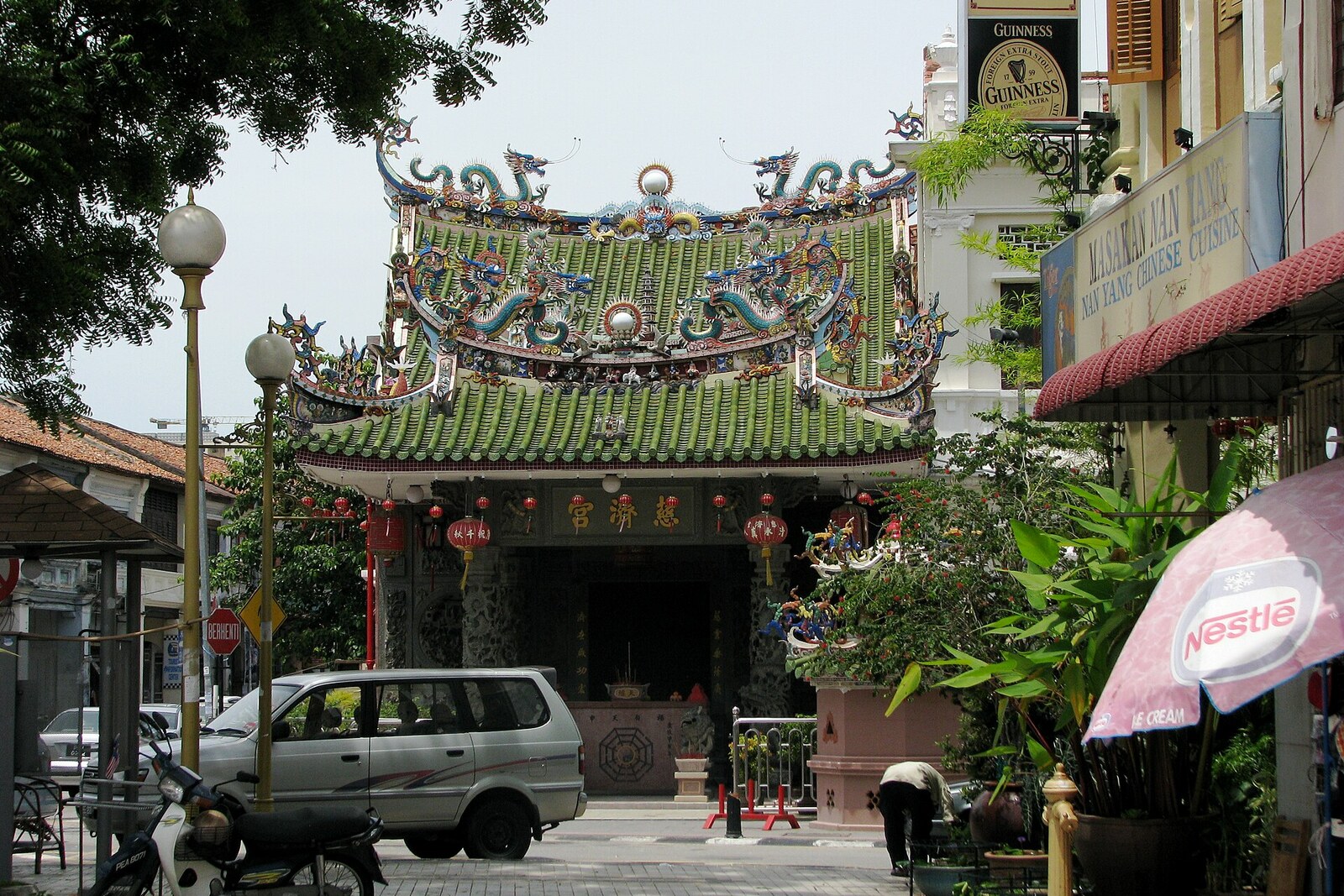
Look around first
What to notice
- Light-colored two-story facade
- The words “Yap Temple”
- The old kongsi building
- The decorated temple next door
The story of the place
The light-colored two-story facade bears the English words: “Yap Temple.” Yap is a surname, and a kongsi is an association of people from the same surname community. In George Town, such an association replaced the relatives a newcomer did not have nearby: it helped them find work, supported them in need, and kept the memorial tablets of the dead.
Yap Chor Ee knew the situation of a poor migrant from his own experience. In eighteen eighty-four, he arrived at the age of seventeen from Fujian province in China; the only possessions he had were his clothes. He became an apprentice in a shop. Later, the trading agent Goh Teik Ghee gave him money for his own grocery store. During the First World War, sea transport was disrupted, sugar became more expensive, and trade brought Yap a fortune. He then invested in rice, tin, and banking.
By then, Penang had two separate organizations of people with the surname Yap. Yap Chor Ee gave them a plot on Armenian Street. On this land, they built a shared house and, in nineteen twenty-four, united as Lum Yeong Tong Yap Kongsi. The first several dozen members gained a permanent address that a person with the same surname arriving from Fujian could turn to for work and support. Spring and winter memorial ceremonies were also held here.
After the Japanese invasion in nineteen forty-one, the meetings stopped. When the war ended, Yap Chor Ee himself was entrusted with restarting the kongsi's work. He did not limit himself to restoring the former ceremonies. In nineteen fifty, he gave the community another plot, directly adjacent to the first, for a separate shrine to the clan ancestor and the lineage's patrons.
Yap Chor Ee died a year later and did not see the completed temple. Choo Chay Keong, the decorated building next door, was completed in nineteen fifty-four. The old building retained the kongsi's rooms and thousands of memorial tablets of Yap families; temple rites are held in the new one. Yap Chor Ee managed to open the first house during his lifetime. The second stands on the neighboring plot he gave them and appeared only three years after his death.
Useful on site
access is limited; the gates are opened in the morning
Checked: date not specified. Check the official source before visiting.Enter only spaces open to visitors, and do not disturb offerings or family rites.