 Guide On Map
The Armenian Street Quarter: Murals and Clan Houses
From Armenian Street through clan courtyards to Cannon Street
Guide On Map on your phone
Open the walk like a regular app
It takes about 10 seconds to install. No app store needed.
The whole path
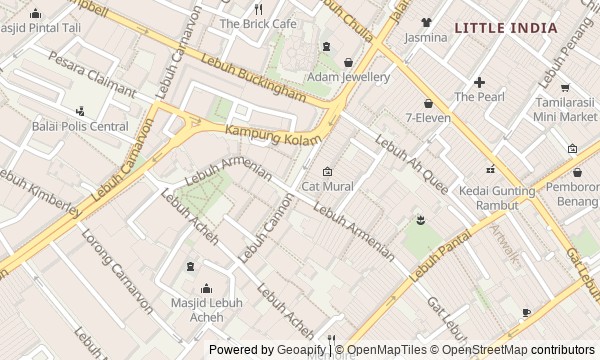
Route map
About the walk
You will begin on Armenian Street, among trading houses and wall paintings. Then you will pass a real bicycle, the pale facade of Yap Kongsi, and the lawn of Armenian Park. After the park, you will return to the narrow archway of Cheah Kongsi, turn onto Ah Quee Street, and finish beside the boy reaching for an opening in an old wall.
This will not be a hunt for famous murals. Behind the line for a photograph, a quarter of merchants, clan associations, and streets born of private decisions comes into view. Why does a community disappear while its address remains? Why would a resident give up his own house for a road? And how could a child's casual game change an entire street?
The story rests on details like these: a donated plot, a real chair, a narrow passage for rickshaws. No promotional haze, no ready-made conclusions.
After the walk, you will read this part of George Town through street names, clan gates, and objects brought out of the wall into the city.
Why this order
The name Armenian Street first introduces a vanished layer of the quarter. The bicycle mural immediately shows what the street became afterward. From the tourist wall, the route goes to Yap Kongsi: nearby, it becomes clear that migrants needed not a commemorative address but a shared house that worked. Armenian Park continues the theme from another angle—behind its quiet open space are the associations that once divided the neighboring streets. The return along Armenian Street to Cheah Kongsi is deliberate: after the story of breakups and clashes, the surviving courtyard shows how property and rules of mutual aid held a community together. From its archway, the route turns onto Ah Quee Street, where a private gift changed the street network itself. The final stretch to Cannon Street returns to street art, but only after clan courtyards, vanished houses, and old names.
Those who want to connect street art with the history of a neighborhood Those interested in clan houses and migrant communities Those who enjoy short stretches and a dense story
Those looking for a route covering every mural in George Town Those wanting large museums and grand monuments Those who do not like returning along a section of street they have already walked
Before you go
Most of the route is outdoors, so choose a time with gentler sun, bring water, and prepare for rain. The murals are on old walls and include real objects: do not sit on the bicycles or motorcycle, move the chair, or touch flaking paint. Clan houses remain active places of memory and ritual; entry and access to particular rooms may change. Check visiting rules on site, speak quietly, and do not photograph ceremonies or people without permission. Popular murals can have lines—leave room for residents to pass and do not block house entrances.
When to go
80 min
Backup plan
If a clan house is closed, do not skip the stop: listen to the story outside and look at the gate, facade, courtyard, or neighboring temple where they are visible from public space. In intense heat, take a longer break in Armenian Park; in rain, wait out the downpour and continue only on non-slip surfaces—old streets and the metal elements by the murals may be wet. If Children on a Bicycle is too crowded, go to Yap Kongsi first and return later; the stop does not require a photograph on the bicycle. The route still holds together without interior visits, since all its key transitions can be understood from the streets and exterior details.
Route conditions
Surface. Paved — 927 m (data covers 91% of the route)
Facilities. Toilets — 3
Elevation. Ascent — 5 m; descent — 5 m
OpenStreetMap extract of June 18, 2026: database data, not a check on the ground. Data © OpenStreetMap contributors, ODbL licence
Walk plan
Open in maps ↗- 1
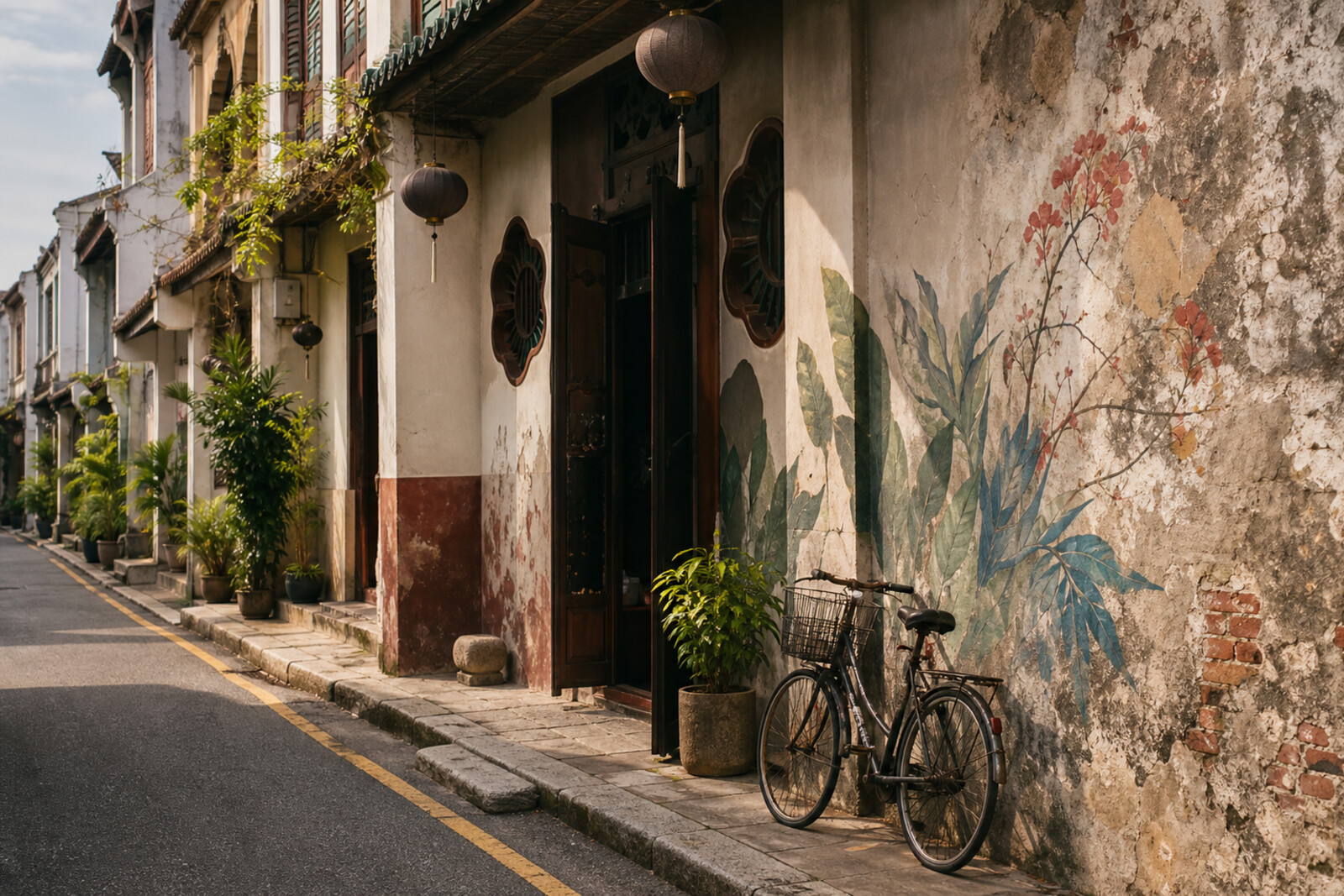
Armenian Street
Here, the name will prove more enduring than the community that brought it to George Town. - 2
Children on a Bicycle
An ordinary wall will show how a single installation changed the function of an entire stretch of street. - 3
Yap Kongsi
This stop will explain what kind of house a migrant arriving without family or possessions needed. - 4
Armenian Park
A quiet lawn now occupies the site of a neighborhood from which armed detachments once set out. - 5
Cheah Kongsi
This courtyard shows how property and family rules carried on the work of a deceased founder. - 6
Ah Quee Street
Here a vanished house will explain why the lane became a through city street. - 7
Reaching Up
The final stop returns to the murals and shows exactly what the artist restored twelve years later.
Route features
Everything you need stays in the browser
Progress, saves and your trip plan are stored on this device.
Add Guide On Map to your home screen so the walk opens outside the browser.
How we handle sources, maps and corrections: our editorial standards