 Guide On Map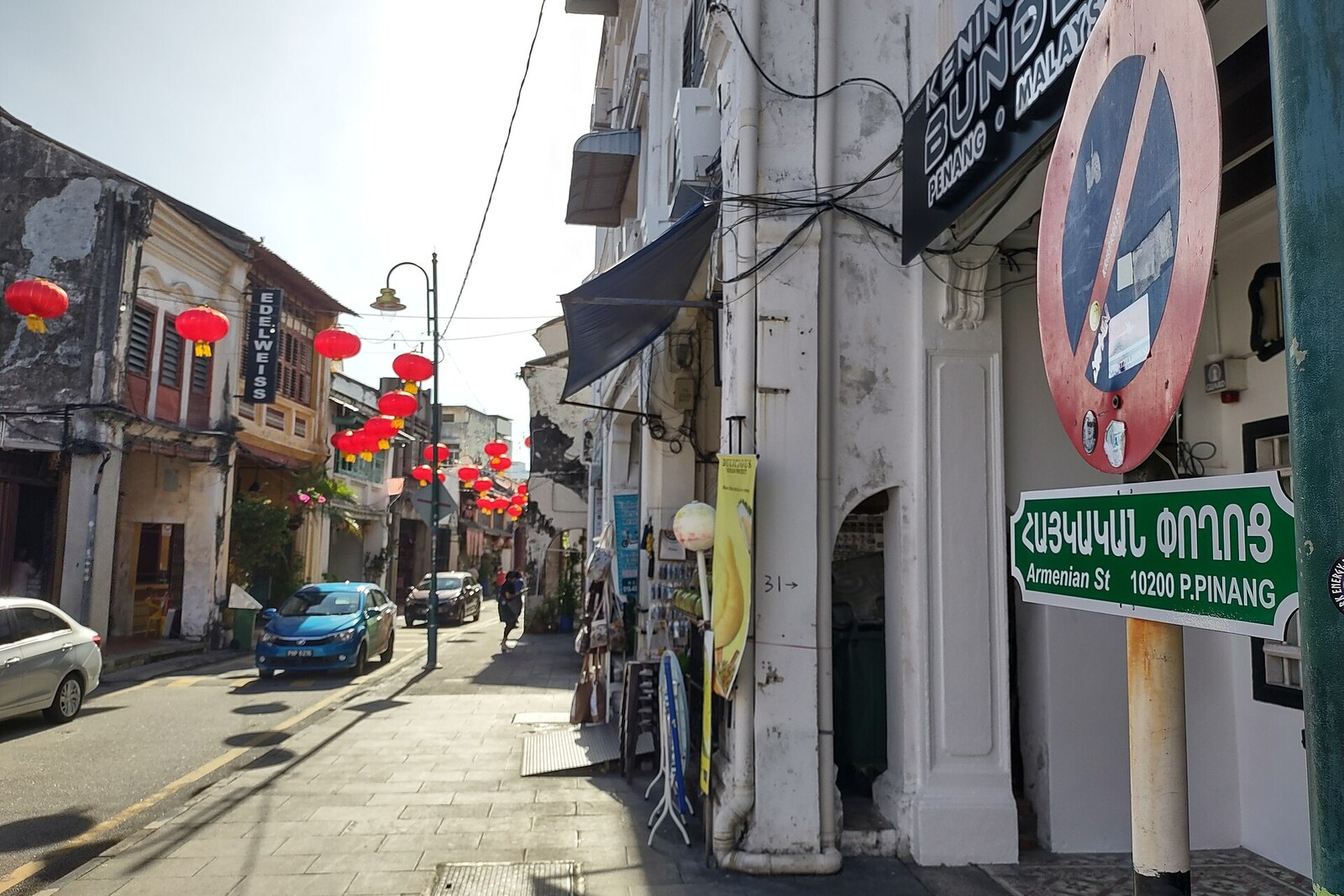
Look around first
What to notice
- The “Armenian Street” sign
- The facades of commercial houses
- The intersection with Beach Street
The story of the place
Near the intersection with Beach Street, the facades of houses with commercial premises stand where ships once came up to the shore: goods were unloaded nearby, while routes and cargoes between India, Malacca, and Batavia were arranged in the offices. At first, the road was called Malay Lane after the neighboring settlement of Malays and migrants from Sumatra. Later, one of the houses at the eastern end became the address of merchants who had come from Persia through Indian cities; they kept vessels, sold passage on routes, and leased out ships. The street received its present name from that house.
Today, people photograph the murals on this short street, visit clan compounds, and buy souvenirs. There are no Armenians among all this. Their community has disappeared from George Town, but the name remains on the street signs.
Before they arrived, the road was called Malay Lane: a settlement of Malays and people from Sumatra stood nearby. Then an “Armenian House” appeared in the documents. A deed from eighteen oh one places it at the eastern end of the lane, at the intersection with Beach Street. A few years later, a cartographer had already labeled the road Armenian Lane.
The owners of the house belonged to the Armenian trading diaspora. These people came mainly from Persia through Indian cities. They carried goods and passengers between Calcutta, Malacca, Batavia, and the new British port of Penang. The house stood where the lane met Beach Street: ships were unloaded by the shore, and merchants kept offices there. The Armenian address appeared precisely in the commercial part of George Town.
One such merchant, Catchatoor Galastaun, made his living from sea transport. He owned several vessels, sold passage to Calcutta, took on cargoes, and leased out ships. In the early eighteen twenties, Galastaun led an attempt to turn a small colony of merchants into a permanent community. The Armenians needed their own priest and church.
Seven thousand dollars were needed for construction. Four thousand were raised through donations, and the East India Company contributed another five hundred. Galastaun supplied the remaining two and a half thousand and bought a plot on neighboring Bishop Street. There was never an Armenian church on Armenian Street itself: the name appeared earlier, thanks to the merchants who lived here.
The Church of St Gregory the Illuminator was consecrated in eighteen twenty-four. Immediately after the consecration, Galastaun married Varterny Carapiet there. The building was intended for baptisms, weddings, and funerals of people who expected to remain in Penang with their families.
That expectation did not come true. No more than thirty Armenians lived on the island at one time. When Singapore became the region’s main trading center, the entrepreneurs moved there, and the remaining parishioners found it difficult to support a priest and a large building. Services became infrequent. The last one was held in nineteen oh six. Three years later, rotted beams brought down the balustrade and part of the walls, after which the church was dismantled.
The Armenians erected a monument in its place, but it too later disappeared. In nineteen thirty-seven, twenty burials were moved from the church cemetery to the city’s Western Road Cemetery. The remains of several generations of the families for whom Galastaun had once paid for the church were taken there.
That “Armenian House” at the intersection with Beach Street can no longer be reliably identified among today’s buildings. What remains here is the “Armenian Street” sign—the address of a community whose first durable structure turned out to be the street name.
Useful on site
the street is open around the clock
Checked: date not specified. Check the official source before visiting.Listen at the edge of the street without blocking entrances to homes and shops.