 Guide On Map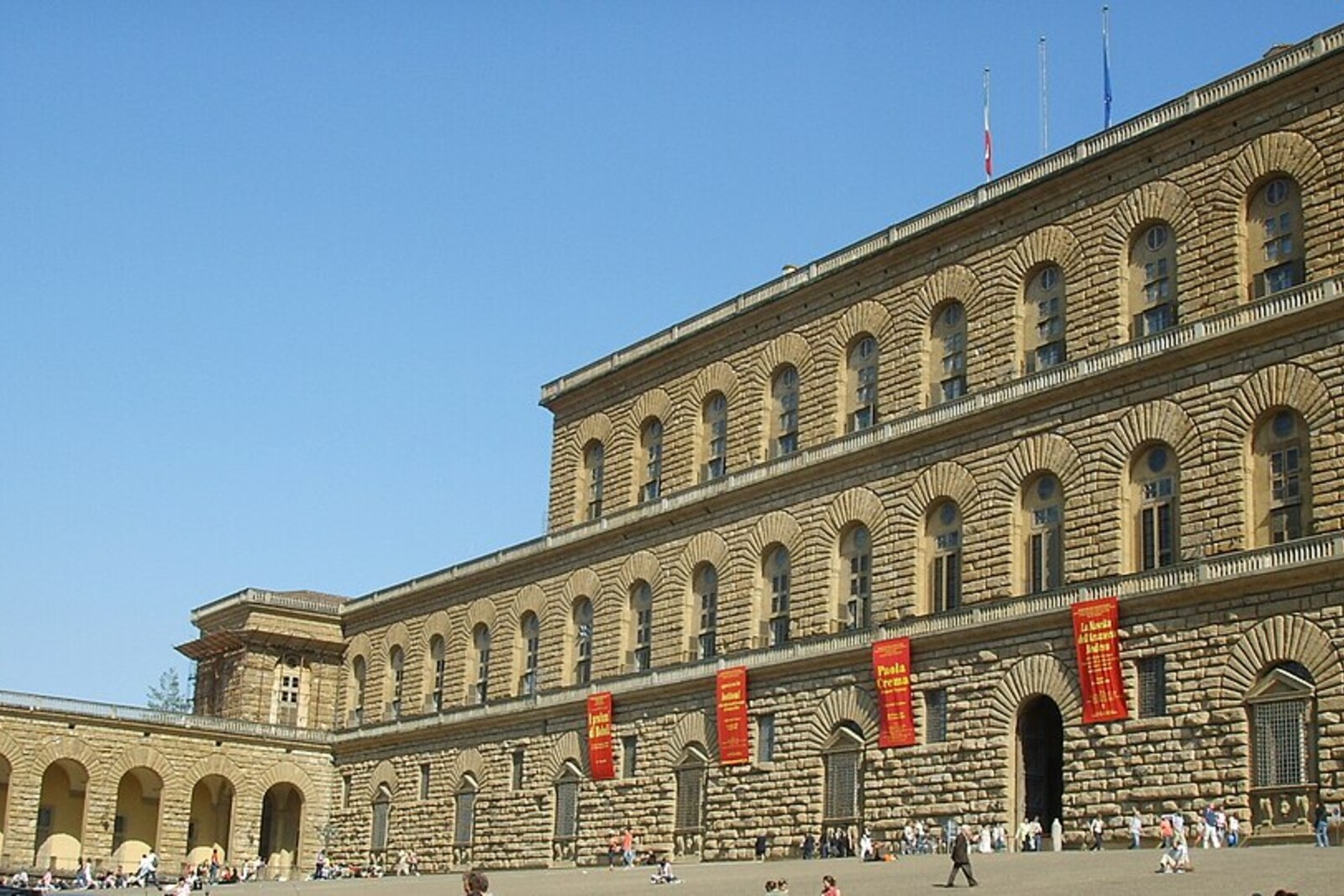
Look around first
What to notice
- Three wide doors in the central part
- Two levels of seven windows each
- The palace’s central volume
- Long side wings
The story of the place
Today’s palace grew out of a private house that remained unfinished: after the first owner’s death, his heirs did not have enough money to complete it. The original middle is easy to distinguish from later additions: three wide doors below and seven windows in each of the two upper levels form a compact central volume, while the facade stretches far to the right and left through the side wings. Later, the house was extended toward the hill, given a formal courtyard, and provided with the Boboli Gardens, then made into the main ducal residence; museums now operate in these rooms.
Luca Pitti ordered built here the largest private house ever constructed in Florence before his time. He made money from the wool and silk trade, financial dealings, and land investments. His standing came from his alliance with Cosimo de' Medici the Elder, the city’s wealthiest banker and the republic’s effective leader. In fourteen thirty-four, Pitti took part in the decision to recall Cosimo from exile, and then held the highest city offices for many years.
Construction began in the middle of the fifteenth century, when Pitti had reached the height of his career. The owner intended the citizens to read his status from the facade alone. A legend later arose that Pitti demanded windows larger than the doors of the Medici Palace. There is no evidence for that condition, but the legend accurately conveys the impression of his contemporaries: the new house exceeded in size every earlier residence of a private citizen.
Niccolò Machiavelli, writing decades later and sharply condemning Pitti, claimed that individual citizens and entire communities helped the construction with gifts. According to Machiavelli, a person accused of theft or murder could take refuge here from punishment if he knew how to dress stone or was useful in another craft. This is an accusation by a political historian, not a surviving record of workers. It does, however, show that contemporaries linked the house’s scale with the patron’s influence, not only with his income from trade.
After Cosimo’s death, Pitti’s calculation changed. The dead man’s son, Piero de' Medici, wanted to preserve the family’s leading position in Florence. Pitti led Piero’s opponents. They were preparing for an armed confrontation and waiting for Pitti’s signal to begin the uprising. At the decisive moment, he refused and made peace with Piero. The other leaders of the opposition were sent into exile; Pitti was forgiven, but he no longer had his former authority among his allies.
In that same year, fourteen sixty-six, the documented work at the palace ceases. Pitti still received city offices, but did not return to the large-scale construction. He died in fourteen seventy-three, leaving a facade with three wide doors and two rows of seven windows. Behind them stood only part of the intended rooms.
His heirs did not have enough money to finish the house. In fifteen forty-nine, they sold it for nine thousand florins to Eleonora of Toledo, the wife of Duke Cosimo the First de' Medici, who needed a spacious residence for her family and court. At her request, architects extended the building toward the hill, created a formal courtyard, and began the Boboli Gardens. Later, the Medici family extended the facade to the right and left and turned the former private house into their main residence.
The seven windows in each of the two upper levels of the central part belong to Luca Pitti’s original palace; the long side extensions appeared under later owners. Museums now operate inside, while their tickets, plans, and the name of Piazza de' Pitti bear the surname of the man whose descendants sold the unfinished house to the Medici family.
Useful on site
Exterior viewing is free. The Pitti museums are usually open Tuesday—Sunday 08:15—18:30; closed Monday, January 1, and December 25; the ticket office closes one hour before closing time.
Opening hours by day
Viewing the exterior is easy to include in a walk. The museums and gardens require separate visits and noticeably increase the length of the route.