 Guide On Map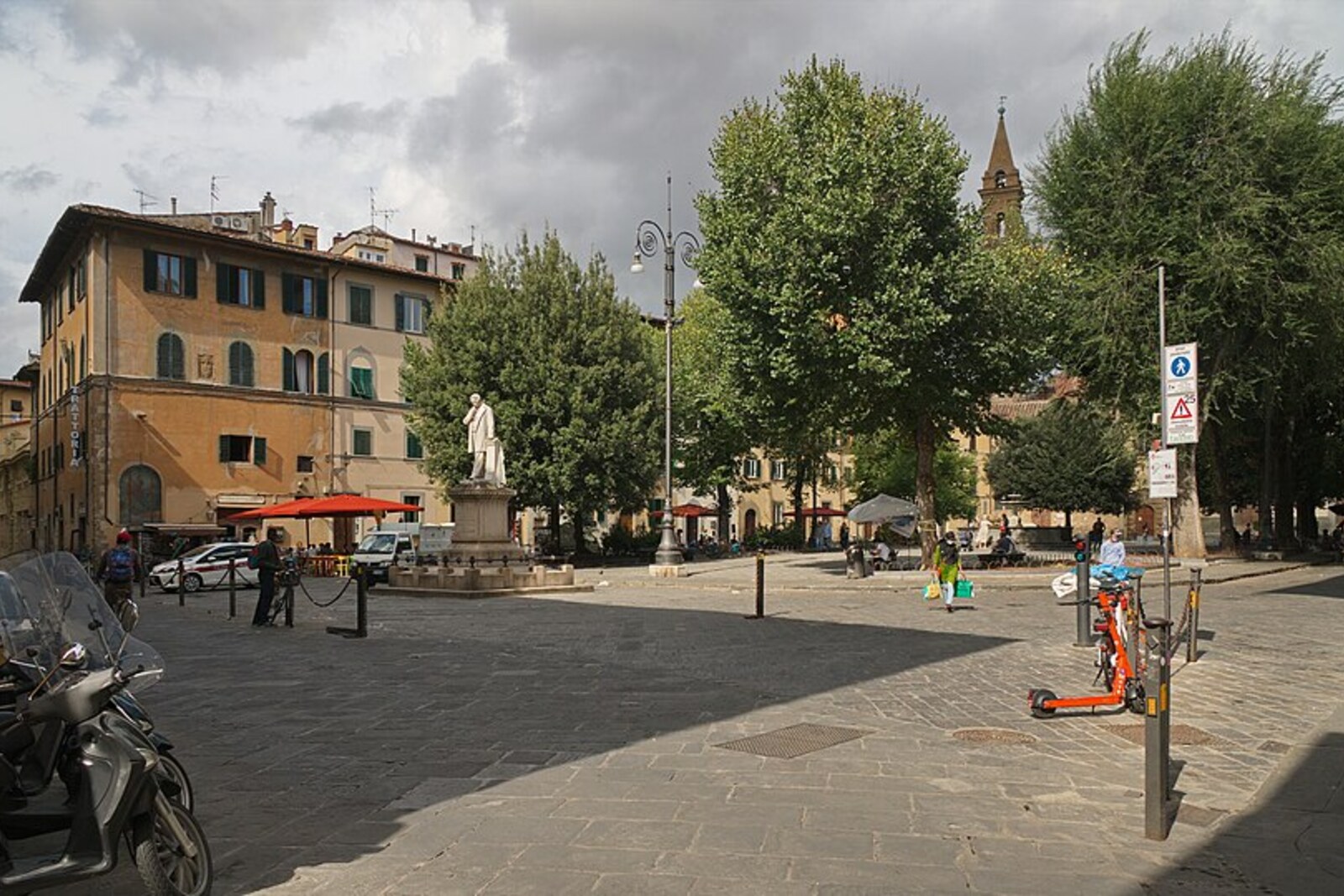
Look around first
What to notice
- Facade of the Church of Santo Spirito
- Central fountain
- Trees
- Open middle of the square
The story of the place
The facade of the Church of Santo Spirito faces the broad Piazza Santo Spirito, which is named after the church. A fountain stands in its center, moved here from the monastery courtyard: its basin was once used to breed fish. The trees appeared later, while the open middle remains clear; on weekdays, a neighborhood market sets up around it, and nearby establishments put out tables.
The empty space before the church cost Florence several residential houses. They were bought out and demolished for the people who were meant to stand here and listen.
In twelve fifty, the Augustinian prior Aldobrandino acquired a house, land, and vineyards in what was then Casellina, a sparsely built-up part of Oltrarno inside the city walls. Before that, his fellow brothers had lived in a secluded monastery on the hill of Arcetri. Aldobrandino wanted to move the community to where a new neighborhood was growing quickly. The Augustinian Order was a mendicant order: donations and city subsidies paid for the building and upkeep of the monastery, while the brothers’ main work was preaching among the laity.
Two years later, the first church appeared here. It was dedicated to the Virgin Mary, all saints, and the Holy Spirit. In everyday speech, the long dedication was shortened to Santo Spirito—the Holy Spirit—and from the church the name passed to the square.
Oltrarno was being settled, the Augustinians were gathering ever more listeners, and the space before the church was no longer enough. From twelve ninety-two to thirteen oh one, the Florentine City Council successively bought the neighboring plots. Houses were demolished until a space of more than five thousand square meters opened up before the monastery—the largest in Florence at the time. The city paid for an open-air preaching hall.
The space was kept free of permanent structures. It could hold religious performances, celebrations, and fairs. At Pentecost, fires were lit across the entire space, depicting the tongues of flame that, according to the Gospel account, descended on the apostles together with the Holy Spirit. The church’s name was then dramatized before the whole neighborhood in a square created specifically for a large crowd.
The fountain and trees appeared much later. The fountain was moved from the monastery courtyard to the center of the square in eighteen twelve; before that, its basin had been used to breed fish. Landscaping was added only in the second half of the nineteenth century. Originally, there was nothing here but uninterrupted open ground before the church.
Now, from Monday through Saturday, a neighborhood market operates in the square, while the edges are occupied by tables from nearby establishments. Traders once again gather people on the ground that seven centuries ago the Florentine City Council cleared for the Augustinians’ listeners.
Useful on site
The square is always open. The Fierucola market is listed for the third Sunday of the month, except August, from 09:00 to 19:00 on the published dates for 2026.
Checked: June 28, 2026. Check the official source before visiting.This is a working city square, not a museum courtyard: keep in mind the market, bicycles, tables, and local residents’ daily life.