 Guide On Map
Oltrarno: bridge, palaces, and monastic squares
From Ponte Vecchio through Pitti Palace and Church of Santo Spirito to Carmine
Guide On Map on your phone
Open the walk like a regular app
It takes about 10 seconds to install. No app store needed.
The whole path
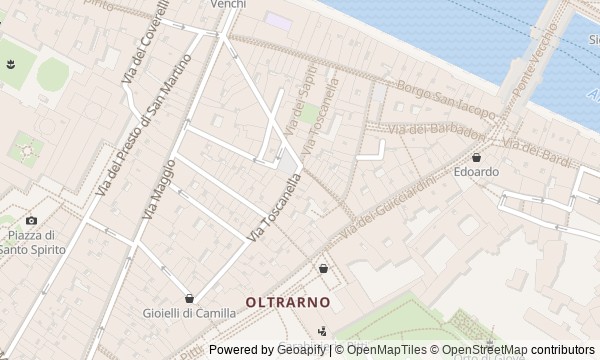
Route map
About the walk
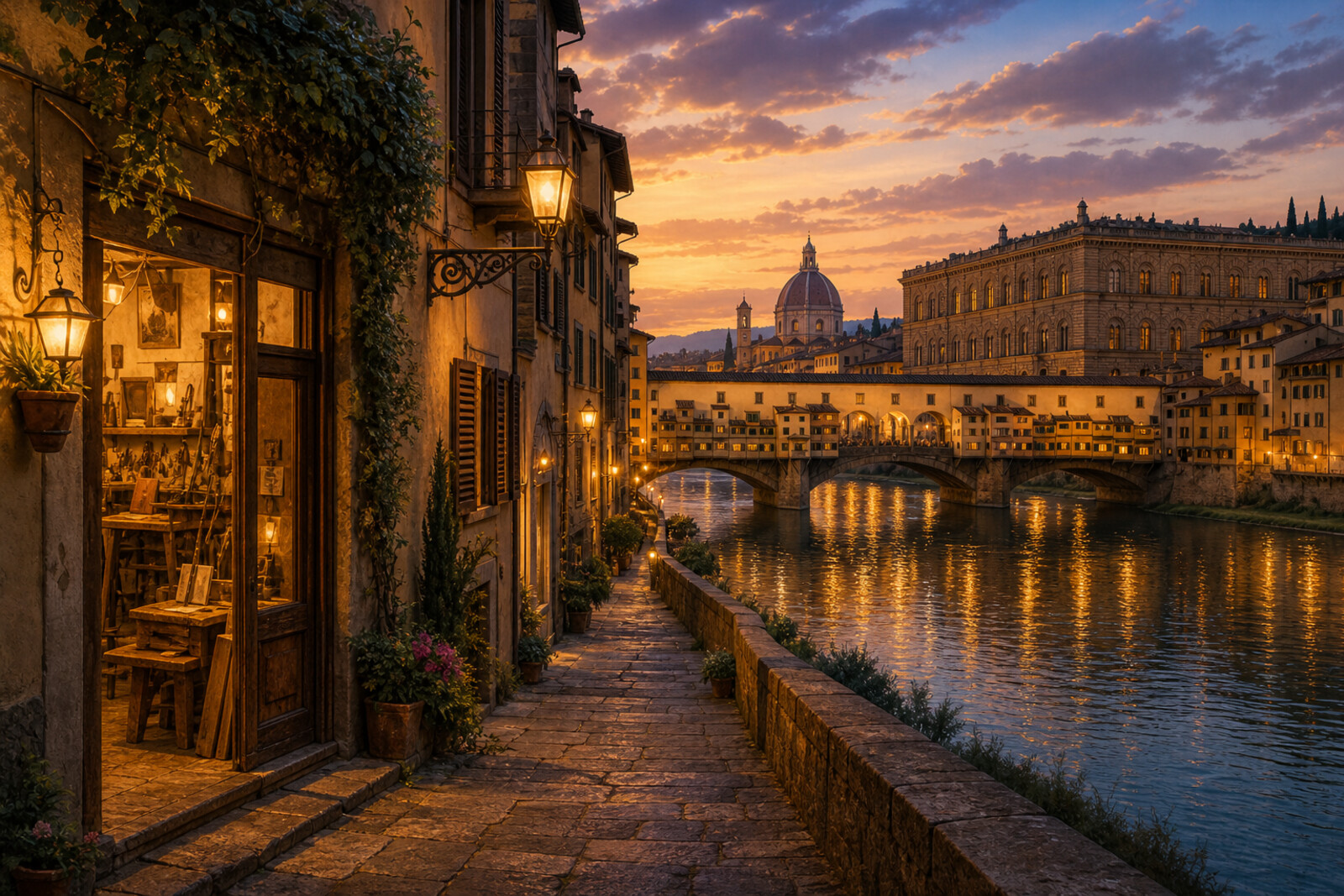
You will cross Arno on Ponte Vecchio, then immediately turn away from the ceremonial road into Oltrarno. Ahead lie the narrow Borgo San Jacopo, the austere Via Maggio, the enormous facade of Pitti Palace, the market square of Piazza Santo Spirito, and two churches whose main stories are hidden behind plain outer walls.
This is a walk through a city reshaped for specific purposes. On the bridge, you will see shops that appeared after an order to clear out the premises. On a nearby street, there are numbered stones in a house pieced back together after the war. On one facade, a hat and the Medici family coat of arms still sit side by side. In the square, a question arises: why buy and demolish houses just to create an empty space?
The story will rest on documents, human decisions, and their visible consequences. Where an account remains disputed, it will stay an account. By the end, you will read Oltrarno by its seams: telling old masonry from postwar rebuilding, the original palace from later wings, and an architect's intention from the builders' compromise.
Why this order
Ponte Vecchio sets the ducal route across Arno: on the south bank, it becomes clear how this passage changed trade. Turning straight onto Borgo San Jacopo reveals the cost of saving the bridge—destroyed approaches and postwar construction. The street leads to Via Maggio, where Palazzo di Bianca Cappello connects a private story with the pull of nearby Pitti Palace; the palace itself comes next, the reason this part of Oltrarno drew people in. From its vast facade, a short passage brings you to Piazza Santo Spirito: first the square made for crowds, then Church of Santo Spirito, where you can compare its even outer shell with the order inside. The final stretch continues the monastic thread to Piazza del Carmine, where a private family commission collided with city politics.
Those who want to understand Oltrarno, not simply cross the bridge Lovers of urban fabric, architecture, and human reversals Those who value a careful distinction between fact, legend, and interpretation
Those looking for an overview of the main cathedrals and squares on the right bank Those who want a walk without dense historical storytelling Those who do not want to look closely at architectural details
Before you go
Decide in advance which interiors are essential for you: the outdoor route is complete on its own, but Michelangelo's wooden crucifix and the Brancacci Chapel frescoes are inside separate spaces.
It is best to check and arrange access to Brancacci Chapel separately; ordinary entry to the church should not be treated as a guarantee of visiting the chapel.
Pitti Palace requires its own museum time, while the Vasari Corridor is viewed from outside on this walk—visiting it does not follow naturally from crossing the bridge.
When to go
Streets and facades only take about an hour and a half. Allow two to two and a half hours if you visit Church of Santo Spirito and Brancacci Chapel. Treat seeing Pitti Palace inside as a separate half-day.
Backup plan
If you cannot get into Brancacci Chapel, end the walk in front of the severe wall of Church of Santa Maria del Carmine: the story of fire, exile, and surviving painting still ties the finale to the route.
If Church of Santo Spirito is closed, linger in the square and read it as a stop in its own right—through the blank facade, the fountain, and the everyday use of the space. Do not replace the missed interior with a random church.
Route conditions
Surface. Paved — 2.1 km (data covers 82% of the route)
Stairs. Flights: 2, 9 m in total
Access. Wheelchair — no; stroller — limited (stairs)
Facilities. Toilets — 5; drinking water — 4
Elevation. Ascent — 31 m; descent — 35 m
OpenStreetMap extract of June 18, 2026: database data, not a check on the ground. Data © OpenStreetMap contributors, ODbL licence
Walk plan
Open in maps ↗- 1
Ponte Vecchio
This is where the story begins of how the Medici route changed ordinary city life. - 2
Borgo San Jacopo
Surviving towers and new walls make it possible to see what was preserved and what was sacrificed in the reconstruction. - 3
Palazzo di Bianca Cappello
From the facade, you can reconstruct the courtly calculation that tied together two families and one house. - 4
Pitti Palace
The central part of the facade shows where the first owner’s ambition ended and the Medici residence began. - 5
Piazza Santo Spirito
The open space will explain why a medieval order needed the city’s largest site. - 6
Santo Spirito—architecture hidden inside
A comparison of the facade and interior will show which parts of Brunelleschi’s project his successors preserved. - 7
Church of Santa Maria del Carmine
The frescoes show what happened to a family commission after its patron was exiled.
Route features
Everything you need stays in the browser
Progress, saves and your trip plan are stored on this device.
Add Guide On Map to your home screen so the walk opens outside the browser.
How we handle sources, maps and corrections: our editorial standards