 Guide On Map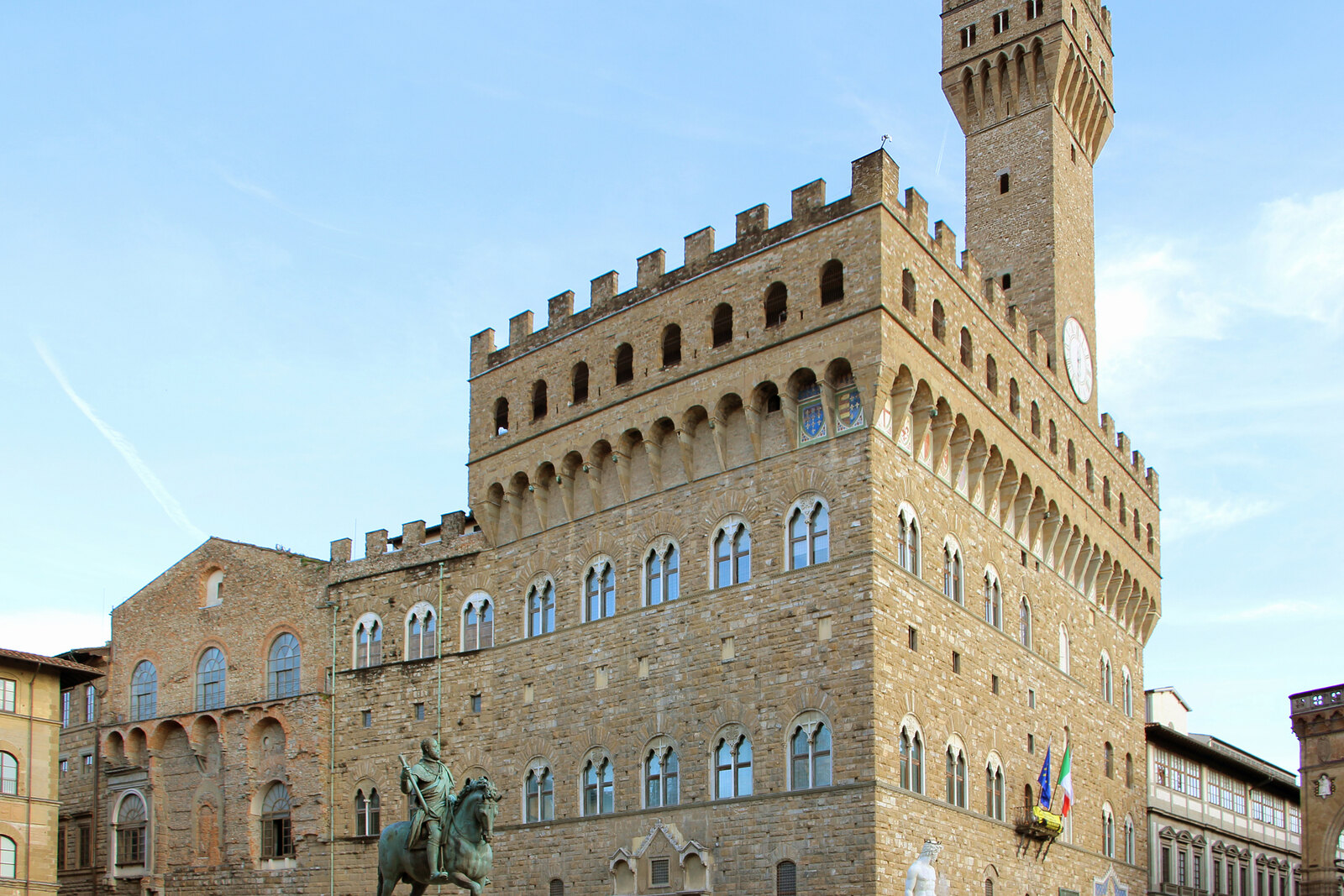
Look around first
What to notice
- Round slab of red granite
- Fountain of Neptune
- Facade of Palazzo Vecchio
The story of the place
The square is named after the Signoria, the highest council of the Florentine Republic. The elected elders of the city's guilds moved into Palazzo Vecchio for two months: they met there and governed the city. Before its facade, decisions were announced and townspeople were gathered for ceremonies. Florence's municipal government still works in this palace.
A round slab of red granite in front of the Fountain of Neptune marks the place where Girolamo Savonarola's body was burned. A year before his execution, his supporters themselves lit bonfires in this square. Between those two fires came the downfall of a man whose position depended on the crowd's trust.
The square is named after the Signoria, the highest council of the Florentine Republic. Elected elders of the city's guilds met in what is now Palazzo Vecchio, changed every two months, and lived in the palace for the duration of their terms. Before its facade, they announced decisions, gathered townspeople, held ceremonies, and carried out public executions. Florence's municipal government is still located in the building today.
Savonarola was a Dominican monk and prior of San Marco Monastery. He wanted to turn Florence into a strictly Christian republic, which he called New Jerusalem. He held no office in the Signoria. His position rested on his sermons and on the townspeople's belief that he could predict disasters.
After the expulsion of the Medici in fourteen ninety-four, Savonarola took part in reshaping the republic. At his insistence, penalties were introduced for gambling and for what the preacher considered licentiousness. Groups of his young supporters watched the clothing, jewelry, and behavior of Florentines. On February seventh, fourteen ninety-seven, they piled mirrors, playing cards, musical instruments, books, paintings, and expensive clothes in Piazza della Signoria. All of this was declared to be objects of vanity and burned before a huge crowd.
Meanwhile, Pope Alexander VI, seeking to bring the preacher into submission, forbade him to speak and then excommunicated him. The city was also under threat: the pope could impose an interdict—a ban on church services for all Florentines. Merchants especially feared this, because they depended on business connections outside the republic. On March seventeenth, fourteen ninety-eight, the Signoria demanded that Savonarola stop preaching.
The dispute was to be settled in the place where the republic was accustomed to dealing with its most important affairs. The Franciscan preacher Francesco di Puglia, who wanted to disprove Savonarola, proposed that Savonarola's defenders walk through fire. Savonarola's closest associate, the Dominican Domenico da Pescia, accepted the challenge: if he emerged from the flames unharmed, it was to confirm that his teacher was right.
The Signoria approved the rules of the ordeal, and a notary recorded the matter in dispute. On April seventh, two long piles of firewood were prepared in the square, with a narrow passage left between them. A crowd gathered, expecting a miracle. For hours, the participants argued about the conditions, the clothing, and the cross that Domenico intended to carry with him. Not one of the monks ever entered the fire; bad weather finally disrupted the drawn-out ordeal.
Formally, it was impossible to determine a loser. But a miracle was expected of Savonarola, and he received the disappointment. The next day, armed opponents of the preacher attacked San Marco Monastery. The Signoria gave Savonarola seven hours to leave Florentine land and avoid being declared a rebel. He stayed. After a battle lasting many hours, he was arrested together with Domenico and another associate.
Savonarola was held and interrogated in Palazzo Vecchio. Under torture, he was made to confess that his prophecies were false. On May twenty-second, the three monks were declared heretics and schismatics. The next day, they were led from the palace to the square, hanged, and their bodies were burned. Their ashes were thrown into the Arno so that supporters could not collect the remains as relics.
There is no grave here. A round slab in front of Neptune marks the site of the scaffold. Every year, on May twenty-third, flowers are laid on it.
Useful on site
The square is always accessible; Palazzo Vecchio, its tower, and the museum halls follow the municipal museums' separate schedule and may be partly closed because of events, heat, or weather.
Checked: June 27, 2026. Check the official source before visiting.Start with the overall view from the edge of the square, then approach the individual markers. Do not linger in front of the palace entrance, and watch your step carefully in the crowd.