 Guide On Map
Florence between Cathedral of Santa Maria del Fiore and Ponte Vecchio: Money and Power
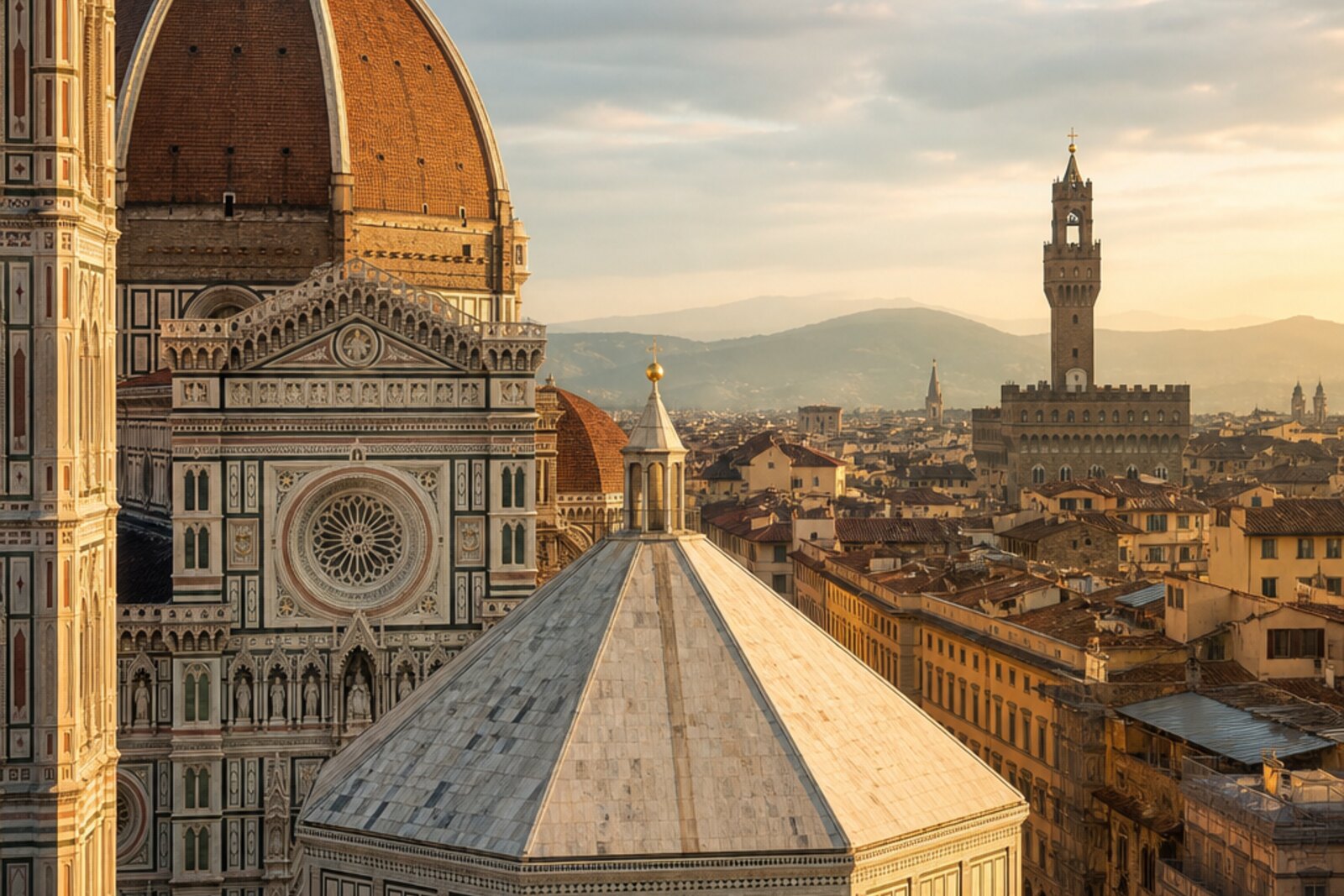
From Piazza del Duomo through Signoria and Uffizi to Ponte Vecchio
Guide On Map on your phone
Open the walk like a regular app
It takes about 10 seconds to install. No app store needed.
The whole path
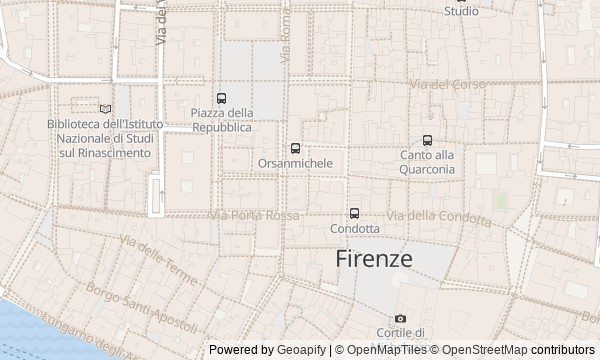
Route map
About the walk
You will walk from Piazza del Duomo along Via dei Calzaiuoli to Signoria, then descend between the buildings of Uffizi toward Arno and Ponte Vecchio.
At first, Florence's ceremonial center will appear as a city of deals. One family will wait for a better price for its homes. At the baptismal font, a trace will remain of an act a poet will have to explain years later. In the Cathedral of Santa Maria del Fiore, a heavy bronze door will separate the part of a plan that succeeded from the part that was thwarted.
Further on, the market will give way to a church, a republican arcade to the duke's guard, and city institutions will gather behind matching facades. Even the shops on the bridge will prove to be the result of a decision made over the merchants' heads.
The story will examine documents, qualify legends, and stay with human decisions rather than general admiration for the Renaissance. By the end, you will read central Florence as a chain of redistributions: land, shrine, square, offices, and bridge will show how the city changed owners, occupations, and rules.
Why this order
Piazza del Duomo will raise the route's first question: who could clear a residential quarter for a shared project. The Baptistery of St. John comes next because it stood here before the new Cathedral of Santa Maria del Fiore and bound Florentines to the city from baptism onward. The Cathedral of Santa Maria del Fiore itself will turn that belonging into a struggle for control of the republic. Via dei Calzaiuoli will lead from the religious center to Orsanmichele, where citizens' money changed the purpose of a market. Continuing along the same street brings you to Piazza della Signoria: beside the guild church, the republic's main political address comes into view. The loggia by Palazzo Vecchio will show the next step—the duke's appropriation of its public ceremonies. The adjoining Uffizi will continue this redistribution at the level of institutions gathered around the ruler. The arch on the Arno side leads to the final consequence: an elevated passage from Uffizi changed trade on Ponte Vecchio.
Those visiting Florence's main squares for the first time Those interested in the human decisions behind famous facades Those who want to connect the Cathedral of Santa Maria del Fiore, Signoria, Uffizi, and the bridge through one story
Those looking for an overview of painting and museum collections Those who want a route only about the construction of the Cathedral of Santa Maria del Fiore Those who prefer a walk without stories of struggles over money and power
Before you go
The main walk can be completed without entering interiors, but some of the things mentioned are inside the Cathedral of Santa Maria del Fiore, the Baptistery of St. John, or the Opera del Duomo Museum. The originals of the “Gates of Paradise” and many outdoor statues have been replaced with copies; keep this in mind as you look around. Climbing the dome, the museum collections, Palazzo Vecchio, and Uffizi Gallery are separate visits worth planning on their own if you want them. For churches, choose clothing suitable for an active religious space. In the squares, stay clear of entrance lines, tour groups, and service passages: the best details are often easier to see from the opposite side.
When to go
Start in the morning, while it is easier to change your viewpoint in Piazza del Duomo. Allow more time for the first 3 stops: they are close together, but require you to keep looking up and walking around the buildings. At Signoria, the pace will slow again because of the dense crowds, and it is pleasant to end by the river, when the light better reveals the bridge and the corridor above it.
Backup plan
If entrances are closed, lines are long, or a service is underway inside, do not wait: the cathedral section works fully as an exterior visit. In rain, use the arcades of Loggia dei Lanzi and Uffizi for short pauses without blocking the way. If Signoria is too crowded, first view Palazzo Vecchio from farther away, then return to the Savonarola marker later. If Ponte Vecchio is overcrowded, finish the story from the embankment: from there, the shops, elevated corridor, and bridge itself are easier to read as a single structure.
Route conditions
Surface. Paved — 1.2 km (data covers 96% of the route)
Facilities. Toilets — 3; drinking water — 5
Elevation. Ascent — 16 m; descent — 26 m
OpenStreetMap extract of June 18, 2026: database data, not a check on the ground. Data © OpenStreetMap contributors, ODbL licence
Walk plan
Open in maps ↗- 1
Piazza del Duomo
Here it will become clear what price private owners could pay for the expansion of the shared urban center. - 2
Baptistery of St. John
The baptismal church will connect an exile’s personal fate with the right to call oneself Florentine. - 3
Cathedral of Santa Maria del Fiore
This stop will show why a public attack did not bring the conspirators power over the city. - 4
Orsanmichele
The former market shows how wills made after the plague changed the purpose of an entire building. - 5
Piazza della Signoria
The square will help you see how the crowd's trust turned into political power and vanished in a single day. - 6
Loggia dei Lanzi
The arcade will show how a place for republican ceremonies became a backdrop for ducal power. - 7
Uffizi Courtyard
Here it becomes clear why the duke needed to gather the institutions of a republican city near the palace. - 8
Ponte Vecchio
The final stop explains why jewelry trading took hold above the old meat market.
Route features
Everything you need stays in the browser
Progress, saves and your trip plan are stored on this device.
Add Guide On Map to your home screen so the walk opens outside the browser.
How we handle sources, maps and corrections: our editorial standards