 Guide On Map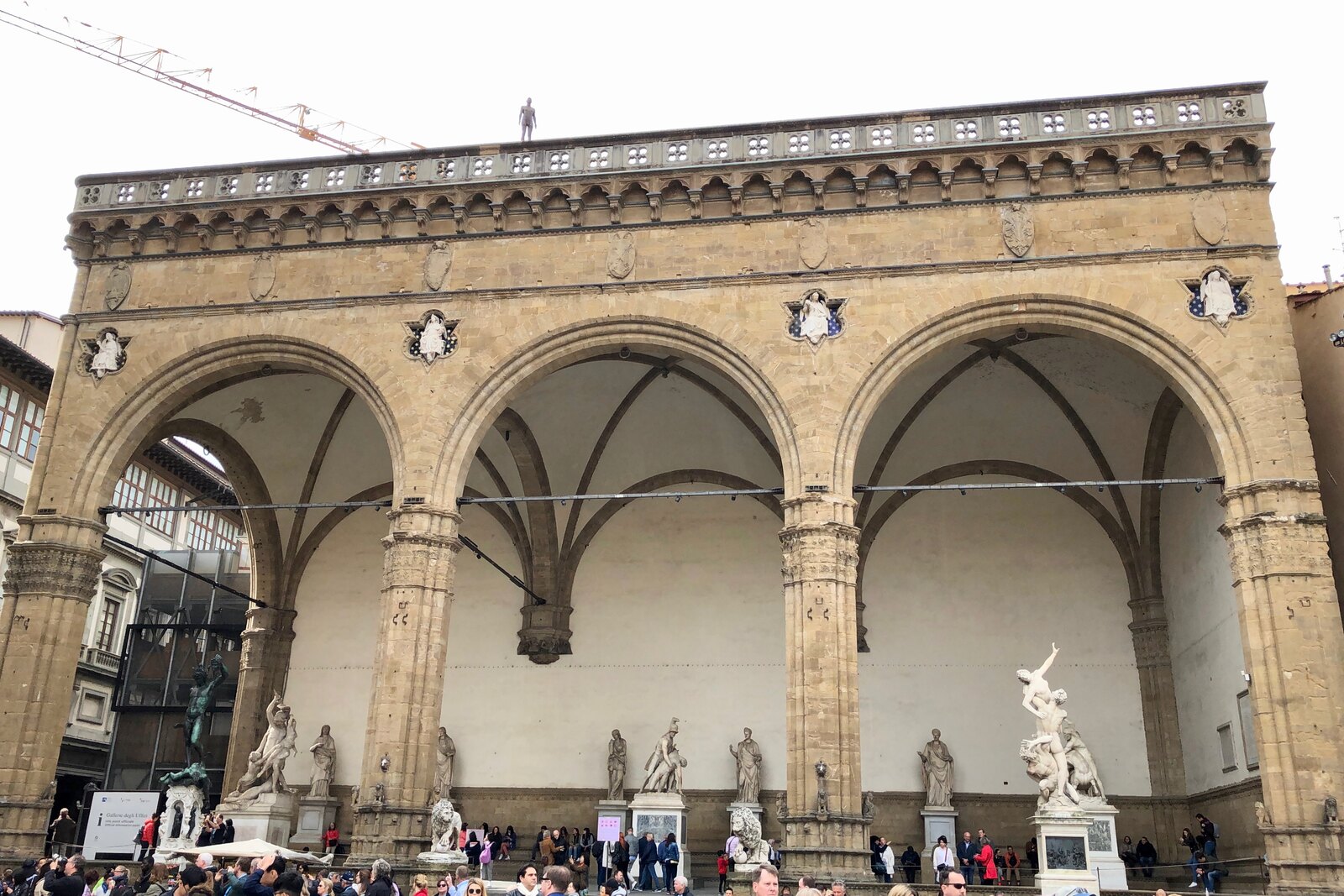
Look around first
What to notice
- Broad arches
- Bronze Perseus
- Medusa's head
- Sculptures beneath the arches
The story of the place
The name Loggia dei Lanzi preserves a military nickname: Florentines called the German halberdiers lanzi, shortening the word Landsknechts, although most of them served at court rather than in campaign infantry. The guard headquarters stood in the neighboring buildings, and the broad arches served as its facade and ceremonial section. Sculptures now stand beneath them, including Perseus: the hero raises Medusa's head, while her headless body lies at his feet. The loggia belongs to the Uffizi Gallery, so this collection can be seen free of charge day and night.
In fifteen thirty-seven, seventeen-year-old Cosimo I de' Medici was made Duke of Florence. His predecessor had just been killed by a relative, and a few months later Florentine exiles tried to overthrow the new ruler. Cosimo defeated their detachment at Montemurlo, but after that he had no intention of trusting his own fellow citizens.
In the summer of fifteen forty-one, he dismissed the Italian guard and hired one hundred German halberdiers, officers included. In a letter to Admiral Andrea Doria, the duke explained his calculation: he expected greater loyalty and less trouble from foreigners than from Italian soldiers. For the guardsmen themselves, it was paid service; many arrived with their families. They were housed in buildings near present-day Chiasso dei Baroncelli, while the open arcade became the facade and ceremonial section of the guard headquarters.
In city speech, these German guardsmen were called lanzi, short for Landsknechts. Strictly speaking, most served as court halberdiers rather than mercenary campaign infantry, but the colloquial name proved more durable than the distinctions between military professions. The name Loggia dei Lanzi comes from them.
Before the guard appeared, the arcade had a different purpose. It was built for assemblies of citizens and public ceremonies of the Florentine Republic. This was where the Signoria took office—eight elected priors and the Gonfalonier of Justice who headed them. They governed Florence for only two months, so the ceremony regularly presented the city with a new college of rulers. Now, during court appearances, the duke's personal bodyguards lined up before the same arches.
Cosimo reinforced the change with another commission. In fifteen forty-five, he instructed the court sculptor Benvenuto Cellini to cast Perseus for this loggia. The mythical hero holds Medusa's severed head and tramples her headless body. For the patron, Medusa represented the conflicts of the former republic, which he declared ended. Cellini worked for nine years, and on April twenty-seventh, fifteen fifty-four, the bronze figure was installed beneath the outermost arch. The public received it enthusiastically, and the sculptor kept his position at court. The arcade, where elected officials had once been sworn in, began to turn into an exhibition of Medici sculpture.
Cosimo lived to hold the title of the first Grand Duke of Tuscany. The German guard continued to protect his descendants for almost two centuries. In seventeen thirty-eight, the new House of Lorraine replaced it with Swiss guards. The headquarters disappeared, the ceremonies of the Signoria ended, but the name of the mercenary guards remained. Perseus stands in its intended place, and the sculptures beneath the arches are still visible free of charge day and night: the present-day loggia belongs to the Uffizi Gallery.
Useful on site
The loggia is freely visible from the square; since 2026, a free ticket available only on site is required to enter beneath the arches.
Checked: June 27, 2026. Check the official source before visiting.Both works can be viewed from outside. Walk around the marble group as far as space allows: its movement unfolds as the viewpoint changes.