 Guide On Map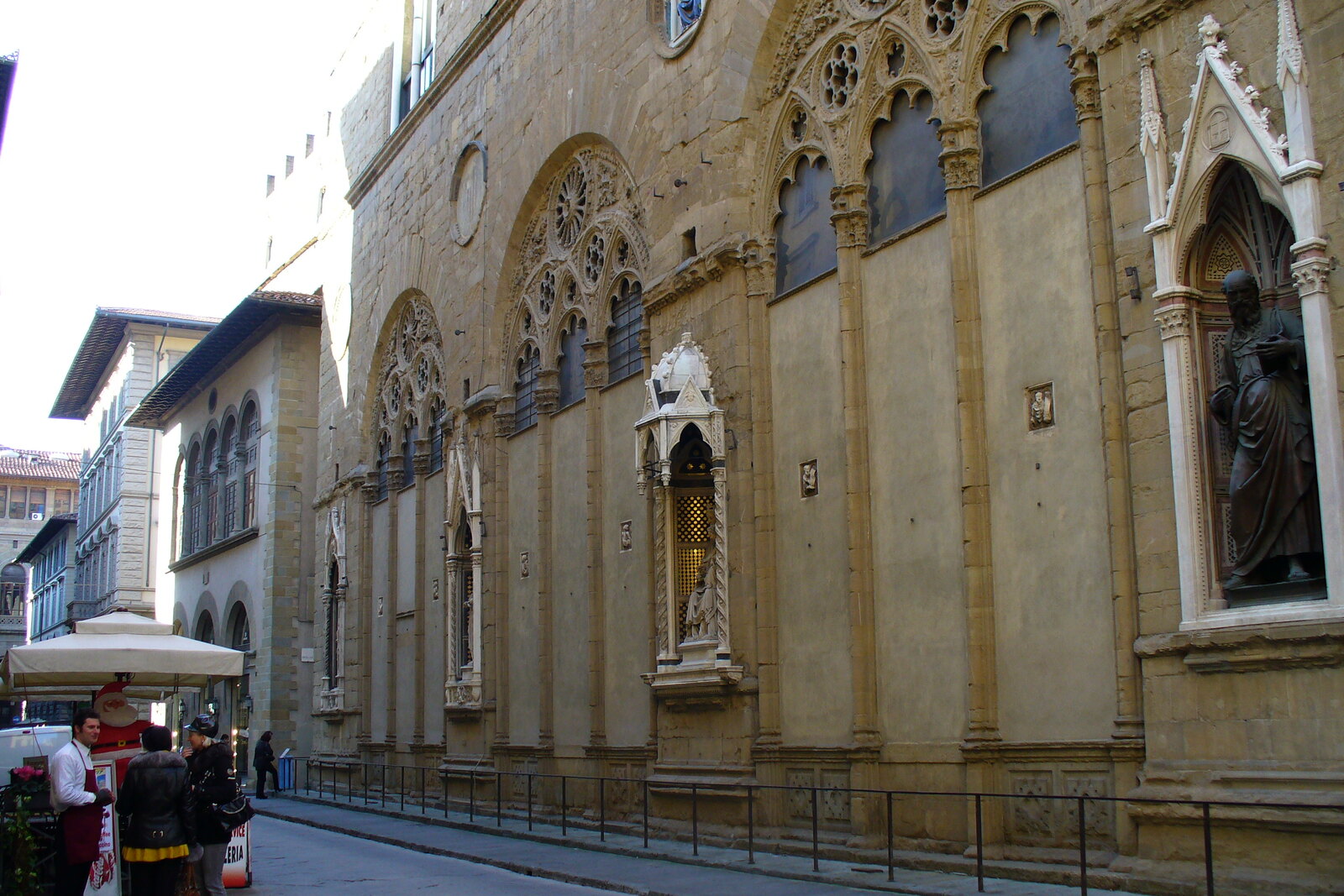
Look around first
What to notice
- Orcagna's Tabernacle
- Madonna and Child by Bernardo Daddi
- Stone grilles in the former arches
- Chutes in the corner supports
The story of the place
The ground floor of Orsanmichele was built open. In the mornings, grain was measured and sold here, and after the market closed, people gathered before an image of the Madonna on one of the supports and sang prayers of praise. The place's name is older still: “Orsanmichele” was shortened from “San Michele in Orto”—“Saint Michael in the Garden.” Before the market, a small church of Archangel Michael stood here among monastic vegetable gardens.
The Madonna's devotees formed a lay confraternity. They were not monks: craftsmen and merchants paid dues, sold candles, accepted donations, and distributed alms. Their six elected administrators were called captains—the office had nothing to do with military service. Healings were attributed to the image. The miracles themselves belong to religious tradition; the money left here, the wills, and the confraternity's accounts, however, survive in documents.
In thirteen forty-seven, the painter Bernardo Daddi completed a new, large Madonna and Child by Bernardo Daddi. A few months later, the plague came to Florence. Dying townspeople appointed the captains of Orsanmichele as executors of their estates: property was to be sold and the money distributed to the poor and to hospitals. In a short time, the confraternity received so many wills that its former charity became the management of an enormous fortune.
Accusations followed this trust. The chronicler Matteo Villani, who recorded the consequences of the epidemic, claimed that the captains appropriated part of the estates and sold property on terms favorable to themselves. This is an accusation by a contemporary, not a proven verdict. Something else is unknown as well: whether the captains intended to restore their good name with a lavish commission. The sequence is known exactly—after the plague wills and public reproaches, they gave a substantial part of the funds for a new setting for the Madonna.
In thirteen fifty-two, the work was entrusted to Andrea di Cione (Orcagna), a Florentine sculptor and the head of a large workshop. For seven years, he assembled a separate marble chapel around the painting: with columns, a vault, reliefs, colored inlays, and gilding. At the bottom, Orcagna carved his name and the completion date—thirteen fifty-nine. Here, the money of people who did not survive the plague became an object the captains could present to the entire city.
After it was installed, the merchants had to leave. In thirteen sixty-one, city officials moved the grain market out of here to free the space around the shrine. Then the people overseeing the construction ordered the former arches of the loggia closed off with stone grilles and walls. The ground floor became a church, but grain continued to be stored above in case of famine; chutes still exist inside the corner supports, through which it was poured down.
The trade guilds also remained at Orsanmichele, but changed their way of being present. Each commissioned its patron saint for an exterior niche, so around the building stand butchers, armorers, money changers, and cloth merchants, represented by apostles and martyrs. Copies are now on the facades, while the original statues have been moved to the former grain halls above.
Below, Madonna and Child by Bernardo Daddi still stands in Orcagna's Tabernacle of marble. Above it remain the city's grain stores, and inside a stone support is the channel through which grain once descended directly into the market.
Useful on site
Exterior viewing is unrestricted; the Bargello Museums museum section is currently open Tuesday–Sunday 08:30-18:30, but check the day of your visit and the last entry time.
Checked: June 27, 2026. Check the official source before visiting.Look at the figures from below and from the opposite side of the street: their proportions were designed for exactly that viewpoint. Most of the statues outside have been replaced by copies.