 Guide On Map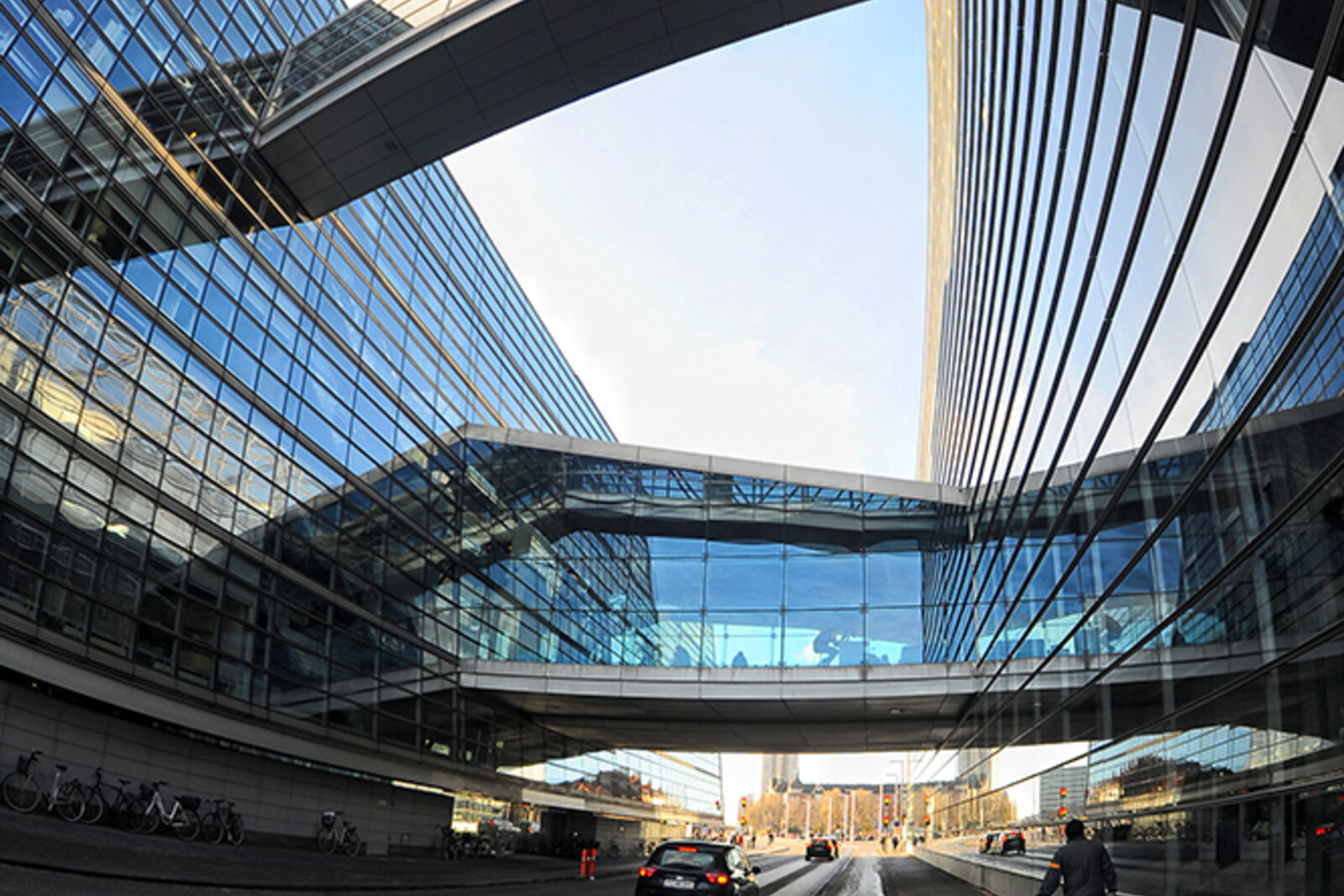
Look around first
What to notice
- Black granite façade
- Glass atrium
- Walkways above the road
- Open passage to the harbour
The story of the place
The black granite façade by the harbour leads into the Royal Danish Library's new wing, with a glass atrium inside. The wing was built beside the old building: it remained across the road and could no longer hold the growing collection. Walkways run above the roadway between the library's two parts, while the atrium hosts exhibitions and concerts, with a café and bookshop nearby. The cladding stone was quarried in Zimbabwe and polished in Italy; an accidental comparison by the culture minister gave the building its present name.
On January twenty-ninth, two thousand one, Peter Bellwood entered the Royal Danish Library's rare maps department. The former gardener from Leeds had become an antiquarian dealer, had already served prison terms for thefts from British libraries, and was now looking for maps he could sell to collectors. He needed money because of a gambling addiction. Only a year and a half earlier, the Royal Danish Library had opened its new wing, The Black Diamond, and tourists had poured in alongside readers. Among them, a man with a library card did not look suspicious.
Bellwood registered under his own name, and the first thing he did was hand the staff a found five-hundred-krone banknote. The gesture helped him pass for a respectable researcher. He then ordered old atlases and Itinerario—a guidebook from the late sixteenth century with maps of the then-known coasts of Africa, Arabia, and South America.
For three days, Bellwood cut out leaves with a small pencil-sharpening knife. He ran his hand along the binding, hid the detached map under the table, then slipped it beneath a loose sweater. In this way, he carried out eight maps, including world maps created by Abraham Ortelius, Petrus Plancius, and John Speed. On one of them, California was still shown as an island. The total value of what was stolen then was estimated at around one hundred thousand pounds.
A reading-room staff member noticed a page sticking out of a damaged book only after Bellwood had left. Jesper Jørgensen, the head of security, who was to find the thief and recover the leaves, reviewed the camera footage frame by frame. On screen, both the knife moving by the binding and the maps beneath the sweater could be seen. Jørgensen passed the footage to the police, and the library posted Bellwood's photograph online.
The photograph prompted other European libraries to check their reader logs and atlases. Dozens of cut-out maps were found in Wales, and around forty more in Stockholm; similar disappearances were discovered in The Hague and Helsinki. Bellwood was sought for several years. In two thousand four, a British court sentenced him to four and a half years in prison for thefts from the National Library of Wales. By then, the maps taken from Copenhagen had still not been found.
After this episode, library directors and police officers from different countries gathered right here. In May two thousand two, they adopted the Copenhagen Principles: institutions committed themselves to immediately notifying one another about thieves of rare books and to working jointly with the police and antiquarian dealers. Libraries had often concealed thefts before, fearing damage to their reputations; Bellwood and his accomplices used that silence while traveling around Europe.
The openness that helped him get in was built into the building's design. The library director, Erland Kolding Nielsen, had been campaigning for a new wing since the mid-nineteen eighties. The old building from nineteen oh six could no longer hold the growing collection, but Nielsen also wanted exhibition halls, a concert venue, and an open passage to the harbour. Some regular readers feared that cafés, music, and visitors would turn a scholarly library into an entertainment center.
Four young architects from Aarhus won the international competition. They placed the new wing by the water, left the old library across the road, and connected the buildings with walkways above it. The black granite for the façade was quarried in Zimbabwe, then sawn and polished in Italy. According to the recollections of Culture Minister Jytte Hilden, when the project was presented, she said the building looked like a black diamond. The offhand remark became its name, The Black Diamond.
Now exhibitions and concerts take place in the open atrium, alongside a café and bookshop. Rare maps and manuscripts are kept separately: they are ordered from closed storage and received in controlled reading rooms. Behind the gleaming façade, an entrance without a library card and doors through which an old map can no longer be carried out beneath a sweater operate at the same time.
Useful on site
Royal Danish Library lists the usual hours for The Black Diamond: Mon–Fri 08:00-20:00, Sat 09:00-18:00, Sun 10:00-16:00; check events and holidays separately.
Checked: June 26, 2026. Check the official source before visiting.The main view is from the waterfront; plan visits to the interior rooms and events separately.