 Guide On Map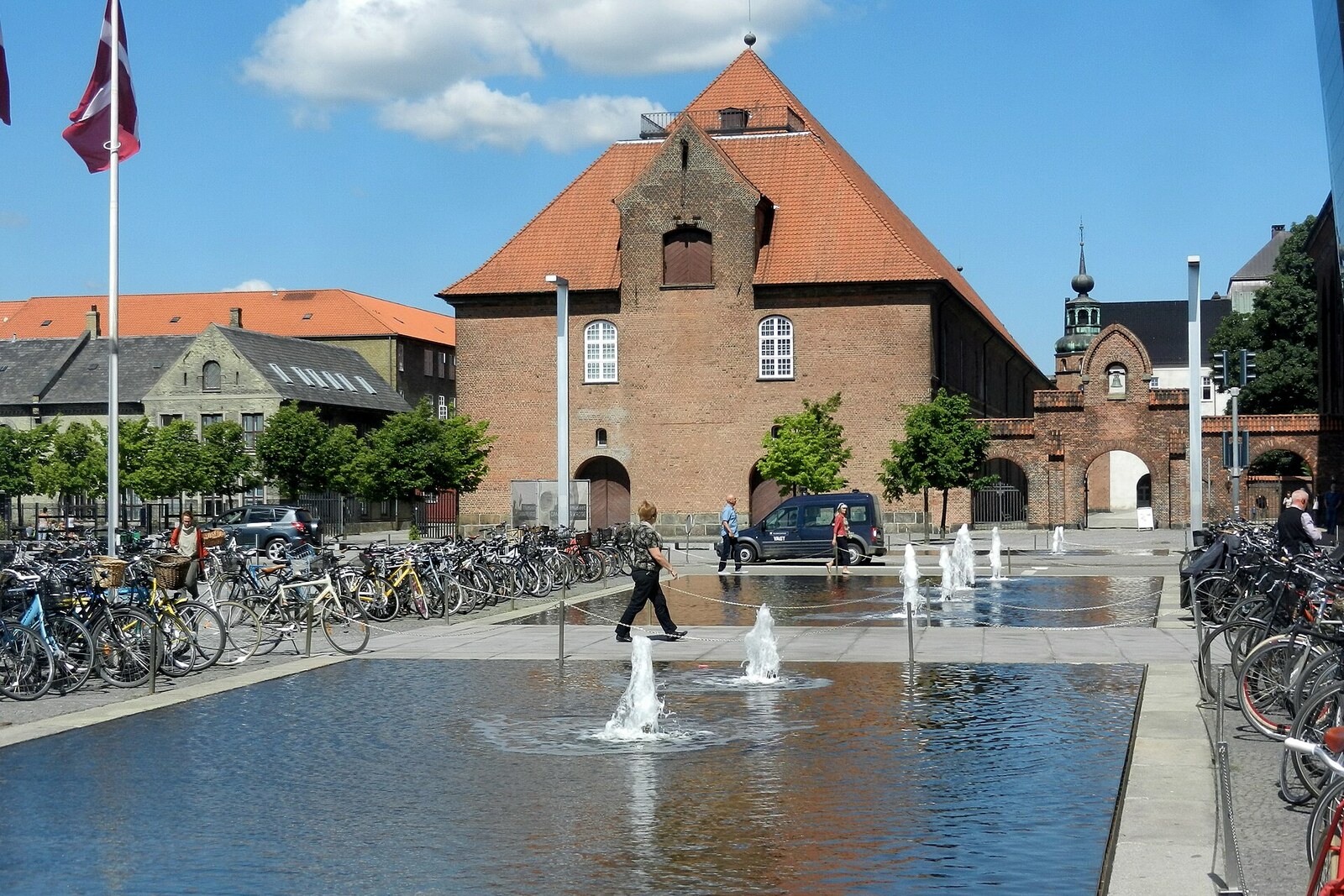
Look around first
What to notice
- Granite paving
- Long wooden steps
- Carved words on the wooden cladding
- The façade of The Black Diamond
The story of the place
This granite square appeared together with The Black Diamond in nineteen ninety-nine. It serves as the library courtyard by the harbor: people pass through it to reach the main entrance, sit by the water on the long wooden steps, and during major city events, stages are set up here and spectators gather. The square is named after the Danish philosopher and writer Søren Kierkegaard. By then, his manuscripts were already held by the Royal Danish Library.
During Kierkegaard's lifetime, there was no square here. The house that connected him with the island of Slotsholmen stood farther north, on a vanished stretch of Børsgade near Børsen. Regine Olsen lived there, the eighteen-year-old daughter of an official in the Finance Ministry. Kierkegaard often came to see her by way of the island.
In September eighteen forty, the twenty-seven-year-old theology graduate arrived at the Olsen house firmly intending to propose. Regine sat down at the piano, but he interrupted the music and confessed that she was the one he had been looking for. She agreed. Kierkegaard lived on the fortune left by his father: he did not need to seek a parish or a salary, and he could choose between family life and independent work as a writer.
Eleven months later, he returned Regine's ring, and two months after that he broke off the engagement for good, against her wishes. There is no single indisputable explanation for this act. Later, Kierkegaard wrote that his melancholy and the authorship he had conceived would have made a marriage unhappy. To make Regine reject him herself, he tried to present himself as a frivolous seducer. She did not believe him and asked him to stay. In small Copenhagen, the breakup became a public scandal; soon afterward, Kierkegaard left for Berlin.
He never married. After the breakup began the most productive period of his work: Either/Or, Repetition, and Fear and Trembling appeared. Regine is never named directly, yet the unconsummated marriage reappears in stories Kierkegaard invented about choice, promise, and refusal. Regine herself married the civil servant Johan Frederik Schlegel in eighteen forty-seven. When the couple were leaving for the Danish West Indies, she found Kierkegaard in the crowd and said goodbye to him. It was their last meeting.
Before his death, Kierkegaard declared Regine his sole heir, as if the engagement still bound them. Her husband refused the inheritance; Regine took only a few personal belongings. The writer's papers went to his older brother, Bishop Peter Christian Kierkegaard. In eighteen seventy-five, he transferred them to the university library, and later the archive entered the holdings of the Royal Danish Library. Regine kept thirty-two letters received during the engagement and bequeathed these letters, together with other papers, to the library. They were accepted after her death in nineteen oh four.
The Kierkegaard archive is now included in UNESCO's Memory of the World Register. Regine's house on Børsgade is no longer there. On the wooden cladding of the steps by the water, the artists Ingrid Falk and Gustavo Aguerre carved Kierkegaard's words that life must be understood backward. The letters of the woman he tried to make forget him are kept in the library at the address Søren Kierkegaards Plads.
Useful on site
Open public space; events and temporary installations may alter passage.
Checked: June 26, 2026. Check the official source before visiting.There is little shelter from the weather here, but it is a convenient place to step back and take in the surroundings as a whole.