 Guide On Map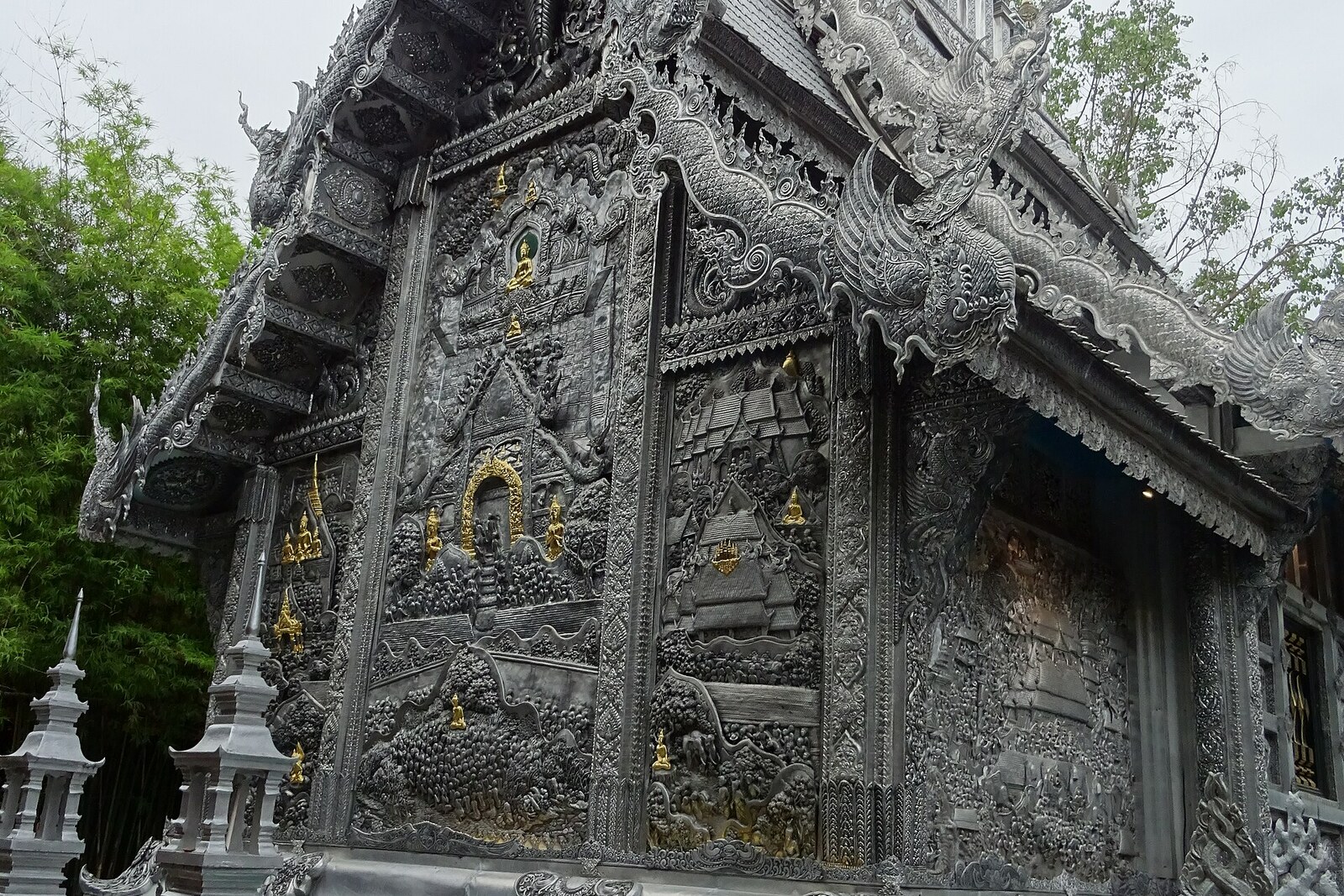
Look around first
What to notice
- Metal reliefs on the walls
- Repoussé roof panels
- The ubosot finial
The story of the place
At the center of Wat Sri Suphan stands the current ubosot, built on the foundation of the previous temple hall. Monks conduct ordinations and communal rites inside it; the ritual boundaries were kept unchanged, as was the bronze Buddha statue. Women are not permitted to enter under a Lanna custom connected with relics beneath the foundation. The metal reliefs on the walls and roof depict Buddhist subjects, the temple’s past, and local life, while pure silver was reserved only for the finial and the relic niche.
Direk Sittikan grew up in a family of Wua Lai metalworkers and wanted to master the craft his parents used to make a living. From the age of seventeen, he helped his family with silverwork in the mornings, then learned to draw in the afternoons—the future relief first had to be laid out on paper.
At the time, the family business was understood literally. Experienced masters showed techniques to their children and nephews, but kept their knowledge from outsiders. Direk visited older metalworkers, asked questions, and watched. They agreed to speak with him, but would not put a tool in his hands: he was not a relative. He had to reconstruct the missing techniques on his own, combining what he had managed to observe with his drawing skills.
By the beginning of the twenty-first century, that closed-off approach had become dangerous for the craft itself. Silver was becoming more expensive, other occupations brought in more money, workshops were closing, and masters’ children were choosing their parents’ work less and less often. Direk decided to teach for free and not ask students about kinship. In two thousand one, he assembled a group at Wat Sri Suphan that initially had just over ten people.
At that time, the abbot Phra Kru Pitak Sutthikhun was looking for a solution for the old ubosot. An ubosot is a consecrated hall where monks conduct communal rites, read the monastic code, and perform ordinations. The previous building had deteriorated so badly that it had become unsafe to use. The abbot, the monks, the temple committee, and the congregation decided to build a new hall on the old foundation, preserving the former consecrated boundary.
The abbot suggested that Direk cover the new ubosot with repoussé panels. The commission would have been beyond the capacity of just a few students, so Direk called on masters who had already left the craft. Most of them were elderly. His students and young metalworkers worked beside them: the older masters took up their tools again, while the younger ones received work for which making a single bowl and going their separate ways was not enough.
Construction began in two thousand four. About forty Wua Lai masters worked for twelve years. They covered the walls and roof with reliefs depicting Buddhist subjects, the temple’s history, and scenes of local life. Pure silver was used in protected and especially significant details—for example, in the finial and the relic niche; the large surfaces were made from silver alloys, aluminum, tin, and other metals. The name “Silver Temple” refers to the metalworkers’ work and the ubosot’s silvery appearance, not to an ingot of precious metal the size of a building.
Over the long years of the commission, several families that had previously given up metalworking returned to it. For some, it once again became their main income; for others, an additional one. Direk’s students began passing the techniques on to new beginners themselves.
The ubosot was completed in two thousand sixteen. The old bronze statue of Phra Chao Chet Tue, which had stood in the previous hall, was moved inside. Women are not permitted to enter: the temple community preserves a Lanna custom connected with the consecrated boundary and with relics that, according to local belief, are laid beneath the foundation. Thus, the silver walls surround an active ritual space, not a museum hall.
The old ubosot no longer exists. What remains of it are the foundation, the consecrated boundary, and the Buddha statue; over them lie panels jointly worked in repoussé by elderly masters who returned to work and by the students of the man whom people had once refused to show an outsider’s strike.
Useful on site
The temple’s official website, as of the verification date, indicates daily access from 06:00–18:00; check fees and access to separate areas at the entrance.
Checked: June 30, 2026. Check the official source before visiting.Do not mistake all the shine for pure silver: different metals were used in the decoration. Follow the temple rules and read the notices at the entrances carefully.