 Guide On Map
Wua Lai: Chiang Mai’s Silver Quarter
From Chiang Mai Gate along Wua Lai Road to Wat Muen San

Guide On Map on your phone
Open the walk like a regular app
It takes about 10 seconds to install. No app store needed.
The whole path
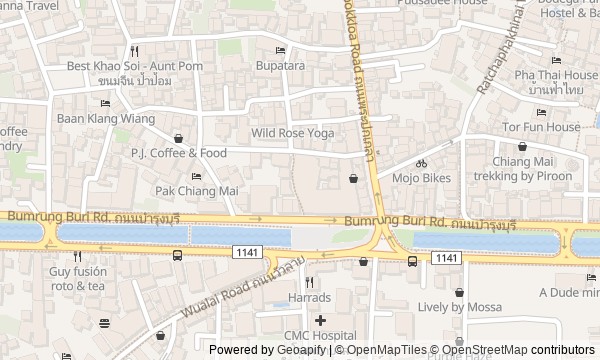
Route map
About the walk
From Chiang Mai Gate, you will step beyond the moat and head south along Wua Lai Road. Along this straight street, silver shops, market stalls, and 2 temple courtyards will give way to one another. The gleam of metal will be misleading: beside silver, you will find aluminum panels, and behind a festive facade, the work of families who nearly lost their craft. You will hear about an aluminum elephant that took 2 weeks to make, a market initially allowed to run on only a few Saturdays, and a boy with a woven box beside an old well. The answers will emerge from the choices of ordinary residents, without legends of timeless tradition or temple grandeur. The story will separate inheritance from a handsome signboard: who was allowed to learn, who remained outside the door, and why a master eventually passed his tools to someone else’s student. By the end of the walk, you will understand why Wua Lai kept its silver name, even though metal is not its greatest value.
Why this order
At Chiang Mai Gate, you will learn why displaced silversmiths were settled just beyond the moat. In the workshops along the same road, you will see the direct result: techniques passed within families together with commissions. The market comes next because residents brought goods out of their homes and 3 temple courtyards onto a shared street. After the stalls, you will enter Wat Sri Suphan, where one large commission brought veteran masters and newcomers together again. Sala Sip Mu Lanna continues this turn: beside the finished ubosot, you can see how the effort was no longer about saving individual objects, but the transmission of skills itself. At neighboring Wat Muen San, the ending broadens the neighborhood’s story—from a craft passed to someone else’s student to secret help that residents also passed from hand to hand.
Those who want to see the life of an artisan neighborhood behind temple facades Those interested in handwork and family workshops Those who prefer human stories to a survey of sights
Those looking for an overview of the main temples in Chiang Mai Old City Those who only want an evening market and shopping Those uncomfortable with stories of forced relocation and war
Before you go
The Wua Lai Walking Street is a distinct state of the street, so decide in advance whether you want to see a market evening or a quieter working neighborhood. Do not expect every workshop to be open, or a master to be able to interrupt a commission for a demonstration at once. Ask permission before photographing people or work in progress. In temple complexes, speak quietly, do not disturb prayer, and follow directions on site; arrange classes and detailed workshops separately.
When to go
On a weekday, this route is best walked in daylight: it is easier to study the chased metalwork and notice active workshops. On Saturday, start before the evening crowds, see the gate and temples, then let the street gradually shift into market mode.
Backup plan
If the market is not running, do not replace it with random shops: look at the street itself as a space of former home workshops, then continue to the temples. If the learning center is closed, turn your attention to the exterior metal panels of Wat Sri Suphan and finish at Wat Muen San. In heat or fatigue, skip a long look through the shops, but keep the sequence of the 2 temples—it shows how one craft serves architecture, teaching, and memory.
Route conditions
Surface. Paved — 789 m; unpaved — 124 m
Access. Wheelchair — limited; stroller — limited
Facilities. Toilets — 1
Elevation. Ascent — 3 m; descent — 4 m
OpenStreetMap extract of June 18, 2026: database data, not a check on the ground. Data © OpenStreetMap contributors, ODbL licence
Walk plan
Open in maps ↗- 1
Chiang Mai Gate
Here you will learn why the craft quarter began beyond the moat and bears the name of another place. - 2
Wua Lai Workshops
This stop will show how a family technique adapted to the disappearance of its usual commissions. - 3
Wua Lai Walking Street
Here it will become clear how residents turned three temple fairs into a single street market. - 4
Wat Sri Suphan
Here, masters of different generations will come together on a single project that lasted twelve years. - 5
Sala Sip Mu Lanna
Here you will see how learning a craft ceased to depend on being born into the right family. - 6
Wat Muen San
The finale will broaden the story of the neighborhood: its residents passed down not only craft techniques from hand to hand.
Route features
Everything you need stays in the browser
Progress, saves and your trip plan are stored on this device.
Add Guide On Map to your home screen so the walk opens outside the browser.
How we handle sources, maps and corrections: our editorial standards