 Guide On Map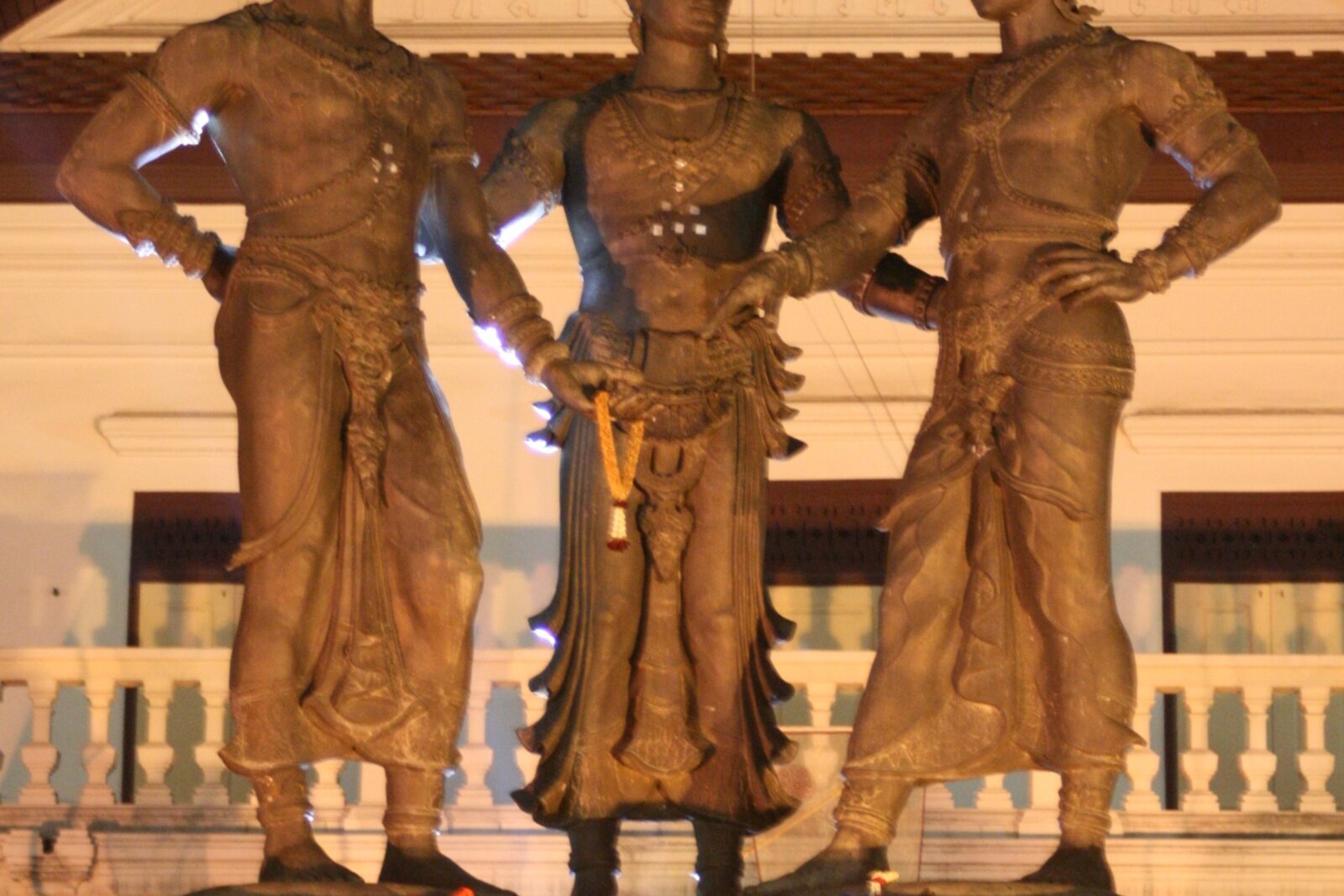
Look around first
What to notice
- Three bronze figures
- Stone pedestal
- Facade of the old city hall
- Flower garlands
The story of the place
The three bronze figures on a stone pedestal appeared here in nineteen eighty-three. They were placed in Chiang Mai's old administrative and ceremonial center: princely palaces once stood in this part of the city, and after they were dismantled, an open space for rituals and large gatherings was laid out here. The provincial administration operated behind it; today, the Chiang Mai City Arts and Cultural Centre occupies the former building. Garlands, marigolds, and boiled eggs are still brought to the statues, and a city rite from here links ceremonies at the gates and corners of the old walls.
The bronze group depicts a consultation, but this businesslike conversation became possible only after a scandal that nearly made these three enemies.
Mangrai stands in the middle—the ruler choosing a site for the new capital of Lan Na. To his right is Ram Khamhaeng, king of Sukhothai. To his left is Ngam Mueang, ruler of Phayao. According to the Chiang Mai Chronicle, Ram Khamhaeng entered into a relationship with Ngam Mueang's wife. The offended husband captured his rival and referred the case to Mangrai for judgment. Ngam Mueang sought punishment, Ram Khamhaeng risked his freedom, and Mangrai needed to reconcile two neighbors whose feud could draw his own lands into war as well.
Mangrai persuaded Ram Khamhaeng to apologize and pay compensation. The chronicler names an enormous sum—nine hundred ninety thousand cowrie shells, which were used for payment at the time. Ngam Mueang released his prisoner, after which the three rulers swore not to harm one another. This is an account from a late chronicle, not a surviving court record; the love scandal and the exact sum belong to legend.
A few years later, Mangrai took advantage of the fact that the former opponents were keeping their oath. He had already subjugated prosperous Hariphunchai and founded the settlement of Wiang Kum Kam by the Ping River, but he continued to look for a site for the main capital. On the plain between Doi Suthep and the Ping, he ordered temporary quarters built and invited Ngam Mueang and Ram Khamhaeng to assess the chosen site.
The chronicle says that the guests inspected the surroundings and approved the site and the plan. They did not build the city with their own hands, nor did they rule it as a threesome. Mangrai sought confirmation from two neighboring kings with whom he had recently made peace; their agreement meant that the new capital would arise not in the midst of an immediate war with Phayao or Sukhothai. In twelve ninety-six, Mangrai's people began digging the moat, raising the walls, building the palace, and opening the market. Mangrai gained a capital, while Ngam Mueang and Ram Khamhaeng returned to their kingdoms.
The chronicle places their consultation within the territory of the future Chiang Mai, but does not specify a point that can be matched with the present-day pedestal. The scene in front of the old city hall is a later depiction of that conversation. The sculptor Khaimook Chuto placed Mangrai in the center, with Ngam Mueang and Ram Khamhaeng on either side: the three no longer judge one another, but discuss a city.
The site for the monument was chosen in the old administrative and ceremonial center. Princely palaces once stood in this part of Chiang Mai; after the earlier buildings were dismantled, a khuang—an open space for rituals and large gatherings—was laid out here. Later, the provincial administration operated behind the square, and the Chiang Mai City Arts and Cultural Centre now occupies its building. The bronze kings were installed here in nineteen eighty-three.
Flower garlands, marigolds, and boiled eggs are still left before the statues. The anniversary of Chiang Mai's founding is marked here, and a rite to extend the city's destiny is performed. During this rite, a signal from Three Kings Monument Square sets ceremonies in motion at the five gates and four corners of the old walls—the very walls that Mangrai's people began building after the council of the three reconciled rulers.
Useful on site
The open square is freely accessible; the museums and indoor spaces around it follow separate schedules.
Checked: June 15, 2026. Check the official source before visiting.The square is visible from outside; during ceremonies, keep your distance from offerings and participants.