 Guide On Map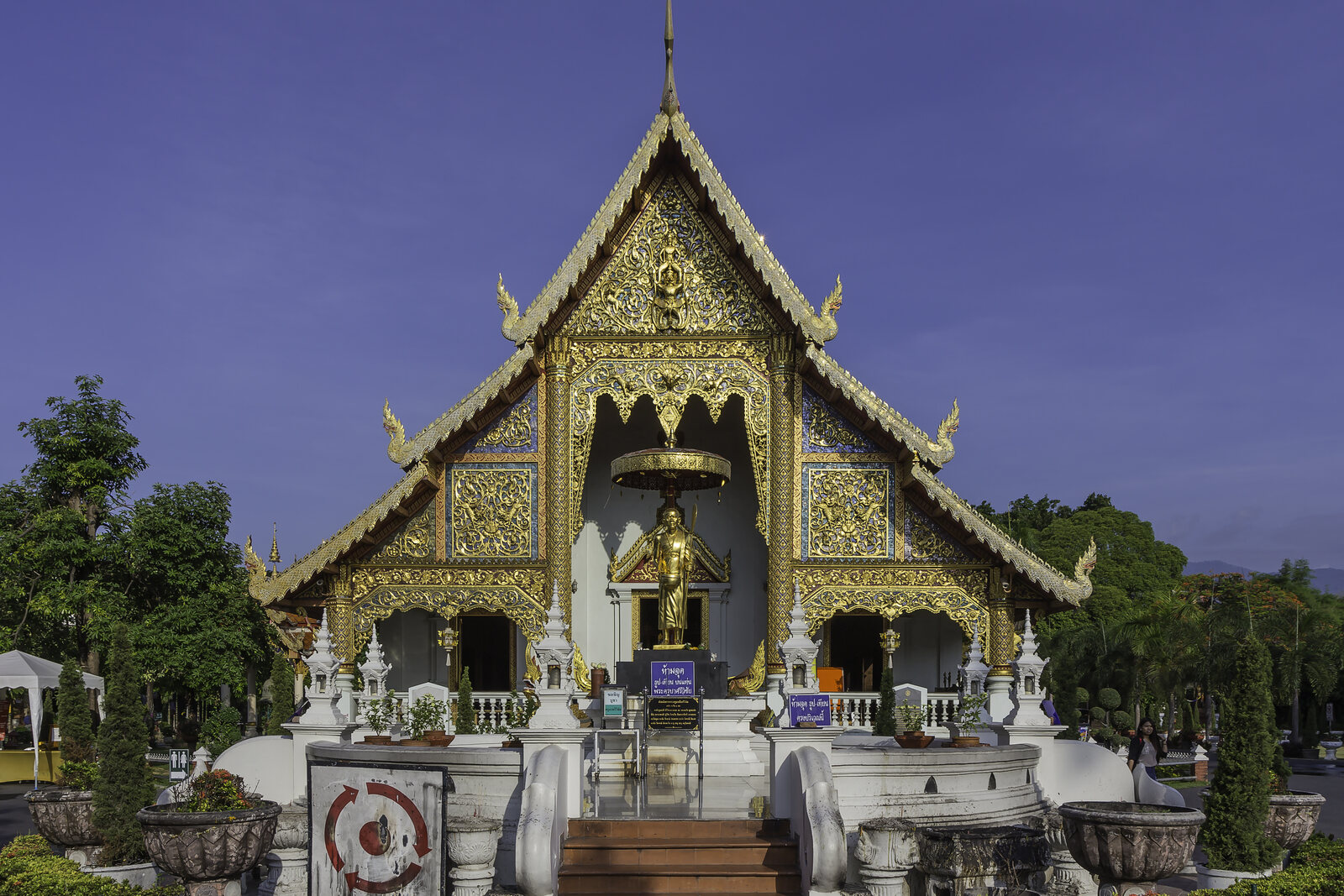
Look around first
What to notice
- Wihan Lai Kham
- Phra Sing statue
- Gilded carvings
- Multi-tiered roofs
The story of the place
At the far end of Wat Phra Singh stands Wihan Lai Kham, a temple hall beneath multi-tiered roofs and gilded carvings. People come here to pray and leave offerings before the bronze Phra Sing, whose name gradually became the name of the entire monastery. The monastery also has a stupa containing the ashes of one of the Lan Na rulers, so this enclosure preserved the dynasty's memory even before its present name. Art specialists see the bronze as a Lan Na work of the early fifteenth century, while legend traces it much farther, through Sri Lanka and several Thai kingdoms.
Long before the monastery came to be called Wat Phra Singh, in the late fourteenth century Maha Phrom, ruler of Chiang Rai and uncle of the new king of Lan Na, decided to seize the throne of Chiang Mai. Saenmueangma inherited the throne after his father's death; he wanted to keep his inheritance, and his uncle led an army against him. Maha Phrom lost and fled south to Kamphaeng Phet. What remained at stake for him was Chiang Rai: the city he had once governed and to which he could return only after being pardoned.
Lan Na legends tell different versions of how the sacred bronze statue Phra Phuttha Sihing came into the exile's possession in Kamphaeng Phet. In one version, local relatives gave it to Maha Phrom; in another, he took it by force. The versions share what follows: Maha Phrom brought the statue to his nephew and presented it along with a plea for pardon. Saenmueangma accepted the gift and allowed his uncle to rule Chiang Rai again. The statue remained in Chiang Mai as the physical outcome of their failed war and completed reconciliation.
By then, this monastery had already belonged to the history of the same family for several decades. King Phayu ordered a stupa built here and the ashes of his father, Khamfu, placed inside it—the common ancestor of the two recent adversaries. Khamfu was Maha Phrom's grandfather and Saenmueangma's great-grandfather. At that time, the same monastery was called Wat Lee Chiang Phra.
A later legend explained why the statue was placed right here. Saenmueangma supposedly intended to take it to another monastery, Wat Suan Dok. A processional cart was pulled through the city, but in front of Wat Lee Chiang Phra the attendants could not move it any farther. The king took the halt as a sign, ordered the statue left here, and had a shrine arranged for it. After that, residents began calling the monastery Wat Phra Singh. Phra Sing is the shortened name of the statue itself, Phra Phuttha Sihing.
Its legendary biography traces it from Sri Lanka through several Thai kingdoms. Art historians are more cautious: from the form of the bronze, they date it to a Lan Na work of the early fifteenth century. The journey from Sri Lanka remains a sacred legend, while several old local texts confirm Maha Phrom's role in the image's appearance in Chiang Mai.
Today, Phra Sing sits in Wihan Lai Kham, a temple hall where laypeople come to pray and bring offerings. Every April, during Songkran, monks take the statue out, place it on a decorated cart, and take it through Chiang Mai so that townspeople can wash it with water. In the legend, people once could not take this cart any farther than the monastery; now, every year, they take Phra Sing away from here for several hours and bring it back.
Useful on site
Plan for daytime or early-evening access to the grounds; individual halls and sacred areas may close temporarily during services.
Checked: June 15, 2026. Check the official source before visiting.Access to the revered image and the murals depends on temple life; inside, keep quiet and observe local photography restrictions.