 Guide On Map
Old Chiang Mai: How the Lan Na Capital Was Assembled
From Tha Phae Gate along the moat—through the old center to Wat Phra Singh
Guide On Map on your phone
Open the walk like a regular app
It takes about 10 seconds to install. No app store needed.
The whole path
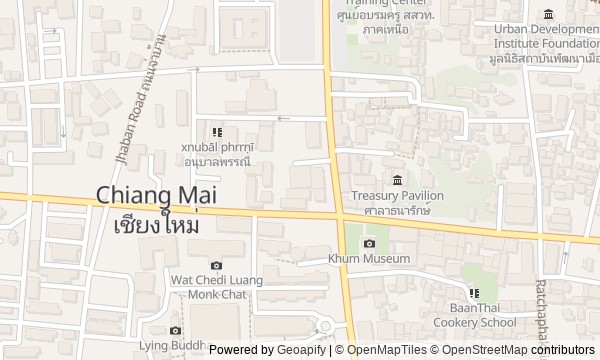
Route map
About the walk
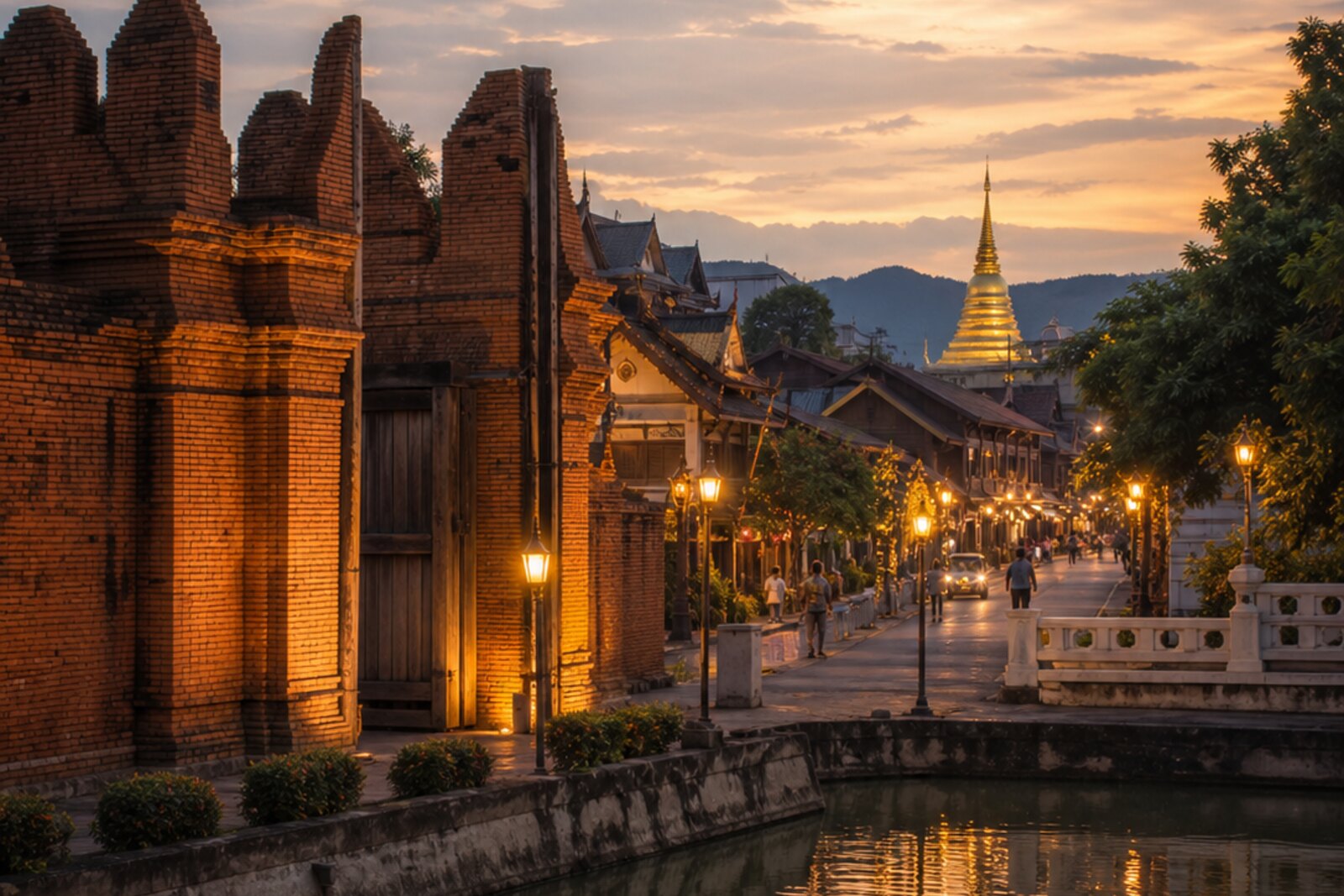
You will begin at the eastern gate, walk along the moat, then turn into the middle of the old city—to a vast brick stupa, a teak temple hall, and the square in front of the former city hall. The final stretch heads west along Ratchadamnoen Road to Wat Phra Singh.
This is a walk through a capital assembled anew several times. Why will a stone pillar with mirror signs disappear inside the rebuilt gate? How did a princely residence become a Buddhist hall? What made 3 feuding rulers debate the fate of a single city?
The story stays close to visible things: water, brick, timber, statues. Chronicle, legend, and later reconstruction will not be flattened into one convenient version.
By the end, you will be able to explain why old Chiang Mai kept the shape of a fortress—and why the right to its throne was confirmed not only by walls, but by sacred images.
Why this order
Tha Phae Gate first shows how Chiang Mai restored a lost urban boundary; the neighboring eastern moat gives that boundary its full scale and explains why the city needed defenses again. From the water, the route turns toward Chedi Luang, once the political and sacred center of the capital. Nearby Wat Phan Tao carries the theme of power into timber: beside the royal stupa stands a hall moved from a princely residence. Then Three Kings Monument Square connects the temple center to the decision to found the city itself. The final westward walk leads to Wat Phra Singh, where the story of the city’s founding closes with another side of Lan Na power—the reconciliation of rivals and the fate of a sacred statue.
Those who want to understand Lan Na history through specific places in the city Those interested in old temples without a list of dates and architectural terms Those who enjoy separating chronicle and legend from later reconstructions
Those looking for a walk focused only on markets and contemporary city life Those who prefer a quick visit to a single temple complex Those uninterested in dynastic disputes and the history of Buddhist shrines
Before you go
Choose comfortable shoes, bring water, and wear clothing that covers your shoulders and knees: much of the walk passes through active temple compounds. Remove your shoes before entering buildings, speak quietly, and do not block worshippers; check photography rules on site. A small amount of cash will be useful for voluntary donations and local fees. The outdoor parts of the route are accessible on their own, but interior halls may be temporarily closed for services, ceremonies, or maintenance.
When to go
Allow about 3 hours for an unhurried walk with listening time and time to look closely at the details. Mornings and late afternoons are usually more comfortable in the heat; on Sunday evenings, Tha Phae Gate and the streets leading into the old city can be crowded.
Backup plan
If it starts to rain, shorten your pauses by the moat and in the square, and finish listening under available cover without occupying temple passageways. If interiors are closed, do not postpone the whole route: at Tha Phae Gate, Chedi Luang, and Wat Phan Tao, the main details of the story read clearly from outside. At Wat Phra Singh, shift your attention from the venerated image to the complex’s architecture; treat access to shrines and murals as an added opportunity, not a requirement for the walk.
Route conditions
Surface. Paved — 2.8 km; unpaved — 47 m (data covers 93% of the route)
Access. Wheelchair — limited; stroller — limited
Facilities. Toilets — 13; drinking water — 1
Elevation. Ascent — 9 m; descent — 5 m
OpenStreetMap extract of June 18, 2026: database data, not a check on the ground. Data © OpenStreetMap contributors, ODbL licence
Walk plan
Open in maps ↗- 1
Tha Phae Gate
Here it will become clear why the familiar symbol of the old city is also a modern reconstruction. - 2
East Moat
This water boundary reveals the scale of a city that at first had no one to restore it, and then had to be defended. - 3
Wat Chedi Luang
The royal stupa will lead into a dispute over two crowns and the fate of a shrine that confirmed the right to rule. - 4
Wat Phan Tao
This stop shows how a princely building could change its purpose and continue its life in a monastery. - 5
Three Kings Monument Square
Here, the city's founding will appear as the result of negotiations between rulers rather than the joint feat of three builders. - 6
Wat Phra Singh
The final shrine will conclude the route with the story of a gift that proved more important than a lost struggle for the throne.
Route features
Everything you need stays in the browser
Progress, saves and your trip plan are stored on this device.
Add Guide On Map to your home screen so the walk opens outside the browser.
How we handle sources, maps and corrections: our editorial standards