 Guide On Map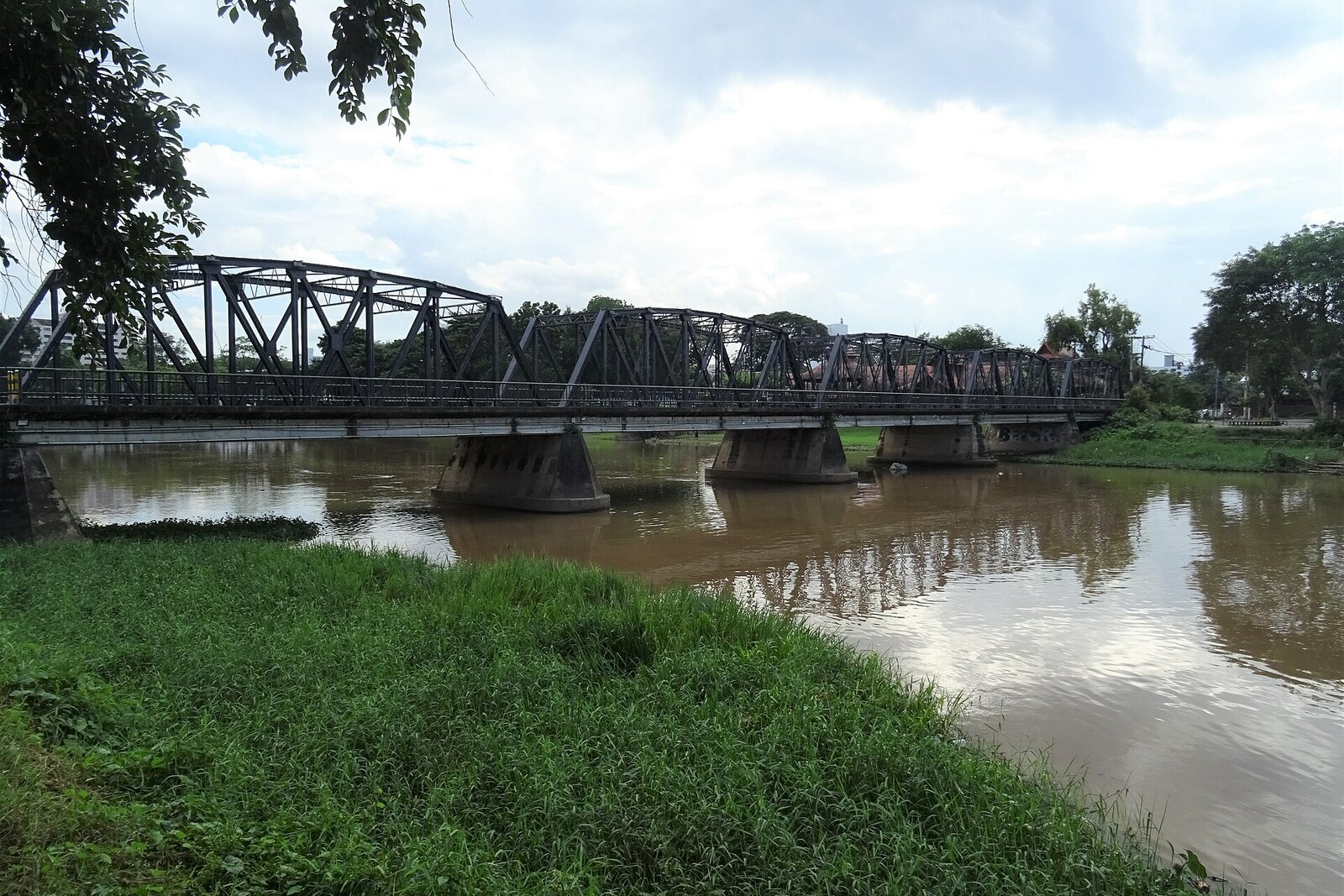
Look around first
What to notice
- Steel trusses
- One traffic lane
- Side sidewalks
- Repeating iron frames
The story of the place
The steel trusses over the roadway look older than the bridge itself. Iron Bridge (Saphan Lek) was built in nineteen ninety-three, and the metal was bought new. The municipality commissioned a copy here of another crossing that had stood about half a kilometer upstream, on the site of today's wide concrete bridge.
That earlier bridge opened in nineteen twenty-three, soon after the railway arrived. Goods from the station crossed it to the western bank. Five spans rested on iron trusses, but the roadway was only a little more than five meters wide. When cars and trucks became more numerous, drivers depended on a crossing that could no longer handle their flow.
In the mid-sixties, municipal officials decided to dismantle it and give its place to a concrete bridge twice as wide. The contractor paid the city sixty thousand baht for the removed structures and built a new crossing designed for ten-ton trucks. It opened in nineteen sixty-seven. The iron silhouette by which townspeople recognized this bank disappeared.
A quarter of a century later, the municipality decided to show young residents what the lost crossing had looked like. No one intended to return the narrow bridge to its former site: the main traffic flow already passed there. The copy was installed here, at the end of Loi Kroh Road, and made into a full crossing between the commercial district by the Chiang Mai Night Bazaar and Chiang Mai–Lamphun Road. Its old-fashioned appearance was combined with one traffic lane and sidewalks on both sides. The name Saphan Lek literally means “iron bridge,” although the iron before your eyes dates from the nineties.
Director Komgrit Triwimol gave it a new purpose. In nineteen hundred five, he was making his first independently directed feature film, Dear Dakanda. For Komgrit, it was a test: before that, he had shared directing with five colleagues, but now he alone was responsible for a film on which his future career depended.
In one scene, Khaiyoi, a student at the faculty of arts, carries Dakanda on a motorcycle. She is a friend to whom he does not dare confess his love. They cross the Ping River right here, inside the repeating iron frames. The film earned more than eighty million baht at the box office, and afterward Komgrit continued making commercially successful films. Iron Bridge (Saphan Lek) acquired another local nickname: “the bridge from Dear Dakanda.” Cars still travel along the single lane, while people take photographs on the side sidewalks between the trusses that the municipality originally installed as a copy of the lost bridge.
Useful on site
The city bridge is open as part of the street network; the main limitations remain traffic, heat, and finding a safe place for a photo.
Checked: June 26, 2026. Check the official source before visiting.View the structures from the bank or from a safe part of the crossing; do not step onto the roadway for a better angle. There is especially heavy traffic here in the evening.