 Guide On Map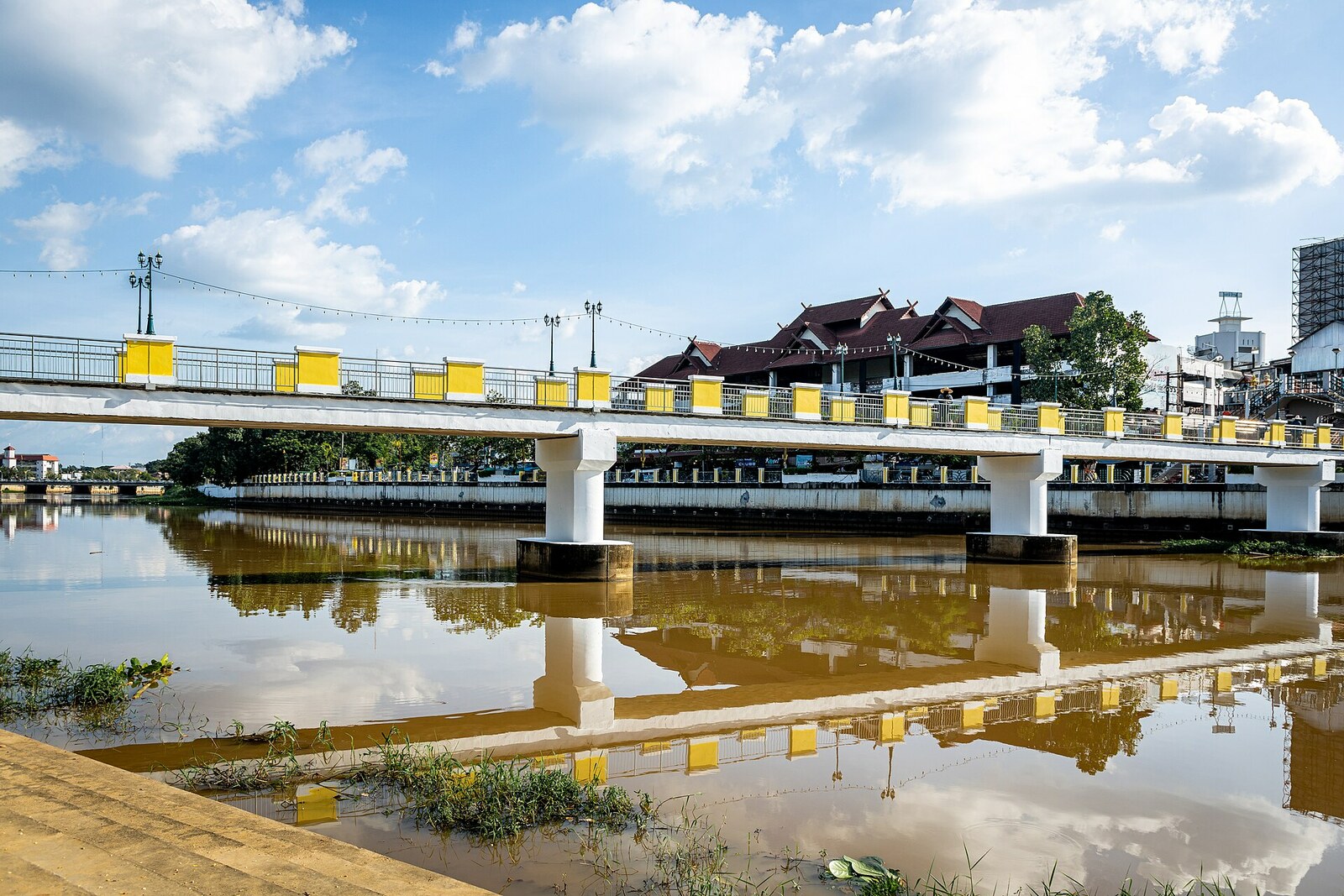
Look around first
What to notice
- Pedestrian span across the Ping River
- Plaque bearing Chansom's name
- Concrete piers
- The crossing line between the markets and Wat Ket
The story of the place
The pedestrian span over the Ping River links the commercial quarters by the markets with the Wat Ket bank. The current bridge stands on the former crossing line: concrete piers and decking replaced the old damaged structure. When there was no permanent crossing here, residents wove a bamboo deck over the river, and during high water they were left with a detour to another bridge or the cost of boatmen. The plaque by the entrance preserves the name under which this crossing became reliable.
Chansom Kosalapirom was the wife of the cloth merchant Motiram Korana (Montri Kosalapirom), who took that name in Thailand. He began as a traveling trader, carrying cloth by bicycle through the villages around Chiang Mai. In one of them, Motiram met Chansom. After their wedding, the couple opened Chiang Mai Store near Kad Luang, the market district of Warorot and Ton Lam Yai markets.
Opposite the store, the shortest route to the Wat Ket community ran across the Ping River. There was no permanent bridge here then. Residents built a crossing from woven bamboo and called it Khua Tae. During high water, the river carried away the decking, after which people had to make their way to another bridge or pay boatmen. Montri used this crossing regularly and saw what happened after every rise of the river.
When Chansom died, he decided to build a reliable pedestrian crossing here and dedicate it to his wife. In nineteen sixty-four, Montri gave the municipality two hundred thousand baht—two-thirds of the sum required. Luang Si Prakat, the mayor of Chiang Mai, collected the remaining one hundred thousand from townspeople and traders. With that, the personal donation was enough to build a concrete bridge, completed in nineteen sixty-six. It was given the name Chansom Memorial Bridge—“in memory of Chansom.”
The bridge also acquired a second name: Khua Khaek. In Northern Thai, khua means bridge, and khaek was the word local residents then used for people from India and Pakistan. The official name recalled Chansom; the colloquial one recalled the origins of the man who paid for most of the construction.
The original concrete bridge is no longer there. After the flood of two thousand eleven, its piers subsided, and the municipality dismantled the damaged structure. The current crossing opened in two thousand sixteen on the same alignment between the markets and Wat Ket. Chansom's name remains on the plaque; the name Khua Khaek recalls Montri, his bicycle trade in cloth, and the two hundred thousand baht.
Useful on site
The pedestrian bridge is open as a city crossing; after heavy rain, check the condition of the approaches on site.
Checked: June 26, 2026. Check the official source before visiting.Keep to your side of the decking, and do not stop on the narrow passage for prolonged photography. In hot weather, the bridge is especially exposed to the sun.