 Guide On Map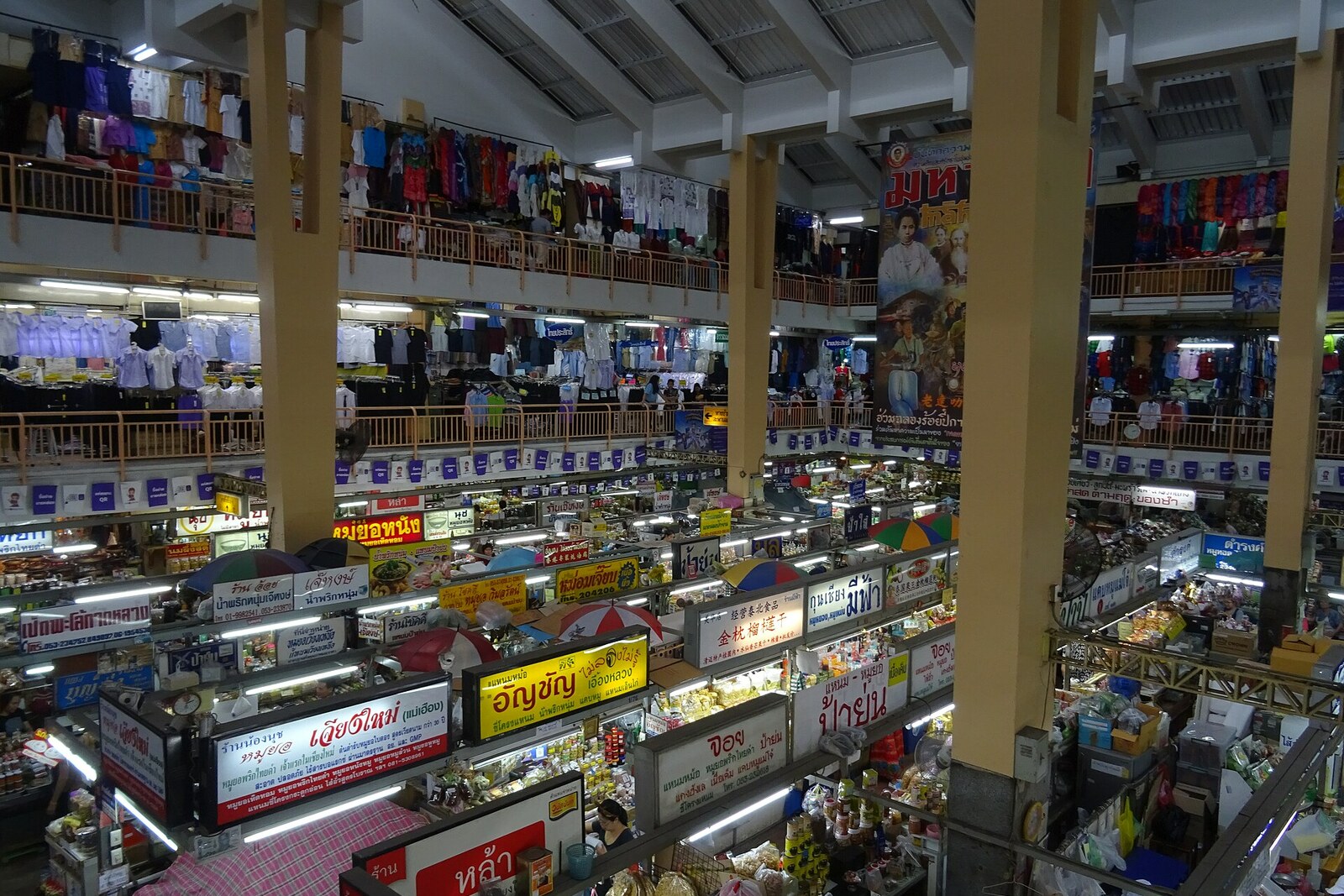
Look around first
What to notice
- The three-story market building
- Basement market rows
- A sign with the name Warorot
- Stalls with northern products
The story of the place
The present concrete building, with shops on three levels and an underground level, stands by the Ping River on land where the rulers of Chiang Mai were once cremated. Nearby, the ashes of members of the dynasty were kept in funerary stupas, so the site remained part of a funerary space rather than river trade for a long time. Nothing remains of the former wooden market: the present building was constructed only after fire destroyed the old market rows.
The three-story building of Warorot Market and its basement contain around five hundred retail stalls. Fresh food, clothing, school uniforms, bed linens, kitchenware, herbs, festival goods, and northern specialties such as sai ua sausage and nam phrik num paste are sold here. In the northern dialect, the name Kad Luang can be understood as both “big market” and “ruler’s market.” Both meanings arose here from one family story.
Before the beginning of the twentieth century, trade on this site was impossible. By the bank of the Ping River stood Khuang Meru, a square where the rulers of Chiang Mai were cremated. Nearby stood funerary stupas containing the ashes of members of the dynasty. In nineteen oh nine, Dara Rasmi arrived here. She was the daughter of one of the rulers buried here and the wife of Chulalongkorn, the king of Siam. At her direction, her ancestors’ ashes were moved to Wat Suan Dok.
Dara cleared the site at a time when the family needed a new source of income. Siam was placing Chiang Mai under direct rule, and the local rulers’ tax revenues were shrinking. The land lay by the Ping River, in a quarter of river trade where merchants had already begun to settle. In nineteen ten, Prince Kaew Nawarat invested money in the construction of a permanent market. The market was then bought by Inthawarorot Suriyawong, the ruler of Chiang Mai at the time. The official name “Warorot” came from an abbreviated part of his name.
After Inthawarorot’s death, his son Lao Kaeo inherited the market. In nineteen nineteen, he needed money for his mother’s funeral and mortgaged Warorot to a city merchant. The heir was unable to redeem the mortgage. He faced a lawsuit, and the family was losing a plot of land that was already bringing income to its many relatives.
Lao Kaeo turned to Dara Rasmi for help. By then, she was the senior princess of the House of Chiang Mai and was responsible for relatives whose former incomes were disappearing along with the old order. In nineteen twenty-three, Dara asked Vajiravudh, the king of Siam, to grant her two hundred fifty thousand baht from the treasury so that she could redeem the market herself.
She proposed repaying the debt from her personal annual payments, about thirty thousand baht. Dara divided the future income in advance into eight shares: six were intended for the family, one for a shrine on Doi Suthep, and one more for a school. The king’s officials supported the request. Their conclusion stated directly that it was more advantageous for the Siamese court to support the princes of Chiang Mai itself than to force them to seek other patrons.
The market was redeemed. Dara Rasmi managed it for about ten years, until her death. The wooden building from her time no longer exists: on February thirteenth, nineteen sixty-eight, a fire destroyed Warorot along with the neighboring market rows. The present concrete building opened in nineteen seventy-two.
It occupies the same site as the former cremation square. The sign still bears Inthawarorot’s name, while vendors still say Kad Luang: “big market” or “ruler’s market.”
Useful on site
A city market with changing shop hours; it is best to come in the morning or during the day and check individual shops on site.
Checked: June 26, 2026. Check the official source before visiting.Walk slowly and do not block the narrow passages: this is a working market, not a museum display. It is best to shop and have a snack here while there is still a choice.