 Guide On Map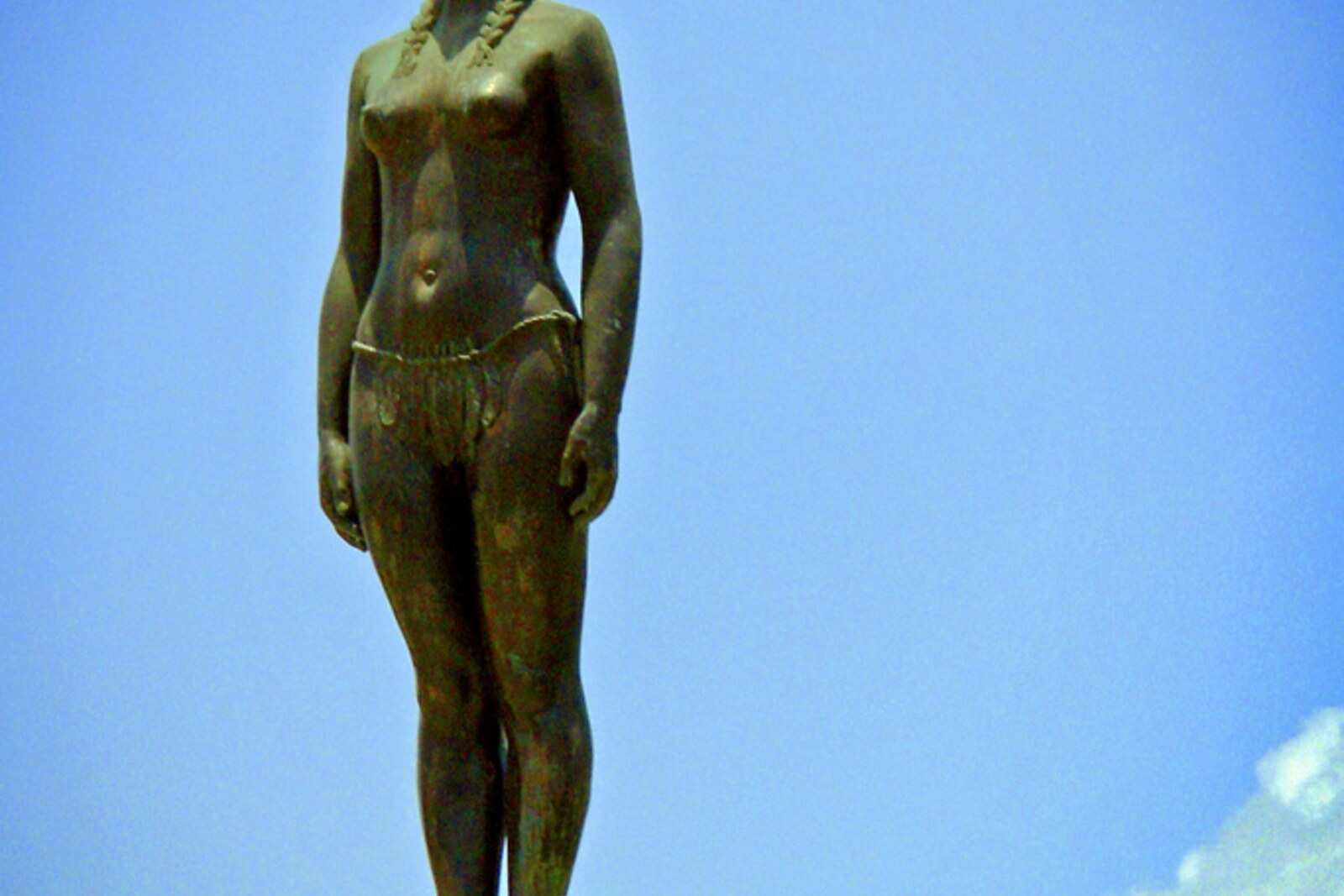
Look around first
What to notice
- Bronze figure
- Stone pedestal
- Signature "Eladio Gil"
- Date on the base
The story of the place
The three-meter bronze figure was not a portrait of India Catalina: no one knows what she looked like. The image familiar to Cartagena was conceived in nineteen sixty-one, when Víctor Nieto, founder of the city film festival, was looking for an image for its main award. On Cartagena's coat of arms, he saw an Indigenous woman sitting beneath a palm tree and suggested that the sculptor Héctor Lombana set her on her feet. That is how the festival statuette appeared.
Thirteen years later, the city commissioned an enlarged version from the sculptor Eladio Gil. Sixteen-year-old Judith Arrieta posed for it. The daughter of farmers who grew cassava, yams, and bananas, she came to Cartagena at the age of twelve and worked as a nanny for the Gil family. The sculptor obtained her parents' consent, screened off part of his yard with a curtain, and spent three months sculpting the figure, first in clay and then in plaster. He composed the face from the features of several models, but reproduced Judith's body. So before us stands a monument to Catalina with the body of another woman, whose name is not written on the pedestal.
The historical Catalina was a girl of the Mokaná people, abducted around fifteen oh nine from the village of Zamba by the conquistador Diego de Nicuesa. She was taken to the island of Hispaniola, where Haiti and the Dominican Republic are now located. There she learned Spanish, converted to Christianity, and adopted Spanish customs.
In fifteen thirty-three, Pedro de Heredia, the leader of an expedition intending to found a Spanish settlement here and search for gold, found Catalina in Gaira. He needed an interpreter who knew the languages of the coast and was related to local chieftains. A chronicler reports that Catalina conveyed the newcomers' terms to them and persuaded them not to fear captivity. Her negotiations helped Heredia's men establish themselves on Cartagena Bay and begin expeditions inland.
Catalina lived with Heredia and accompanied his expeditions, but in fifteen thirty-six she testified against him. A Crown judge was then conducting a "residencia trial"—a review of a governor during which residents could report his violations. Catalina recounted how, on one occasion, Heredia ordered all the servants to leave for the night, while telling her to prepare stockings, boots, an iron bar, and a hoe. In the morning, the boots were wet and covered in sand, the tools had disappeared, as had a large clay container washed the day before. A chest of gold that she had seen earlier was also gone. She did not see the removal itself: a servant told her that Heredia and his relatives had carried off the gold during the night.
A year later, Catalina repeated her testimony. She was one of several accusers; the judge removed Heredia from office and placed him in custody. Later, he secured an acquittal in Spain and returned as governor. After the second interrogation, Catalina disappears from the records: it is unknown where and when she died.
Eladio Gil originally installed the bronze figure at the end of Pedro de Heredia Avenue, at the entrance to the center. In two thousand six, it was moved twelve meters to make way for the city bus route. The sculptor objected to the cramped new location, but agreed to the plan for a spacious square in Puerto Duro. He died in January two thousand eleven without seeing the result. In July, his family attended the statue's relocation here: facing the old city, with its back to San Felipe.
The stone base still bears the signature "Eladio Gil" and the year of creation. At this spot, the bronze Catalina has stood since two thousand eleven; her pose originated in the festival statuette, while her body belongs to Judith Arrieta.
Useful on site
Open urban space; it is safer to view it from the edge of the sidewalk.
Checked: June 26, 2026. Check the official source before visiting.View the monument from the pedestrian side and do not linger near the roadway. Entry to the fortress is not needed for this stop.