 Guide On Map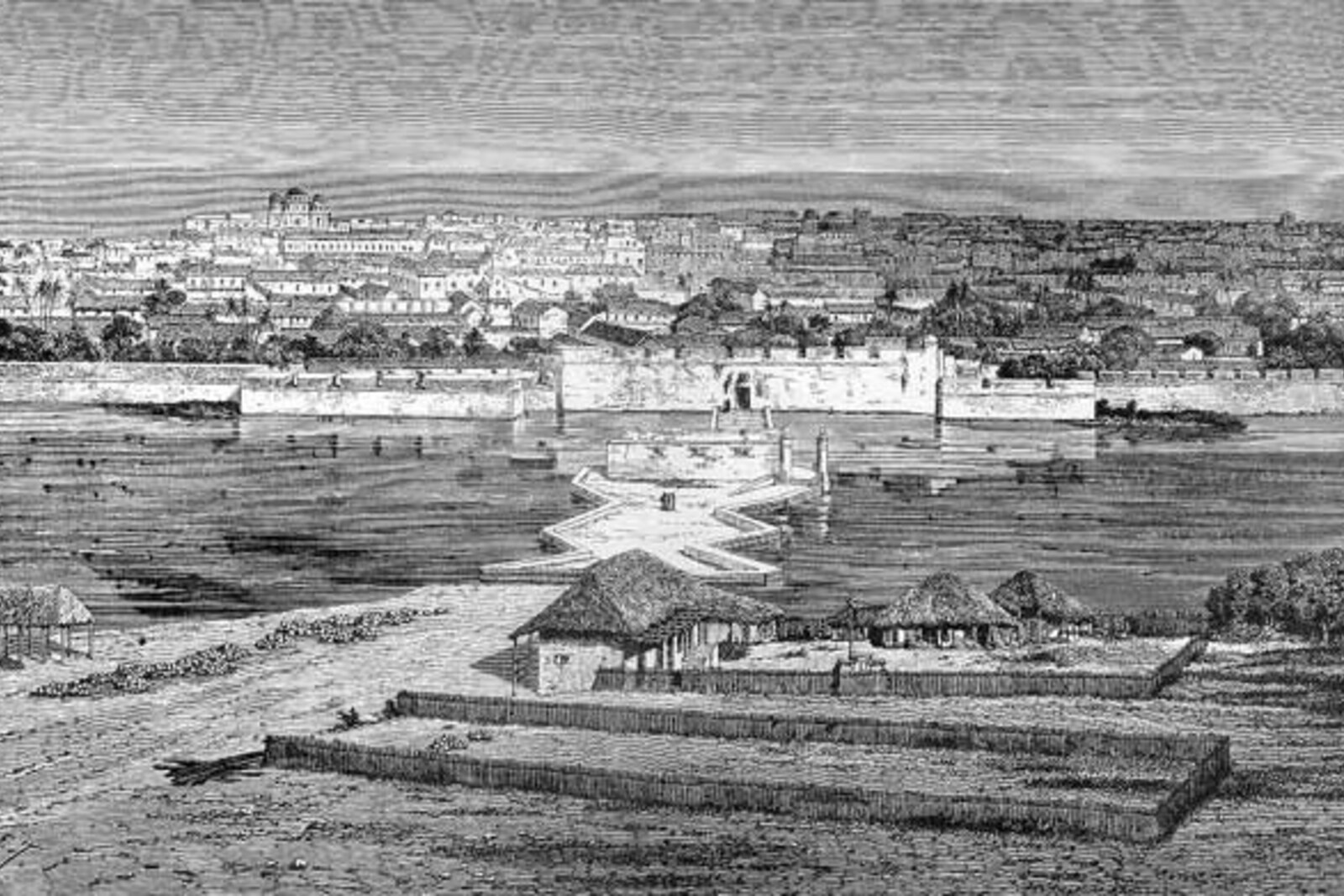
Look around first
What to notice
- Bridge span
- Broad roadway
- Stone retaining walls
The story of the place
The span of Heredia Bridge and the broad road pass above the remains of the ravelin, whose foundations are hidden below, while pieces of the old approach form the stone retaining walls. When Old Cartagena and Getsemaní were surrounded by water, an embankment with the only dry connection between them ran here. The approach to the city was made slow: three water-filled moats, wooden crossings, and a winding passage allowed only one carriage through. Goods and food were brought through this bottleneck, and one of the bridges was raised at night.
In June eighteen eighty-three, the national congress authorized the municipality of Cartagena to dismantle the ravelin that stood here. The law immediately explained why: the stone could be used for a new bridge, and the road could be widened.
Before that, people passed here through a structure deliberately designed to obstruct movement. Old Cartagena and the suburb of Getsemaní lay amid water. The only overland route to them ran roughly along the line of today’s Heredia Bridge. First, the traveler encountered a concave artillery battery facing the road. Its outline gave the fortification the name Media Luna—the Crescent. Then came three water-filled moats with wooden crossings. In the middle of the embankment stood the ravelin—a small, separate fort before the main line of defense. A winding passage was left between its walls, with barely enough room for one carriage. One of the bridges was raised at night.
This was the very route by which food and goods were brought into the city. Those arriving after the gates closed remained outside with their horses and cargo. As long as attacks remained possible, the delay benefited the defenders: a wagon that found it difficult to turn between the walls would also obstruct the soldiers. But by the end of the nineteenth century, those same turns, moats, and narrow passage delayed the drivers and merchants traveling between Cartagena, Manga, Turbaco, and Mompox.
City leaders pressed for a direct passage. Congress transferred the state-owned ruins to them and allowed them to dispose of the recovered stone. In eighteen eighty-three, workers dismantled the ravelin. Behind it, the Media Luna Battery disappeared, the moats were filled in, and the old embankment was straightened. The stretch that for several centuries had forced everyone to slow down and pass beneath the guns was turned into a broad road.
The name of the present bridge is connected with Pedro de Heredia—the Spanish founder of Cartagena, already familiar from the story of India Catalina. A statue of him was to be erected on the Heredia Promenade laid out here. In nineteen fifteen, they even laid the first stone of the monument, but the bronze figure appeared only in nineteen sixty-three, and in another location; it now stands in Plaza de los Coches.
The ravelin itself has almost vanished from the surface. Its surviving foundations are hidden beneath Heredia Bridge, while separate fragments of the old approach were incorporated into the retaining walls. Traffic passes over the site of the dismantled fort—the traffic for which Congress had authorized stone to be removed from here.
Useful on site
Open urban space; access depends on traffic conditions and work around the bridge.
Checked: June 26, 2026. Check the official source before visiting.View the site from a safe pedestrian spot: heavy traffic does not allow you to look for a better angle on the roadway. Do not go down to the foundations for a close-up.