 Guide On Map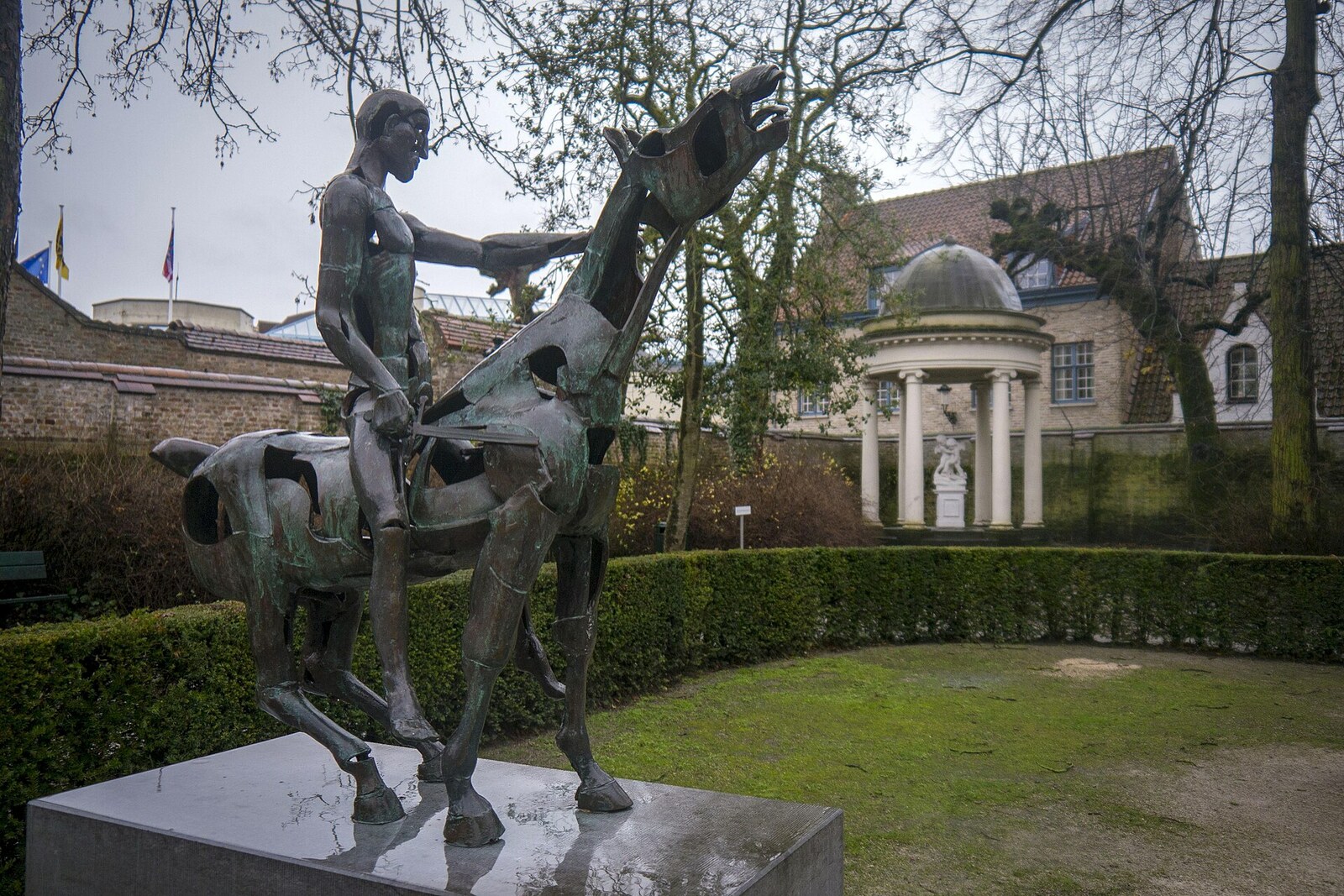
Look around first
What to notice
- Four bronze riders
- A bow in the rider’s hand
- A raised sword
- Scales for grain
The story of the place
A path runs between the Gruuthuse Museum and the Groeninge Museum; four bronze riders stand in a semicircle along its edge. Rik Poot cast them himself using lost-wax casting: human and horse bodies are assembled from thin plates, in places almost pierced through, and the bronze shell is only a few millimeters thick. A bow, a sword, scales for grain, and empty eye sockets distinguish Revolution, War, Famine, and Death, as Bruges calls this group. The city acquired it for the open extension of the museum route.
Aquilin Arents de Beertegem left the white mansion above the canal against his will. He was the last man in an old Bruges noble family, owned numerous estates, and lived here with his wife and two daughters. The house and the walled English garden formed part of the family’s wealth. This space did not exist for passersby.
At the beginning of the twentieth century, the city authorities planned to link the property of the Gruuthuse Museum with the future Groeninge Museum. The private garden lay exactly between them. From nineteen oh six to nineteen oh eight, the city expropriated the estate. An archival description speaks directly of Arents’s furious discontent. He bought another large house, Hof van Maldegem on Garenmarkt, moved there, and lived there until his death in nineteen twenty-three. He was not left without a roof over his head, but he could not keep his house above the canal.
The city engineers turned the acquired plot into a passage. They cut a gate through the southern wall, lowered the wall by the water, laid out a path between the museums, and built Boniface Bridge where a lock had previously stood. In nineteen eleven to nineteen twelve, the private garden became public. Its name was kept from the surname of the man from whom it had been taken: Hof Arents—Arents’s court.
The semicircle of stone pedestals appeared here later. The city acquired four bronze sculptures by Rik Poot, on which the artist worked from nineteen eighty-one to nineteen eighty-seven. On December nineteenth, nineteen eighty-seven, Mayor Frank Van Acker unveiled the group specifically in the former private garden, which already served as an open extension of the museum route.
Poot could cast bronze himself: from the age of fourteen, he helped in his father’s foundry workshop, then mastered lost-wax casting. This technique made it possible to assemble the bodies of people and horses from thin plates, in places almost pierced through. The bronze shell here is only a few millimeters thick. Numbers such as “four of six” on the backs of individual figures indicate the casting number in the artist’s series, not a date.
Bruges calls the riders Revolution, War, Famine, and Death. They can be distinguished without a plaque. Revolution holds a bow, War a sword, Famine scales for measuring expensive grain; Death has empty eye sockets and an emaciated face. In the sixth chapter of the Book of Revelation, the first rider is described more cautiously—as a crowned victor with a bow—so art historians also call Poot’s figure the Crowned One. The other attributes follow the biblical text: the sword takes away peace, the scales measure wheat and barley, and the fourth rider is the only one named there—Death.
All four stand along the path that the city laid through Arents’s garden. Under the name Hof Arents, people still pass through the property that Aquilin Arents did not want to give up.
Useful on site
An open garden space with the Visit Bruges calendar; exact hours may vary by day.
Checked: June 28, 2026. Check the official source before visiting.This is an open-air stop, so keep rain and slippery paths in mind. View the riders from different sides, without stepping onto the lawn or touching the sculptures.