 Guide On Map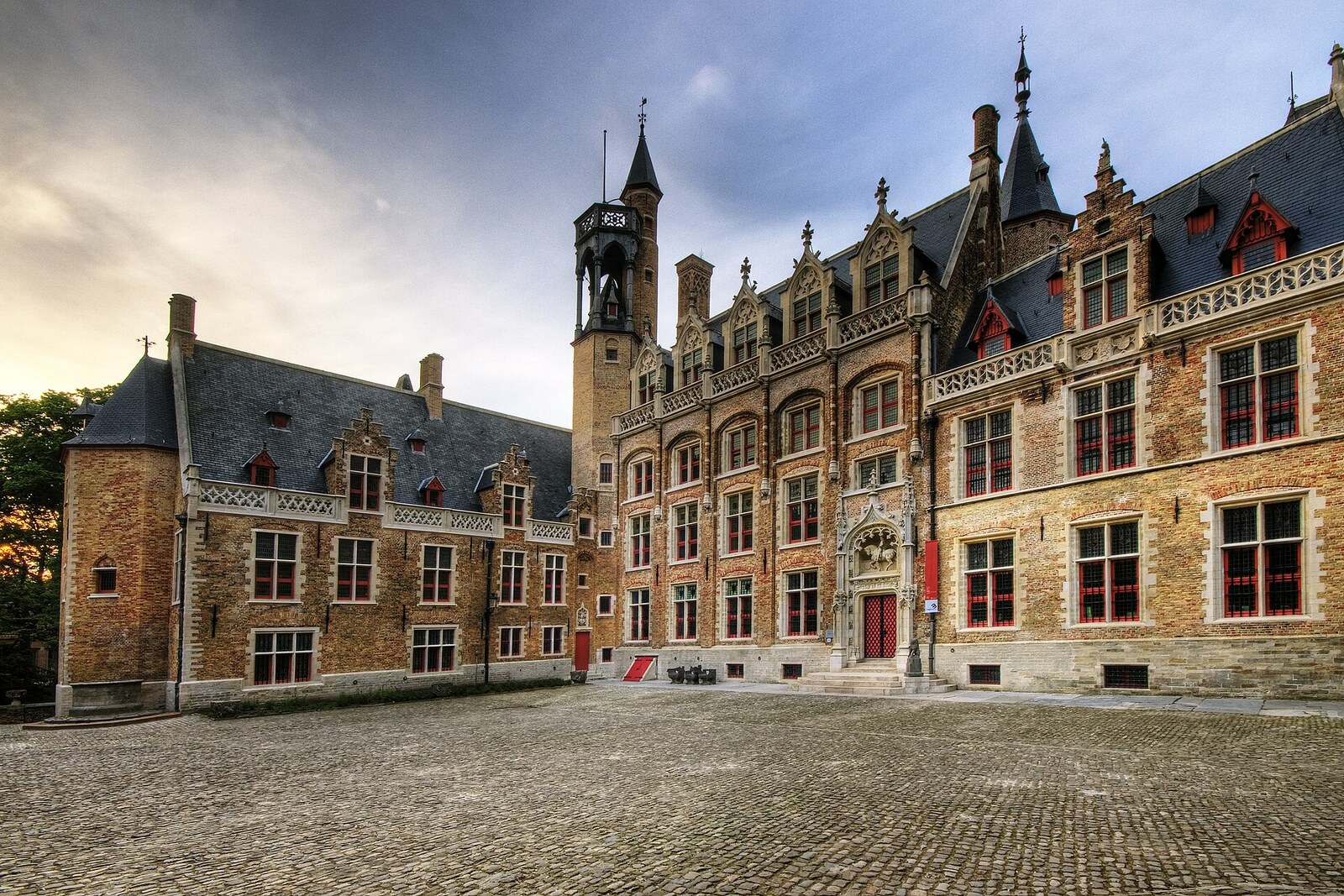
Look around first
What to notice
- Portrait of Lodewijk van Gruuthuse
- Late Gothic chapel
- Passage to the church choir
- Equestrian statue above the entrance
The story of the place
The brick wings around the courtyard date from the fifteenth century, although their appearance is not entirely medieval. Above the entrance stands an equestrian figure installed only at the beginning of the twentieth century; the turrets, windows, and part of the façades appeared during the great restoration of the nineteenth century. These halls now house the municipal museum of Bruges history and applied arts, which grew out of Bruges’s archaeological collections. The palace is still connected to the choir of the Church of Our Lady by a Late Gothic chapel and a passage.
The word “Gruuthuse” means “house of gruit.” Gruit was a mixture of herbs used to flavor beer before hops became widespread. In the fourteenth century, the owners of this plot received the exclusive right to sell the mixture and collect a levy on almost every barrel brought into Bruges or brewed in the city. This was where the house stood in which that beer tax was collected. The family took its name from it, and with the income from the gruit right, Lodewijk van Gruuthuse turned the family estate into a city palace.
In the autumn of fourteen seventy, a man whose palace had already been taken from him came to Lodewijk. England’s King Edward IV lost his throne during the Wars of the Roses. His former ally Richard Neville, Earl of Warwick, went over to his opponents and restored the crown to the deposed Henry VI. Edward fled across the North Sea with almost no money, leaving his pregnant wife and children to seek refuge in Westminster. He now needed ships, soldiers, and credit to return.
Lodewijk was governor of Holland in the service of the Duke of Burgundy. He met the fugitive king after Edward landed in Alkmaar and escorted him to Flanders. The choice of intermediary was exact: Edward’s sister was married to the Burgundian duke Charles the Bold, while Lodewijk belonged to the duke’s inner circle and could bring the guest to the right people.
From January thirteenth to February nineteenth, fourteen seventy-one, Edward lived in this very palace. He had to be received as a king, although at that moment he had neither a kingdom nor an income. The people of Bruges supported his retinue, and at Charles the Bold’s request, the city council granted Lodewijk a separate subsidy for the costs of hosting him. The host himself could afford such demonstrative generosity: besides his estates, he continued to receive the gruit levy on the city’s beer.
Charles the Bold supplied his brother-in-law with money and ships. In March, Edward sailed for England, gathered supporters, and defeated his opponents at Barnet and Tewkesbury. Warwick was killed, Henry VI was imprisoned again, and Edward regained the crown.
A year later, Edward invited Lodewijk to England and made him Earl of Winchester. For a foreigner, this was an exceptional grant; the title came with an annual income from the customs duties of Southampton. Thus the beer tax of Bruges helped support an exiled king, and the restored English king added another customs income to the master of Gruuthuse. A portrait of Lodewijk, painted around fourteen eighty, now hangs in the museum gallery: he is already the master of the palace with an English earldom.
The museum itself appeared much later and does not house Lodewijk’s personal collection. In the nineteenth century, the palace fell into decline. The Bruges Archaeological Society secured the city’s purchase of the building for its collections. The city acquired Gruuthuse in eighteen seventy-five, and the architect Louis Delacenserie then spent almost twelve years rebuilding it according to his era’s idea of a Gothic palace: restoring towers, changing windows, dismantling later additions, and redesigning the façades. In nineteen oh three, an equestrian figure of Lodewijk was placed above the entrance. The sculptor Gustave Pickery, commissioned to depict the owner, used a statue of the French king Louis XII as his model.
In nineteen fifty-five, the city also received the archaeological collection for which it had once bought the palace. This created the municipal museum of Bruges history and applied arts. Its brick wings date from the fifteenth century, but many turrets, windows, and courtyard details are the work of nineteenth-century restorers. Inside this restored Middle Ages, two direct signs of Lodewijk remain: his real portrait and a chapel connected by a passage to the choir of the Church of Our Lady.
Useful on site
09:30-17:00; closed on Wednesdays; check Musea Brugge’s calendar for holiday exceptions and events.
Checked: June 28, 2026. Check the official source before visiting.The façade and the palace’s connection with the neighboring church can be understood from outside; the rooms and museum objects require a separate visit. Whether you can see the chapel and individual exhibits depends on which museum spaces are open.