 Guide On Map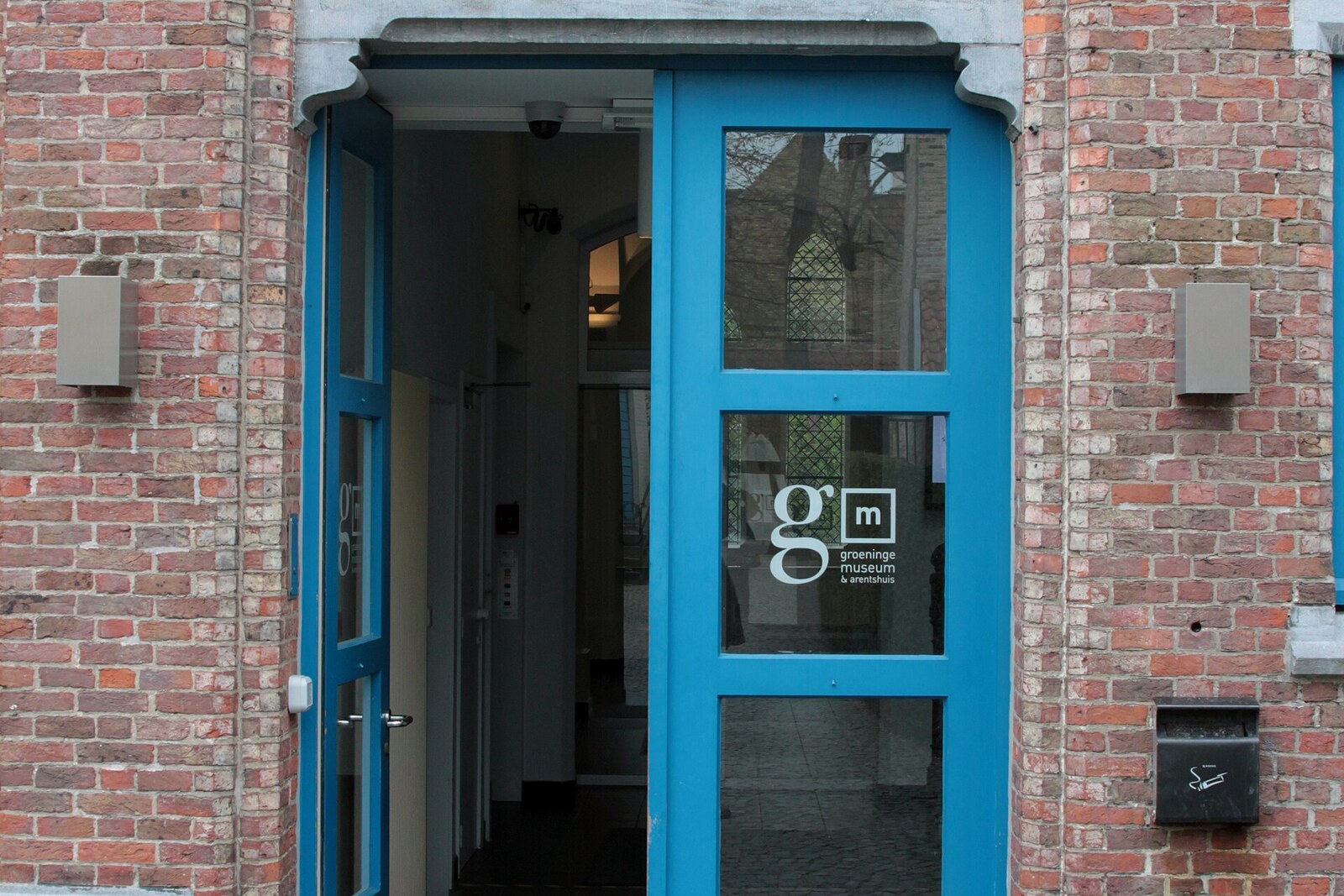
Look around first
What to notice
- Madonna with Canon Joris van der Paele
- Oak frame with inscriptions
- Spectacles in the canon's hand
- The patron's swollen fingers
The story of the place
The Groeninge Museum holds the city's collection of early Netherlandish painting. Before it had galleries of its own, the paintings had been housed in the building of a guild, a school, and a former chapel; among them is an oak panel in an oak frame with inscriptions. The site belonged to Eekhout Abbey, but after the French administration dissolved it, the buildings were dismantled, and nothing of the religious house survived above ground. The museum's name comes from the old Groeninge Quarter, which is associated with an oak grove.
The Groeninge Museum's main painting had a patron who paid in advance for his own commemoration. Joris van der Paele served as a canon at the Church of St Donatian—a member of its clerical chapter, receiving income from church offices assigned to him. Before returning to Bruges, he worked in the papal chancery and amassed a fortune. By fourteen thirty-four, his health no longer allowed him to carry out his duties.
Van der Paele ordered a chaplaincy to be established at the church: he transferred money and property, while priests were to serve three times a week for the salvation of his soul, including a requiem mass. After his death, penitential prayers were to be read and the grave sprinkled with holy water. For the altar, the canon commissioned Jan van Eyck to make a large painting on an oak panel.
Van Eyck portrayed the patron without posthumous embellishment. The canon has heavy eyelids, a furrowed face, and swollen fingers; in one hand he holds a prayer book, in the other, spectacles. Beside him, St George presents him to the Madonna and Child, while St Donatian recalls the church for which the work was intended. On the surviving frame, the artist wrote the patron's name, his own name, and what had been paid for. Van der Paele died in fourteen forty-three. He was buried beside this altar, and the paid-for services continued over his grave.
In seventeen ninety-four, French troops occupied the Southern Netherlands. Commissioners sent by the republican administration seized around two hundred works of the Flemish school from churches and public buildings. Along with paintings by Hans Memling and Gerard David, Madonna with Canon Joris van der Paele was sent to Paris. It was displayed at the Louvre. The Church of St Donatian was soon dismantled; both the patron's chapel and his grave disappeared.
Joseph-Denis Odevaere, an artist from Bruges, took charge of bringing the Bruges paintings back. In eighteen fifteen, he was assigned to search for the works that had been taken away. He knew the Paris art world well: he studied there, received the Prix de Rome, painted commissions for Napoleon's court, and was awarded by Napoleon himself. After Napoleon's fall, Odevaere became court painter to King William the First of the Netherlands and used his new position in negotiations for their return.
In eighteen sixteen, the Madonna was brought back. The city council awarded Odevaere a gold medal, but restoring the painting's former purpose was impossible: the altar and the church no longer existed. Staff of the Bruges Academy of Fine Arts accepted the panel into their collection. The city's paintings were then moved from one adapted space to another: they were shown in the building of the burghers' guild, in a school, and in a former chapel.
In eighteen sixty-one, the scholar James Weale compiled a scholarly catalogue of the academy museum. From archival documents, he restored the names of forgotten artists, among them Gerard David and Jan Provoost, and clarified information about Van Eyck and Memling. Members of the Academy received the English visitor's work coolly, but Weale continued publishing his findings. When a huge exhibition of early Netherlandish painting was prepared in nineteen oh two, he wrote the catalogue for its painting section.
The exhibition was to be held in Brussels, but Bruges refused to send many of its works there. The organizers had to move the project to Bruges's Provincial Court. Nearly four hundred paintings were assembled there; over several months, more than thirty-five thousand people saw them. After the exhibition, townspeople founded a society of friends of the museums, pressed for a permanent building, and helped buy new works.
In nineteen thirty, the city opened the Groeninge Museum, designed by the architect Joseph Viérin, and for the first time brought the scattered collection together in purpose-built galleries. The site of Eekhout Abbey was chosen for the building. The French administration dissolved this religious house in seventeen ninety-six, after which people began dismantling its buildings. Nothing of the abbey remained above ground here.
The museum took its name from the old Groeninge Quarter, mentioned as early as around twelve hundred; it is associated with an oak grove that once occupied this part of Bruges. The grove disappeared, like Eekhout Abbey and the Church of St Donatian. Inside the museum, van der Paele still kneels in a frame bearing his own name—before an altar that no longer exists.
Useful on site
1 Apr-2 Nov: 10:00-18:00; 3 Nov-31 Mar: 09:30-17:00; closed on Mondays, with holiday exceptions.
Checked: June 28, 2026. Check the official source before visiting.A meaningful stop requires entry to the museum; check the availability of particular galleries and works before your visit. Do not try to take in the entire collection: the account is built around several works.