 Guide On Map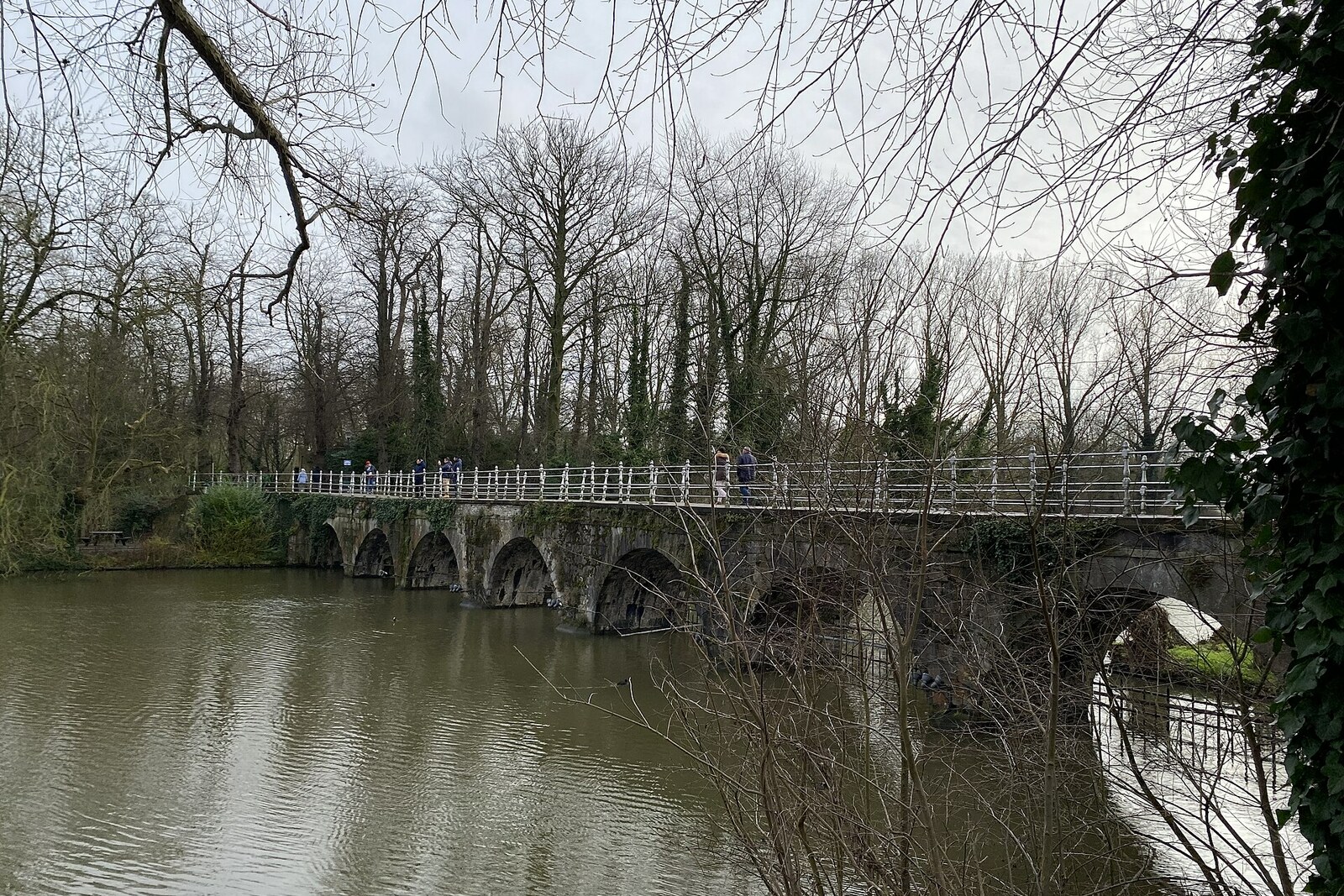
Look around first
What to notice
- Seven stone arches
- Stonework of the middle span
- Round Gunpowder Tower
- Fortified banks
The story of the place
A wooden span once rose in the middle of the present stonework. The bridge let vessels into Minnewater, and people crossed its deck between two sections of the city wall. Towers stood at either end: together with the bridge, they formed a water gate and blocked the southern entrance to Bruges. One survives—the round Gunpowder Tower by the shore.
From sixteen twenty-three, a passenger barge from Ghent arrived here every day—a long vessel towed from the shore by two horses. The States of Flanders, the provincial assembly, set departure times, fares, and traffic rules. If the barge owner was half an hour late without a valid reason, he was fined; oncoming vessels gave way and lowered their masts beneath the towline.
The journey to Ghent took eight hours. The cabins held up to sixty people, lunch was prepared on board, and baggage was accepted according to a detailed tariff. A ticket cost fifteen stuivers—small coins. An unskilled worker earned eleven or twelve a day, yet traveling by carriage cost even more. In seventeen ten, more than thirty-one thousand paying passengers traveled between Bruges and Ghent.
A quarter of an hour before departure, children from a school for the poor rang a bell at the quay. Passengers came out of the taverns, porters from Mariabrug carried trunks and baskets, and the barge owner sold tickets. The surrounding inns lived mainly from these people. Minnewater served as the city's railway station two centuries before the railroad.
When, in seventeen thirty-nine, the magistracy commissioned the architect Hendrik Pulinx to replace the wooden crossing with a stone one, the shipping channel had to be preserved. Pulinx built seven arches and left the middle span liftable. The stone section connected the fortified banks; the wooden one cleared the way for the barge.
In seventeen eighty-four, officials moved the quay to Katelijnepoort—there it was easier for the vessel to turn around and dock. The bell, the porters, and the crowd before departure went with it. After the railroad appeared in eighteen thirty-eight, the former passenger service lost its importance; private night barges lasted until nineteen oh-nine. The lift span was later bricked up. There is no longer a quay by the bridge.
But now people cross Lovers' Bridge for the promise of eternal love. This belief is often called ancient, but the romantic story of Mina and Stromberg was invented by a particular person. In eighteen thirty-four, the Bruges librarian and archivist Joseph Octave Delepierre published a collection of historical novellas. He titled the first one “The Lake of Love, or Stromberg and Mina.”
In his plot, Mina's father wanted to marry her to a groom he had chosen while her beloved Stromberg was at war. The girl ran away and died by the water shortly before his return. Stromberg buried her in a drained riverbed and carved the word “Minnewater” into a stone. This is Delepierre's literary invention. About ten years later, the collector of traditions Jacob Wolf checked the story's origin and explicitly called it made up.
The story continued to be reprinted. In nineteen thirty-eight, Hugo Vrielynck included it in a collection of Bruges legends, citing the author only by his initials. Delepierre's name disappeared, and his novella began to be retold as a folk legend. The name Minnewater existed long before the book: researchers link it either to communal water or to an old word meaning “water spirit.”
There is no grave of Mina on the bridge, nor a stone bearing her name. There is a lift span bricked up with stone, a vanished quay, and couples who pass through the former water gate hoping that the archivist's invention will work after all.
Useful on site
A freely accessible city bridge; check only the weather and the condition of the paving.
Checked: June 28, 2026. Check the official source before visiting.Stop where you will not obstruct passage, and compare today's unbroken bridge with the story of its movable middle.