 Guide On Map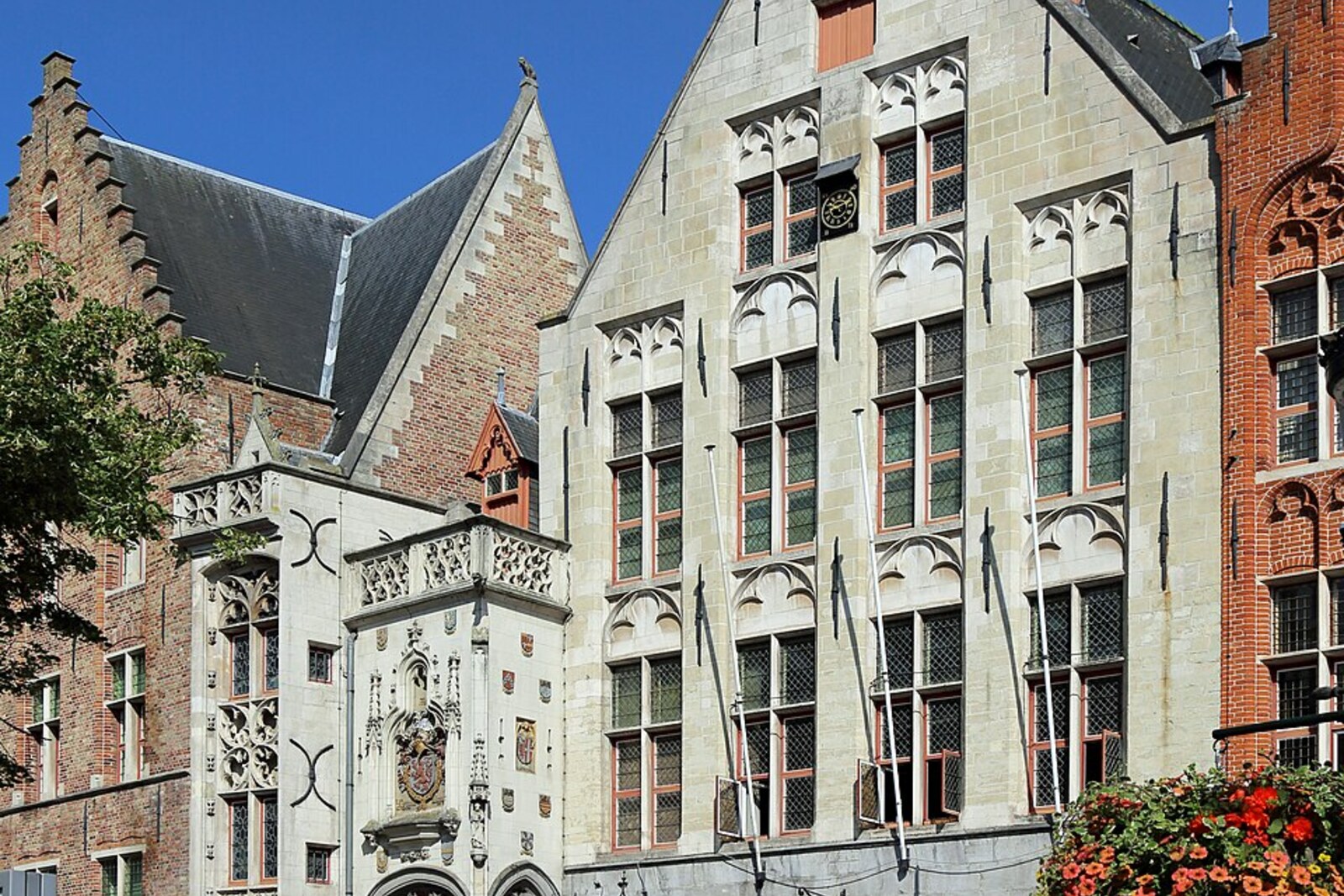
Look around first
What to notice
- Stone gable of the Tolhuis
- Narrow facade of the rijkepijnders' little house
- Stone porters
The story of the place
In the Middle Ages, this was the office of Bruges's Great Toll, through which goods arriving by water from other cities and countries were handled. Barrels and bales were first carried to the scales: the levy was set by weight, and then the cargo was sent to the city warehouse. The stone gable of the Tolhuis stands beside the cramped facade of the rijkepijnders' room; beneath the carving, figures of porters still bend under their loads. In eighteen seventy-nine, both facades were rebuilt, preserving side by side the large office and the small room of people whose work began at the quay.
In fourteen ninety-four, a dispute at these gates concerned barrels of butter. Merchants from Poperinge bought it for making woolen cloth: the fat was used to lubricate the fibers so that they would not become tangled during processing. The magistracy of Poperinge kept four of its own porters in Bruges. They were responsible for their fellow townspeople's goods—guarding them and carrying them between the quay, the scales, and the warehouse. Every delivered barrel was their income.
But the Bruges association of rijkepijnders also claimed that income—the holders of the city's right to control the carrying and weighing of cargoes. They cited an ordinance of fourteen eighty-three: all imported butter had to be delivered to the weigh house, and the rijkepijnders were due one and a half groots, a small coin, from a full barrel and one groot from a half-barrel. Nine years later, the Bruges magistracy confirmed that the rule also applied to visiting merchants. After that, the people of Bruges took the transport and weighing of butter away from the four Poperinge porters.
The magistracy of Poperinge began proceedings. Its representatives argued that the right to appoint these four men had belonged to their city since long ago; even a post left vacant by a porter's death was filled in Poperinge. The decision was made in their favor: the Bruges ordinance was declared inapplicable to the people of Poperinge. The four porters kept their work, while the Bruges rijkepijnders lost the payment from the barrels handled by the four porters.
Such a dispute could have arisen precisely here. Tolhuis means “Toll House.” In medieval Bruges, it was the office of the Great Toll on goods in interregional and international trade. Cargo had to be brought from the water to the scales: the levy was set by weight, after which the goods could be carried farther, to the city warehouse. The building was already serving as this office in the early fourteenth century, and the room of the rijkepijnders was added beside it.
The medieval facade has not survived intact to the present day. Both the stone gable of the Tolhuis and the narrow little house of the rijkepijnders on the left were rebuilt in eighteen seventy-nine. Their juxtaposition was nevertheless preserved exactly: the large weighing office and the cramped room of people whose income depended on every barrel passing through it. Under the carving of the small facade, stone porters still bend beneath their loads—the work over which two cities went to court in fourteen ninety-four.
Useful on site
Free exterior viewing; interior access is not needed for the route.
Checked: June 28, 2026. Check the official source before visiting.Compare both buildings together: the small house explains the human labor, the large one the system of accounting. Do not linger directly in front of the doors.