 Guide On Map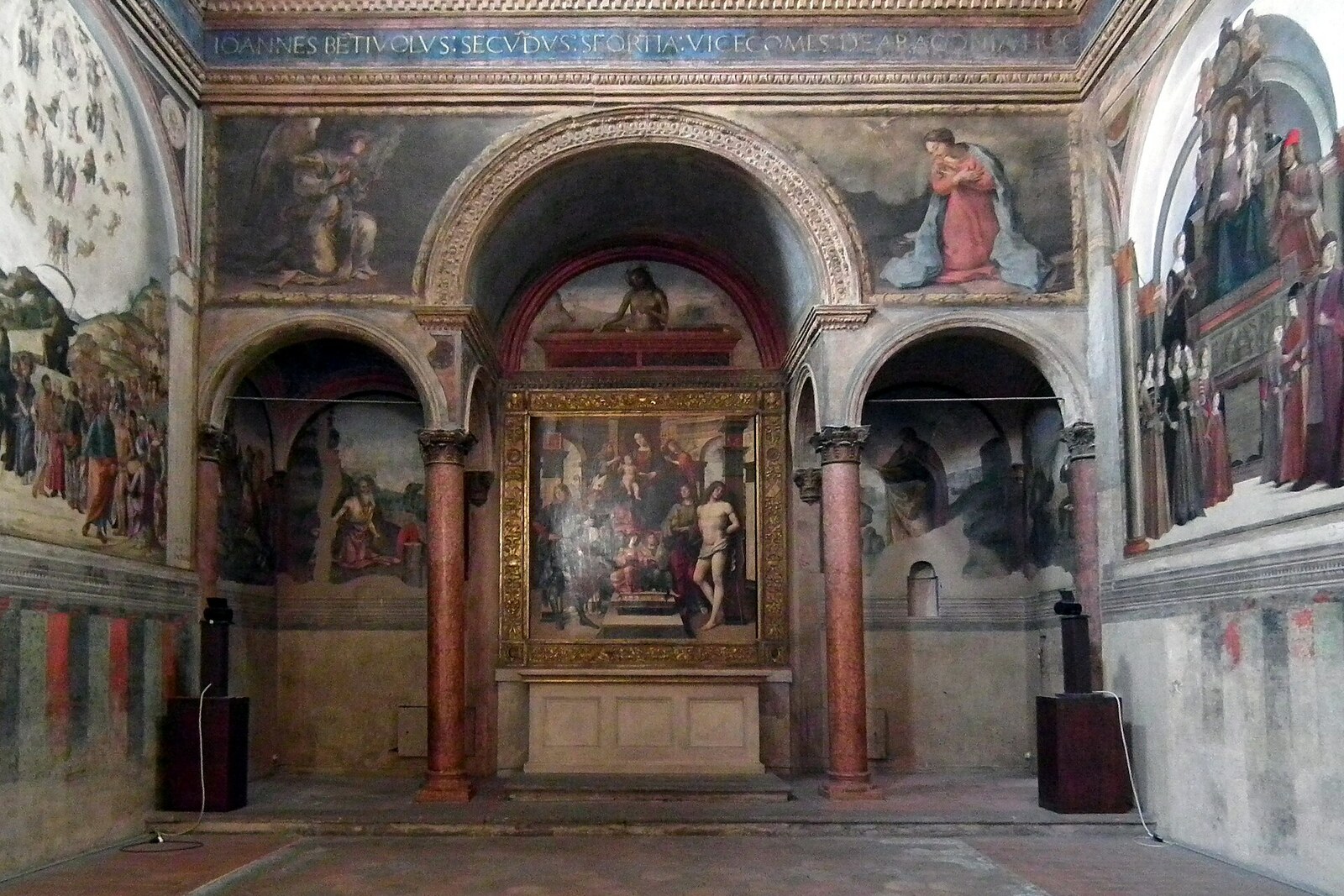
Look around first
What to notice
- Shells above the arches of the portico
- Heads of Roman emperors
- Fluted columns
- Bentivoglio Chapel
The story of the place
Shells containing the heads of Roman emperors repeat above the arches of the portico. The shell explains the basilica's name. “Maggiore” means “the Greater”: this is how the apostle James, son of Zebedee, is distinguished from another apostle with the same name. Medieval tradition linked his burial with Santiago de Compostela in Spain, and the shell became the sign of pilgrims traveling to his tomb.
Augustinian hermits brought the dedication here. Their former monastery stood by the Savena River, beyond the city wall, in a place considered unhealthy and unsuitable for preaching. In twelve sixty-seven, the brothers began building a church inside Bologna, beside the small Church of Santa Cecilia. From here they preached, taught young monks, and summoned townspeople: San Giacomo was one of the four great district churches where people gathered for important city business.
The portico appeared two centuries later. Giovanni II Bentivoglio, Bologna's de facto ruler, commissioned it. Formally, he remained the lifelong head of the city senate, appointed with papal approval. He had no hereditary princely title; the family's position depended on the consent of senators, the Roman court, and noble allies. Giovanni consistently showed that the Bentivoglio family was here to stay.
That was precisely why San Giacomo suited him better than any other church. Several generations of the Bentivoglio family had already been buried here, and the family palace stood nearby. In fourteen forty-five, Giovanni's father, Annibale Bentivoglio, acquired space in the church for a family chapel. That same year, rivals killed him, and construction had to be postponed. His son was two years old. Once grown up and at the head of the city, Giovanni completed his father's plan.
Between fourteen seventy-seven and fourteen eighty-one, Giovanni ordered a covered ceremonial route to be extended along the basilica to his palace. The stonemasons brought out onto the street decoration originally intended for the palace courtyard: slender fluted columns, Corinthian capitals, and a terracotta frieze. They placed imperial heads in Saint James's shells—the patron allowed parishioners to draw the comparison for themselves.
In the chapel, Giovanni commissioned the artist Lorenzo Costa to paint himself, his wife Ginevra Sforza, and their sons and daughters kneeling before the Madonna. The painting is often called an act of thanks for the family's miraculous escape from the Malvezzi family conspiracy. The date on the painting itself disproves this version: Costa finished it in August fourteen eighty-eight, while the conspiracy was not uncovered until November.
The Malvezzi family was an old senatorial family. Once they had helped the Bentivoglio family rise, then they saw Giovanni pushing aside the old nobility and preparing the city for his heirs. The conspirators intended to divide up. Some were to burst into the hall where Giovanni was dining with his sons, others were to kill Ginevra and the daughters in the women's quarters; a third group would occupy the city palace. All the people whom Costa had gathered around the Madonna's throne a few months earlier were under threat.
The plot was exposed. Giovanni accused the chief conspirator before the senators, and at dawn Malvezzi and his accomplices were hanged without trial. Bentivoglio supporters then killed suspects, seized houses, and forced survivors to leave Bologna. Giovanni held on to the city, and in his will of fifteen oh one ordered that he be buried in San Giacomo itself, among his ancestors and his own images.
Five years later, Pope Julius II moved to return Bologna to Rome's direct rule. Twelve thousand ducats were set for Giovanni alive and six thousand for him dead. French troops supported the pope, and the townspeople did not defend the Bentivoglio family. At night, Giovanni took his family and treasury to Milan. There he died in fifteen oh eight and was buried in the Church of San Maurizio.
While Giovanni was still alive, Ercole Marescotti, a member of an exiled and dispossessed family, returned to Bologna and began taking revenge. In May fifteen oh seven, he led men to dismantle Palazzo Bentivoglio. The destruction continued for almost two years; Giovanni's letters from Milan did not stop him. Teatro Comunale di Bologna now stands on the site of the palace.
In the chapel, Giovanni is still depicted kneeling beside Ginevra and the children. The August date of fourteen eighty-eight remains beneath the throne. His tomb is in Milan. Outside, the portico still stretches toward the palace that is no longer there.
Useful on site
Porticoes open around the clock. Church: Mon–Fri 08:00–12:30 and 15:30–18:00; Sat 09:30–12:30 and 15:30–18:00; Sun and holidays 08:30–12:30 and 15:30–18:00; tourist visits may be restricted during services.
Checked: June 28, 2026. Check the official source before visiting.Speak quietly in the church and do not visit the chapels during services. Confirm access to the oratory separately.