 Guide On Map
Via Zamboni: Bologna's University Quarter
From Two Towers to Porta San Donato
Guide On Map on your phone
Open the walk like a regular app
It takes about 10 seconds to install. No app store needed.
The whole path
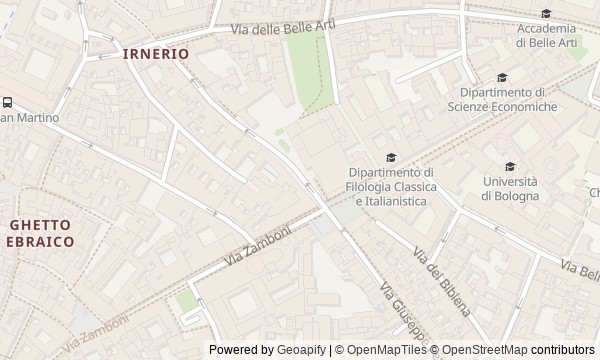
Route map
About the walk
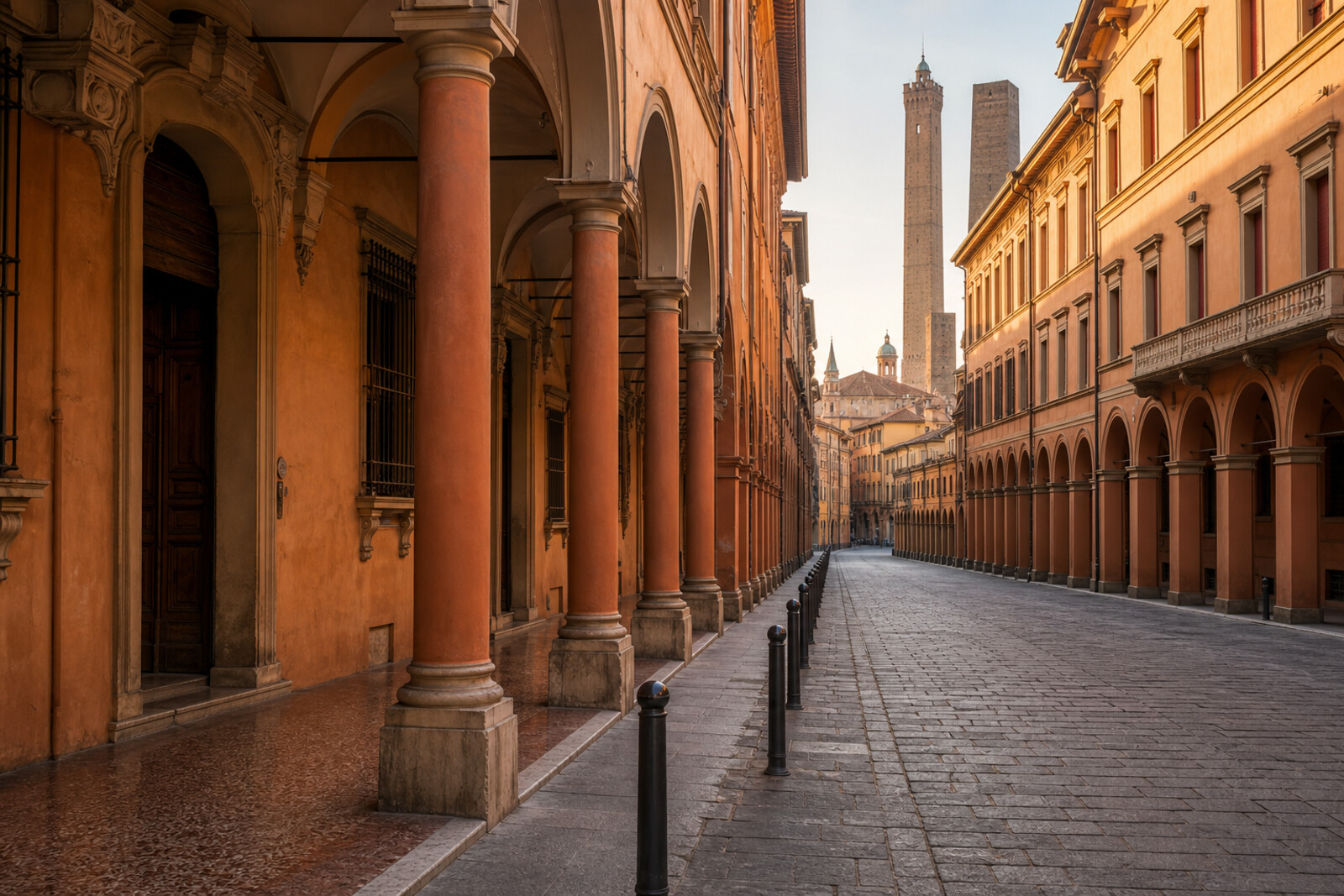
You will set out from Two Towers along Via Zamboni—beneath porticoes, past a basilica and an opera house, then through the university's old buildings to the city gate. First comes a commercial crossroads; farther on, a square, museum rooms, a library, and a pinacotheca.
This walk is not about uninterrupted university glory, but about things that nearly disappeared or unexpectedly remained. At one crossroads, you will find a plaque in place of three towers. Beneath a church portico, a road leads to a palace that is no longer there. By the theater, a side entrance will matter; in the museum rooms, torn silk and wooden models of fortresses.
The story follows documents, visible traces, and human decisions; legend remains legend. By the end, you will be able to read Via Zamboni as Bologna's argument with redevelopment: where buildings were demolished for traffic, and where the brick was left in place after all.
Why this order
Starting at Two Towers shows the cost of a straight new street: you will then follow Via Zamboni itself, created by clearing old buildings to open it onto the crossroads. From Basilica of San Giacomo Maggiore, the route continues to Piazza Verdi for more than simple proximity: the portico was built as a road to Palazzo Bentivoglio, on whose site the theater now stands. After the theater, the same street leads to Palazzo Poggi, where the story of the Institute of Sciences continues first in the museum rooms, then in the library created for it. From Palazzo Poggi, turn onto Via delle Belle Arti toward the National Pinacotheca of Bologna: after books, the route introduces another collection, assembled from paintings taken from suppressed churches and monasteries. Returning to Via Zamboni completes the line at Porta San Donato: after walking the street for which buildings were demolished in the center, you will see a gate where a similar argument ended differently.
Those who want to understand the university quarter through its buildings and collections Lovers of urban history, architecture, and museum collections Those interested in debates over demolition and preserving old Bologna
Those looking for a route focused only on the main squares and gastronomic Bologna Those who want to stay outdoors: an important part of the walk takes place in museum and library rooms
Before you go
The route can be completed entirely from outside, but many of its main characters are inside the basilica, the oratory, the museums, and the library. Before setting out, check the visiting arrangements for each interior separately: an active church, museum rooms, and a working library all have different access rules. Do not plan the walk around a guaranteed tower climb or viewing rare books—such opportunities need separate confirmation. Keep quiet in Basilica of San Giacomo Maggiore and do not disturb services; in the library, remember that it is first and foremost a workplace for readers.
When to go
One unhurried outing is enough for a walk limited to the street, but visits to Palazzo Poggi and the National Pinacotheca of Bologna will make the route noticeably longer. If you want to see both collections without rushing, start in the first half of the day and decide in advance how much time you are ready to spend indoors. Treat the basilica and library as separate opportunities rather than required stops: their access may not align with your museum plan.
Backup plan
If the interiors are closed, keep the main order and listen to the stories by the facades: the towers, the unbroken line of porticoes, the open space of Piazza Verdi, the university palaces, and the solitary arch of Porta San Donato already explain how the street works. Rather than trying to see everything through closed doors, focus on traces of what has vanished: the site of Palazzo Bentivoglio, paintings mentally returned to their chapels, and a gate without its wall. In rain, most of the route can be walked beneath porticoes; at open squares and the gate, linger only as long as the weather allows.
Route conditions
Surface. Paved — 1.2 km (data covers 81% of the route)
Facilities. Toilets — 3; drinking water — 2
Elevation. Ascent — 0 m; descent — 21 m
OpenStreetMap extract of June 18, 2026: database data, not a check on the ground. Data © OpenStreetMap contributors, ODbL licence
Walk plan
Open in maps ↗- 1
Piazza di Porta Ravegnana and the Two Towers
Here you will see the price a medieval crossroads paid for a straight city avenue. - 2
The Portico and Basilica of San Giacomo Maggiore
The surviving ceremonial route makes it possible to reconstruct the basilica's connection with the vanished family palace. - 3
Piazza Verdi and Teatro Comunale di Bologna
At this stop, the service entrance will prove more important than the theater’s grand façade. - 4
Museum of Palazzo Poggi
The scientific rooms will link one man's military downfall to the founding of a new city institution. - 5
Bologna University Library
The history of a personal book collection will explain why the library appeared here before the university itself. - 6
National Pinacotheca of Bologna
Here, the museum collection is presented as a collection of works that were repeatedly moved and saved. - 7
Porta San Donato
The final stop will bring together a dispute over a monument and a transport hub in one surviving forework.
Route features
Everything you need stays in the browser
Progress, saves and your trip plan are stored on this device.
Add Guide On Map to your home screen so the walk opens outside the browser.
How we handle sources, maps and corrections: our editorial standards