 Guide On Map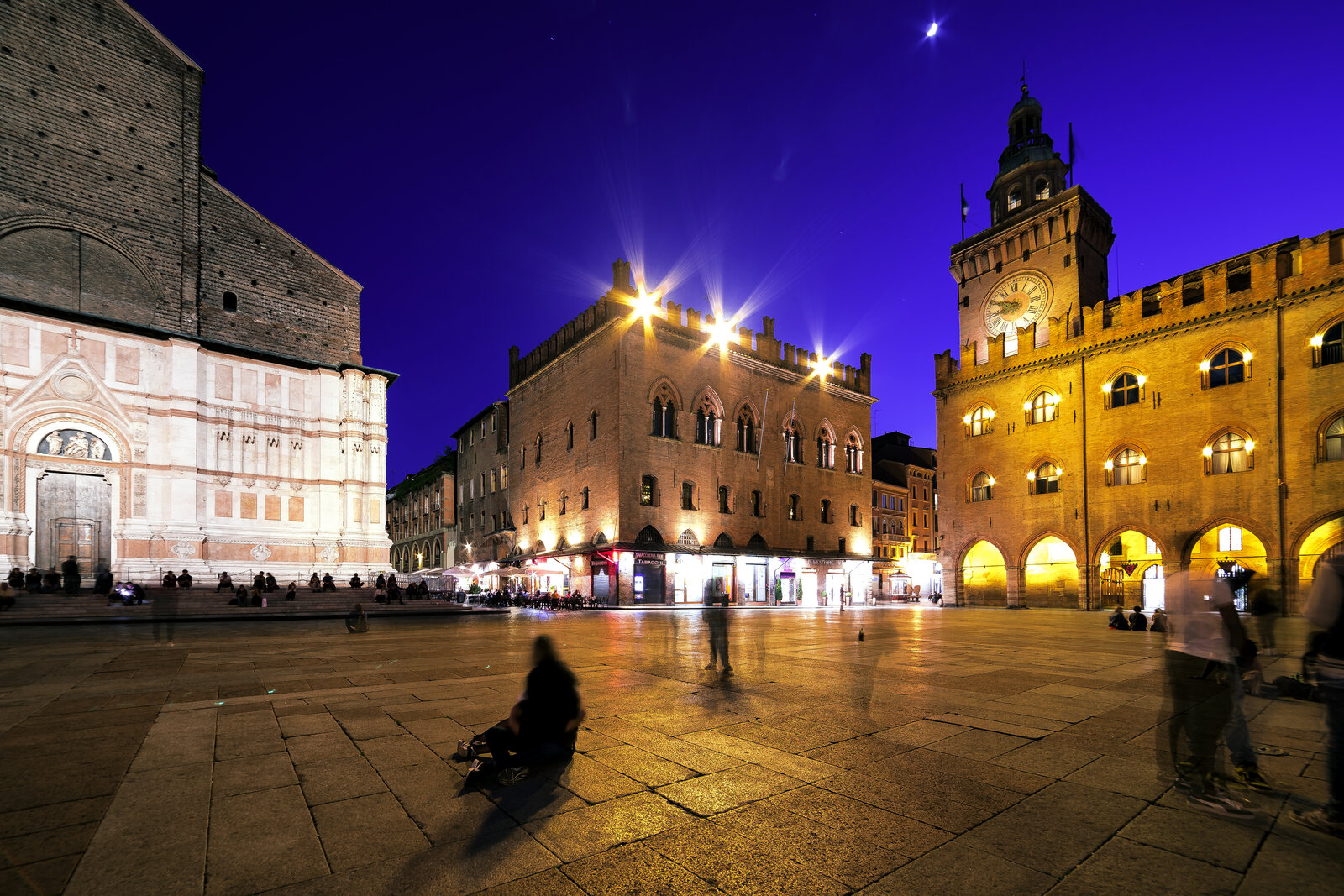
Look around first
What to notice
- Facade of Palazzo del Podestà
- Torre dell'Arengo
- The palace arches
The story of the place
Piazza Maggiore emerged on the site of a residential quarter. In twelve hundred, the council of the Commune of Bologna—an independent city-state—began buying houses and plots of land here, then demolishing them. The city needed a shared space for trade, services, judicial decisions, and assemblies. At the time, it was called Piazza del Comune. Nearby, they built Palazzo del Podestà, the first residence of the city government, and raised Torre dell'Arengo above the palace, with a bell that summoned residents in exceptional cases.
Such a case came in the summer of twelve fifty-six. Bonaccorso da Soresina, captain of the people—the chief representative of craft and trade associations in the city government—proposed that the council buy out all serfs in Bologna and its surrounding district. He sought to end the inheritance of personal dependence on landowners.
These people lived by working someone else's land and were bound to their master by personal obligations. They could not leave of their own will. If a dependent woman married a free man, the landowner could claim their children for himself: medieval law tied a child's status to the status of the mother. It was this family that the city intended to remove from the master's claims all at once.
On August twenty-fifth, twelve fifty-six, the Arengo bell summoned the townspeople to this square. Here it was announced that the commune would free all serfs in its holdings. But first, it had to establish whom to buy out and from whom.
Four notaries surveyed the city and the rural district. They recorded people by families, named the owner, and separated children under fourteen from adults. The register included five thousand eight hundred fifty-five men, women, and children. For each adult, the owner was assigned ten Bolognese lire—roughly the market value of an ox. Eight were paid for a child. Settlements with the owners stretched over three years.
On June third, twelve fifty-seven, the council completed the operation by law: residents of Bologna and its district could no longer be considered serfs, and former owners had no right to make claims on children from mixed families. The notaries gathered the names of those freed in the Liber Paradisus. The title came from the document's opening lines, where humanity's original freedom was linked to life in Paradise before the Fall.
The lofty prologue did not reveal the entire deal. Former owners received money, while the freed peasants had to register on tax rolls at their place of residence within four months. They were given neither land nor new earnings, so many stayed where they were and made new contracts with their former masters. Dependence began to be restored under other names, and in thirteen oh four the city council had to declare such agreements invalid.
Torre dell'Arengo still stands above the arches of Palazzo del Podestà. The present large bell was cast in fourteen fifty-three; the one that summoned people to the proclamation of freedom has not survived. It rang precisely here, on what was then Piazza del Comune.
Useful on site
Open urban space; the square is accessible as an outdoor stop at any time.
Checked: June 28, 2026. Check the official source before visiting.Listen closer to the edge rather than in the middle of the pedestrian flow: it is easier to see the square as a single open-air hall.