 Guide On Map
The Heart of Bologna: Piazza Maggiore, The Two Towers, and Santo Stefano
From the Fountain of Neptune through the main square and the towers to the Santo Stefano complex
Guide On Map on your phone
Open the walk like a regular app
It takes about 10 seconds to install. No app store needed.
The whole path
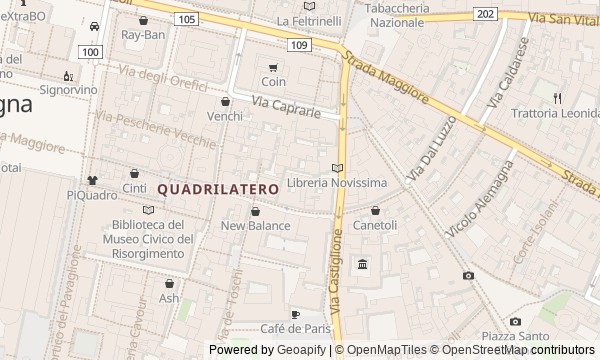
Route map
About the walk
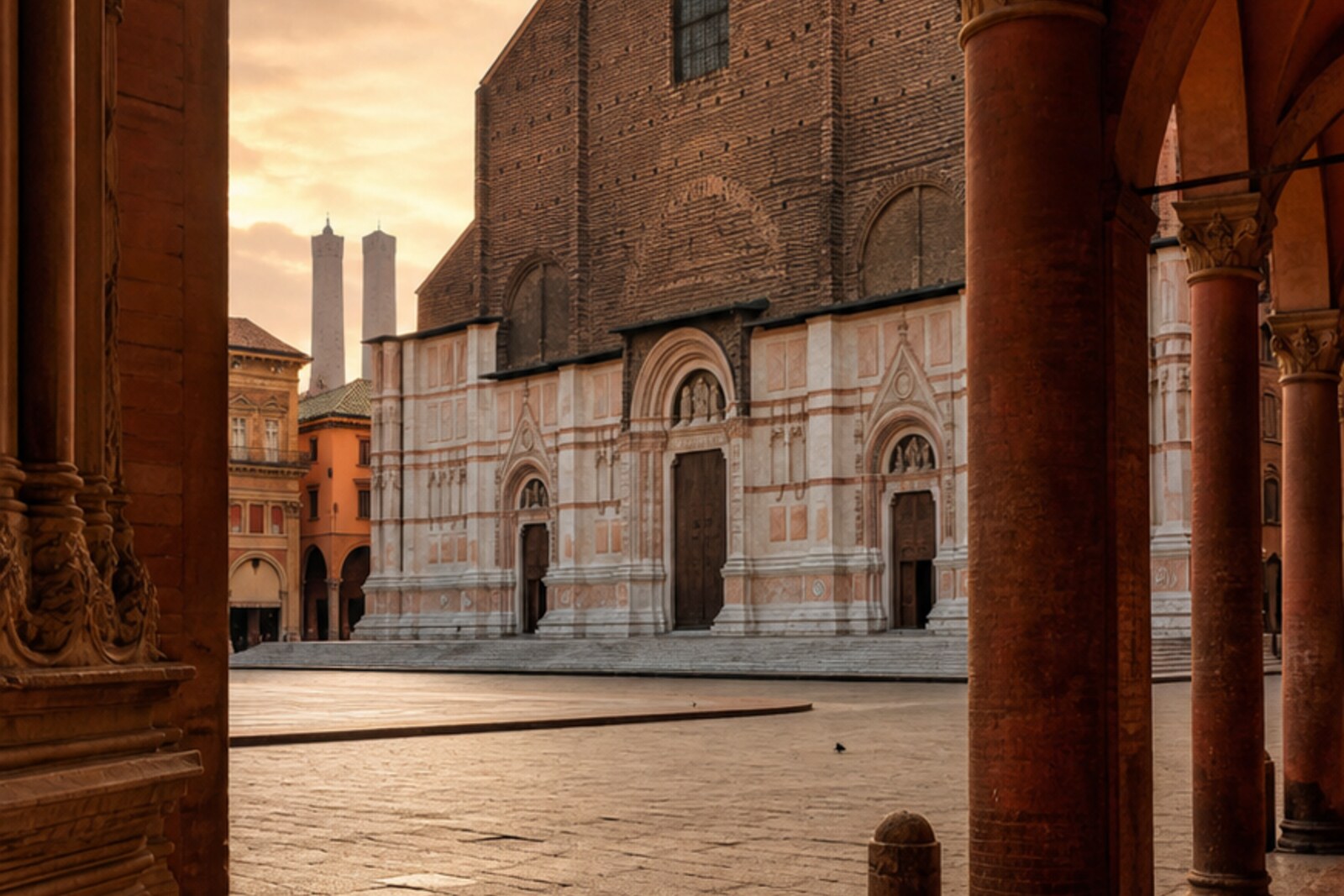
You will walk from the Fountain of Neptune through Piazza Maggiore, Palazzo d'Accursio, and Basilica of San Petronio, then turn toward the Archiginnasio of Bologna and The Two Towers. The last part of the route follows Via Santo Stefano: first across its concave square, then among the linked churches of the old complex.
This is a walk through a Bologna reshaped by more than architects. Residents argued against bans, the council bought people out of dependency, a student lost a scholarship, and a scientist carried clay balls up a tower. You will find out why a promise made “for the convenience of the people” ended in an iron fence, what happened behind the closed gates of a palace, and which feature of a planned square never appeared.
The story stays close to documents, inscriptions, and objects, and a legend will be called a legend. By the end, you will be able to draw one line from the city fountain to the Santo Stefano complex: who in Bologna gained the right to control water, squares, education, and memory.
Why this order
At Neptune, the conversation begins with residents' access to the common good. A few steps to Piazza Maggiore widen that dispute to the scale of the whole Commune of Bologna: here the council made decisions about people's freedom. Next comes the town hall itself, an institution that grew out of a private house and later became the center of a political massacre. Basilica of San Petronio opposite continues the theme of rivalry between civic and papal power. Behind the basilica, the Archiginnasio of Bologna shows how that same control entered university classrooms. From the study halls, the route reaches Asinelli Tower, where a scientist tested authority through measurement. Via Santo Stefano leads from medieval towers to a square reassembled at the end of the twentieth century. Its descent ends at the church complex, where the story of Petronius explains the appearance of the Basilica of San Petronio already passed on Piazza Maggiore.
Those discovering Bologna's historic center for the first time Those who care about human conflicts behind ceremonial facades Those who enjoy verified stories, inscriptions, and visible traces of change
Those expecting only light legends about a medieval city Those looking for a route devoted exclusively to church interiors Those who prefer a sightseeing overview without political and social history
Before you go
The route works well outdoors, but several important details are inside Basilica of San Petronio, the Archiginnasio of Bologna, and the Santo Stefano complex. For the visitor rooms at the Archiginnasio of Bologna, check in advance whether a separate reservation is needed; do not treat the library spaces as a freely accessible sightseeing route. In active churches, choose clothing that covers shoulders and knees, speak quietly, and be ready to postpone your visit during a service. Do not count the climb up Asinelli Tower as an essential part of the walk: access conditions can change, and the story of the towers is fully understood from the street. Wear comfortable shoes—the distance is short, but you will mostly be listening while standing.
When to go
Allow about 2.5 hours for the outdoor route with audio and unhurried stops. With visits to accessible interiors, leave 3.5–4 hours, not including separate lines or extended time in museum spaces.
Backup plan
If you cannot get inside, continue in order: the route's meaning does not fall apart. At Basilica of San Petronio, focus on the unfinished facade and the scale of the building; at the Archiginnasio of Bologna, on the portico, courtyard, and visible coats of arms; view The Two Towers only from a safe point on the street. Before Santo Stefano, pause on the slope of the square and take in the surrounding palaces: they set up the change of pace even if the complex is closed. Do not try to replace a missed interior with a random long visit—better to preserve the transition from noisy civic Bologna to a quieter ending.
Route conditions
Surface. Paved — 1.5 km (data covers 89% of the route)
Facilities. Toilets — 6; drinking water — 6
Elevation. Ascent — 8 m; descent — 9 m
OpenStreetMap extract of June 18, 2026: database data, not a check on the ground. Data © OpenStreetMap contributors, ODbL licence
Walk plan
Open in maps ↗- 1
Fountain of Neptune
Here you will learn why a papal monument immediately became the subject of an everyday dispute. - 2
Piazza Maggiore
Here, the proclamation of freedom will turn from a solemn gesture into a long and expensive municipal operation. - 3
Palazzo d'Accursio and Salaborsa
The history of the palace reveals the moment when street violence disrupted the transfer of city power. - 4
Basilica of San Petronio
The coronation ceremony will explain why the victor and the defeated man needed a shared walkway. - 5
Archiginnasio of Bologna
The story of the first academic year will explain how the new order changed relations between students and the university. - 6
The Two Towers
An experiment with clay balls will show how a scientific dispute was tested by the height of a tower and the counting of swings. - 7
Piazza Santo Stefano
Here you will see how replacing pipes gave cause to remake an entire city square. - 8
Santo Stefano complex
The finale will explain why the saint found here received an enormous basilica at the beginning of the route.
Route features
Everything you need stays in the browser
Progress, saves and your trip plan are stored on this device.
Add Guide On Map to your home screen so the walk opens outside the browser.
How we handle sources, maps and corrections: our editorial standards