 Guide On Map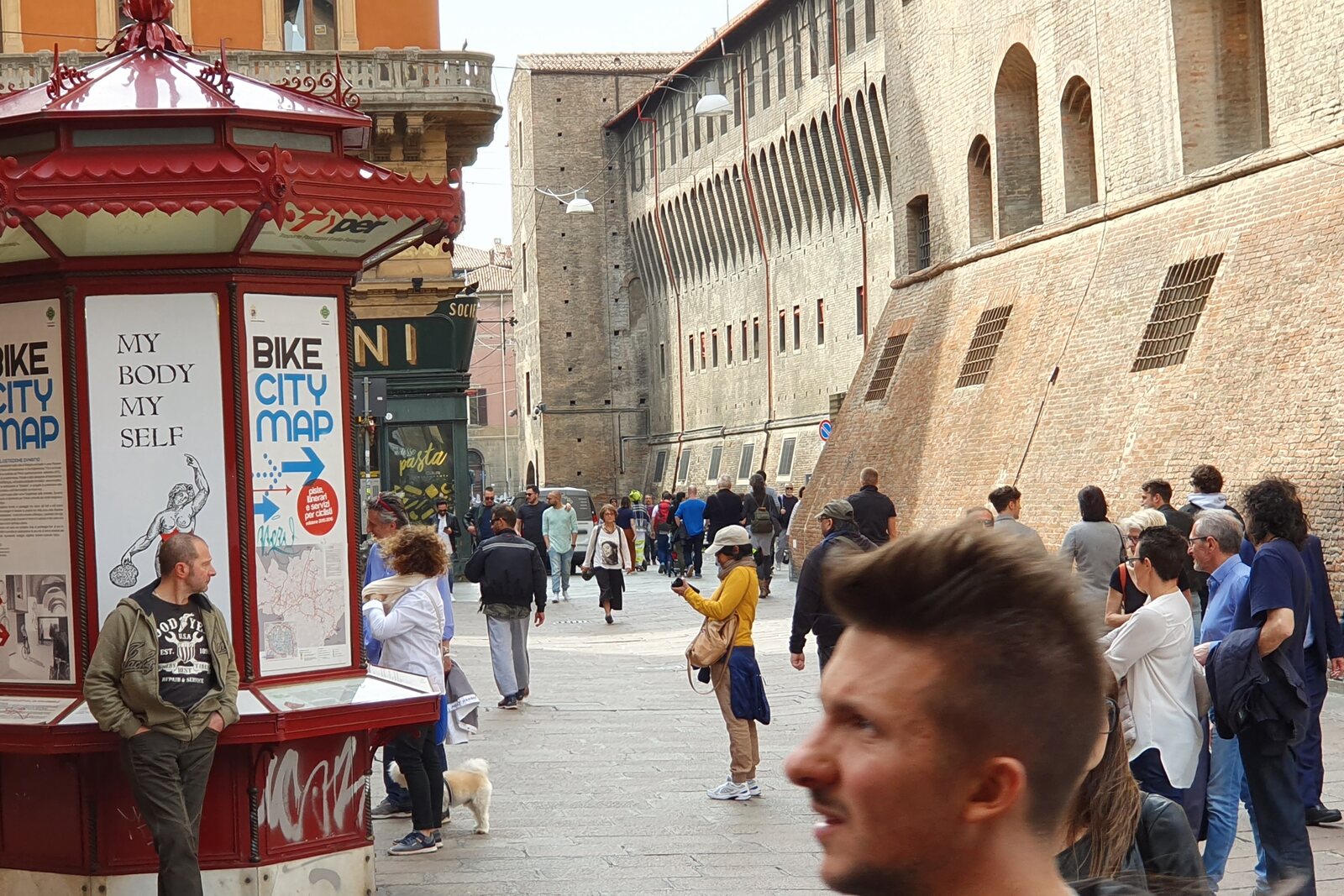
Look around first
What to notice
- The gates to the Courtyard of Honor
- The memorial plaque in the courtyard
- The cast-iron-and-glass hall of Salaborsa
The story of the place
At this façade, two city institutions with different rhythms come together: behind the palace walls, the municipal council still meets, while in the northern wing by Piazza del Nettuno the city library operates. Its spacious hall once brought merchants together so that deals would no longer be made outdoors in Bologna's main squares. The palace garden was replaced for its sake by a light structure of cast iron and glass; the transparent volume of Salaborsa stands out noticeably against the palace's heavy walls. After the exchange, the space also housed a bank, an inexpensive cafeteria, a basketball court, and city-hall offices before becoming a public place for the city's residents again.
The palace retained the name of the jurist Accursius. In the first half of the thirteenth century, he taught Roman law in Bologna and brought together disparate interpretations of Justinian's laws into a single commentary, later used by teachers and judges throughout Europe. His reputation and earnings enabled him to build a large house beside the new city square. In twelve eighty-seven, Accursius's son Francesco Accursius sold his father's estate to the Commune of Bologna. At first, officials set up a grain store here, and from thirteen thirty-six they housed city offices here. Thus, a professor's private house became the core of the municipal palace, but the first owner's surname was never displaced from the façade.
Salaborsa occupies the northern part of the same complex, facing Piazza del Nettuno. Its name means “stock exchange hall.” At the end of the nineteenth century, Bolognese entrepreneurs pressed for merchants to stop making deals outdoors in Piazza Maggiore and Mercato di Mezzo. To create a covered exchange, the palace garden was demolished, and between eighteen eighty-three and eighteen eighty-six a pavilion of cast iron and glass was built. The exchange closed as early as nineteen oh three. Later, the hall was occupied by a bank, an inexpensive restaurant, a basketball court, and municipal offices, and in December two thousand one a public library opened here and retained the old stock-exchange name.
The darkest history of this complex unfolded between the palace balcony, the gates to the courtyard, and Piazza del Nettuno by Salaborsa. On November twenty-first, nineteen twenty, Ennio Gnudi arrived at the municipal council—a railway worker, trade-union activist, and newly elected socialist mayor. He was to take office after his party's victory in the city elections. For him, it was a path from the railway workshops to the mayor's chair; for armed fascist squads, it was an event they had promised in advance to disrupt. In leaflets pasted up across Bologna, they threatened not to allow a red flag over the municipal building.
About three hundred armed fascists moved toward the center. The Royal Guard stopped the main column in Piazza del Nettuno, but several groups broke through the cordon. When Gnudi appeared on the balcony, shots rang out from the corner of the square. The people gathered in front of the palace rushed toward the gates, hoping to take shelter in the inner courtyard.
The palace was guarded by armed socialists and communists known as the Red Guard. They were expecting an attack and mistook the fleeing supporters for opponents who had broken through. The guards shut the gates and dropped hand grenades from above. Ten people taking part in the celebration were killed in the gunfire and explosions, and another fifty-eight were wounded. Among them was sixteen-year-old Ettore Masetti: a bullet struck him in the abdomen, and he died three months later.
The shooting reached the council chamber as well. An unidentified person from the public seating area opened fire on the minority deputies. Giulio Giordani received a fatal wound—an attorney, war invalid, and opposition councilor who had come to take his seat at the first meeting. After his death, fascist propaganda proclaimed Giordani its first great martyr and used his death to place all responsibility for the massacre on the socialists.
Gnudi's elected administration renounced its powers without ever beginning work. A prefectural commissioner was appointed in its place and governed Bologna until March nineteen twenty-three. Police arrested about two hundred socialists and not a single participant in the fascist squads. After this crackdown, the Bolognese fascist organization grew rapidly and became one of the largest in Italy.
The municipal council still meets in the palace. In the inner Courtyard of Honor hangs a plaque installed in memory of the ten citizens who died and Councilor Giordani. It is behind the gates toward which people ran from the square and which the guards shut in front of them.
Useful on site
The façade and square can always be viewed; the interior halls are mostly accessible by tour. Council Chamber: Tue–Thu and Sat–Sun 10:00-13:00, subject to availability. Salaborsa: Mon 14:00-20:00, Tue–Fri 09:00-20:00, Sat 09:00-19:00. Excavations beneath the glass floor: Mon 14:00-19:00, Tue–Sat 09:00-19:00; entry until 15 minutes before closing.
Checked: June 28, 2026. Check the official source before visiting.Salaborsa remains a working library: visit the accessible areas quietly and do not disturb readers.