 Guide On Map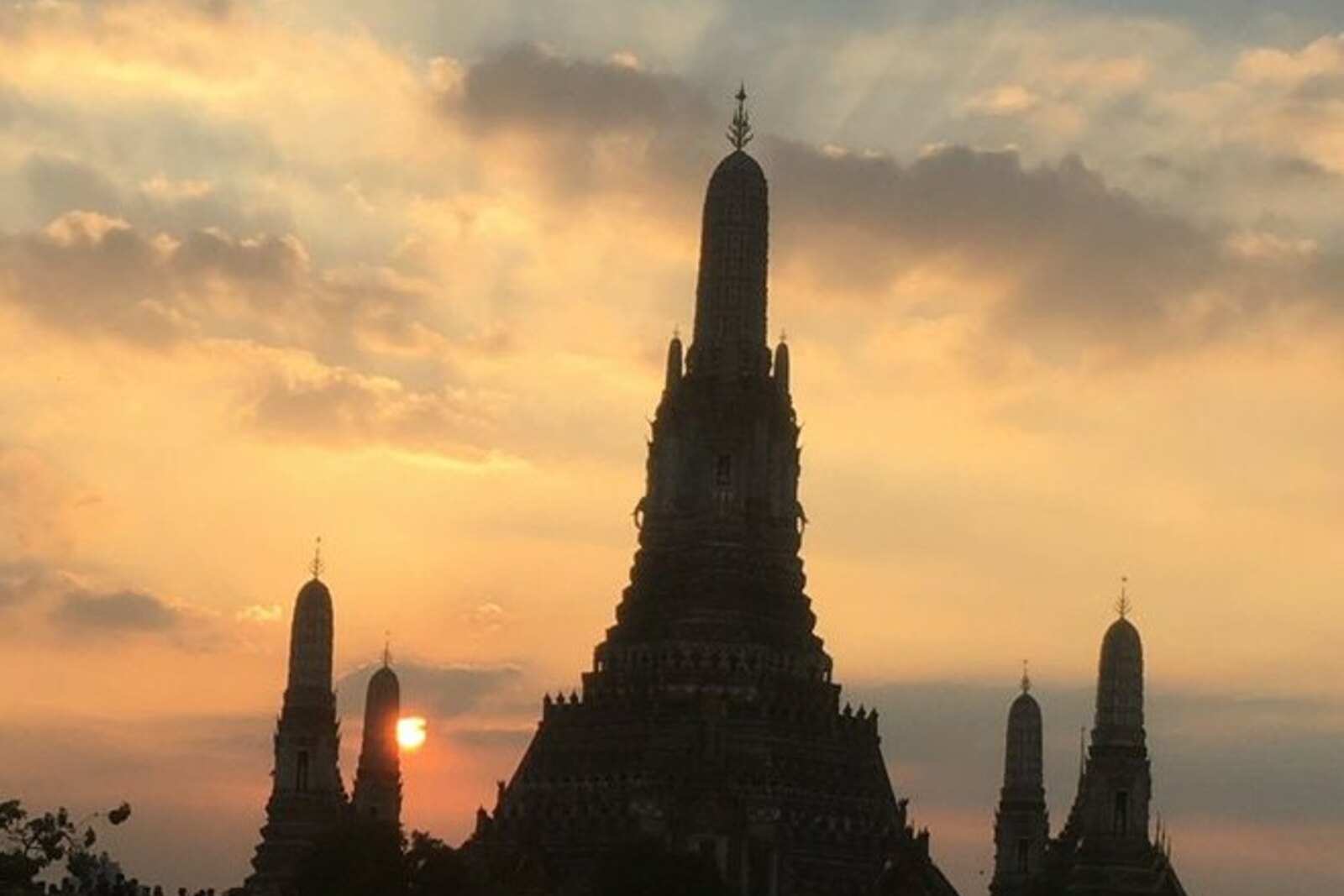
Look around first
What to notice
- Tall central prang
- Four small prangs
- Old hall for monastic ordinations
- Fort Wichaiprasit
The story of the place
The Buddhist monastery Wat Arun stands right on the bank of the Chao Phraya River. Its central prang was conceived as the new capital's principal reliquary; the tower's form refers to sacred Mount Meru, and the four smaller prangs around it correspond to the four parts of the Buddhist world. At the side, a much lower ubosot survives, a hall for monastic ordinations that stood here even before the temple entered the palace boundaries.
In seventeen sixty-seven, Phraya Tak, a military commander and governor of Tak Province, led his detachment out of besieged Ayutthaya. The former capital was soon destroyed. He went east, gathered people and supplies in Chanthaburi, returned, and retook the Thonburi fortress from the Burmese. He now needed a place from which to hold together the fragmented state.
Thonburi suited a man with a small army exactly. It was a fortified river town on the route to the sea. The existing forts could be defended with the forces available to Phraya Tak; if the enemy proved stronger, the people could be put aboard ships and withdrawn to Chanthaburi. He chose a site by the mouth of Bangkok Yai Canal and the old Fort Wichaiyen, refortified the fort, and named it Fort Wichaiprasit. Nearby, the small Wat Makok monastery already stood.
According to temple tradition, Phraya Tak's boats reached Wat Makok at dawn. He promised to restore the monastery and gave it the name Wat Chaeng—the Temple of Dawn. The dawn in this story belongs to tradition; the old temple itself had existed long before the military commander's arrival.
Phraya Tak was crowned King Taksin and built a palace directly south of the monastery. The palace boundary enclosed Wat Chaeng. Taksin forbade monks to live inside: the temple became a palace shrine, modeled after the royal temple of the former capital. No monastic community remained here, but this was precisely where the king placed the sacred object meant to accompany his new capital.
In seventeen seventy-nine, the commander Chao Phraya Chakri brought the Emerald Buddha and Phra Bang from Vientiane. Taksin installed both images in Wat Chaeng. In only twelve years, the old riverside monastery had gone from a provincial temple to a closed palace shrine containing the kingdom's principal image.
The denouement came in seventeen eighty-two. Taksin was overthrown and executed near his palace. Chao Phraya Chakri became King Rama I, moved the residence to the opposite bank, and took the Emerald Buddha there. Wat Chaeng lost both the court and its chief sacred object at once.
For the monks, this meant a return. King Rama I's son, the future King Rama II, lived in Taksin's former palace and began by building monks' cells. After a fifteen-year ban, the community settled in the temple again. Once he became king, King Rama II continued the restoration, personally sculpted a model of the face for the main Buddha image, and gave the monastery the name Wat Arun. Aruna is the Thai form of the name of Aruna, the personification of dawn in Indian tradition. The new name preserved the dawn of old Wat Chaeng.
King Taksin never saw the immense prang visible today. A prang is a tower-like stupa intended to hold Buddhist relics. In his time, a tower about sixteen meters high stood here. King Rama II conceived of raising the new capital's principal reliquary in its place, but died before the plan was completed. His son, King Rama III, brought the prang to its present scale. The central tower represents sacred Mount Meru; the four smaller prangs around it correspond to the four parts of the Buddhist world.
Beside this later giant structure, a small ubosot survives—the old hall for monastic ordinations, which existed even before Taksin. Inside, there is a broad platform made from a single wooden board, associated with his meditation practices. And just beyond the southern wall lies his former palace with Fort Wichaiprasit. It is now the headquarters of the Royal Thai Navy. There is no longer a king in the palace, no Emerald Buddha in the temple, and monks live where Taksin once ordered them to leave.
Useful on site
Tourism Authority of Thailand: daily 08:00–18:00, ticket 200 baht; check separate areas and the climb at the entrance.
Checked: June 28, 2026. Check the official source before visiting.Admission to the temple complex is charged separately; the stairs and accessible terraces may be steep, so climb only where access is open.