 Guide On Map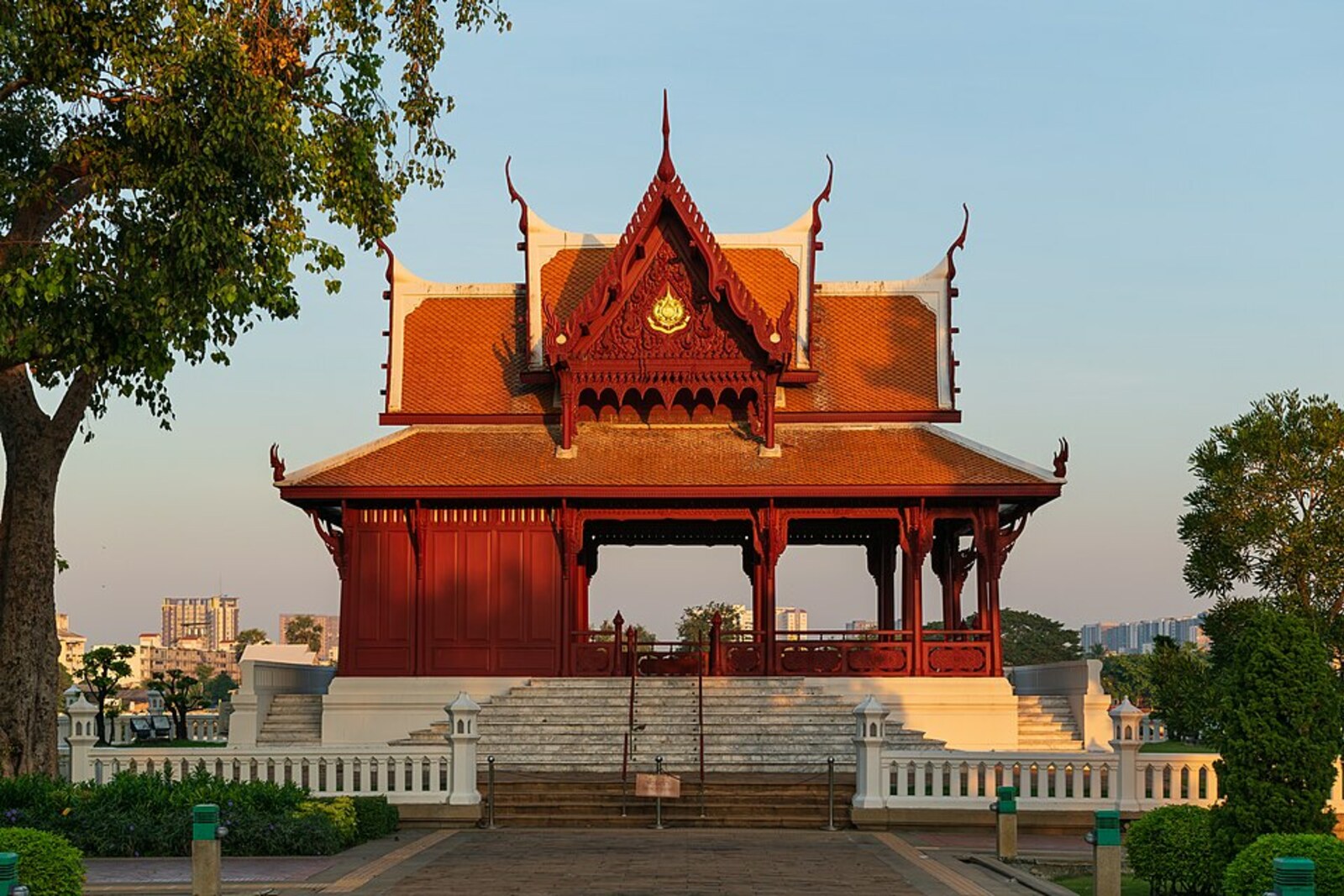
Look around first
What to notice
- Young lamphu trees
- Carved pavilion
- Riverside steps behind the fort
- Chao Phraya River
The story of the place
At the foot of Phra Sumen Fort, a riverside green opens out: stone steps descend to the Chao Phraya River, and a carved pavilion stands above the lawn. The riverbank was once occupied by the sugar factories' office and workers' housing; after the site was cleared, this land was set aside for walks, exercise, music, and neighborhood celebrations. The riverside barrier protects nearby streets from waves, while gates in it let river water through.
Sompong Duangsawai earned his living by teaching drawing at Wat Sangwet School. He was interested in the neighborhood's name: in Thai, Bang Lamphu was written in two ways, although they sounded the same. Sompong suspected that the correct version came from the lamphu, a tree that grows by water, but in twenty years of working in the neighborhood, he had not seen a single one here.
On August thirtieth, nineteen ninety-seven, he set out to search with students and local residents. At that time, the Sugar Factory Administration stood where the park now is, with workers' homes behind it, and the riverbank was overgrown. Sompong had to cross the water and climb onto the protective embankment. Among other riverside trees, the group found an old lamphu. Forestry Department specialists confirmed that it was more than one hundred years old.
The discovery was immediately under threat. The city administration planned to fence off the riverbank with a continuous structure so that water would not flood Phra Athit Road and Phra Sumen Road. For the lamphu, this meant death: its aerial roots needed the tide, and river water would no longer reach them. Sompong wrote about this in the newspaper. After the publications, engineers redesigned the protective line: it gained gates that let water through to the roots and closed against waves.
Two years later, the area was cleared and turned into a public park for the seventy-second birthday of King Bhumibol, Rama the Ninth. The old tree was preserved by the riverbank. The king gave the carved pavilion and the park the name Santichaiprakarn—roughly, “a fortification signifying the victory of peace”—and ordered that the lamphu be protected. This is how a lawn, a riverside platform, and steps behind the fort appeared here: a place for walks, exercise, music, and neighborhood celebrations. The tree found by the schoolteacher also confirmed the spelling of the name Bang Lamphu.
During the great flood of two thousand eleven, water covered the aerial roots for a long time. The old trunk was hollow, and the yellowing leaves were at first taken for an ordinary seasonal change. When the mistake was understood, specialists pruned the branches and tried to grow new plants from them, but the tree could not be saved.
On July sixth, two thousand twelve, city workers cut down the dead trunk and took it away before Sompong and the residents could intervene. The teacher found three remaining pieces of wood. Around the former stump, residents planted young lamphu trees, and one saved branch was later incorporated into a model of the tree in the neighboring neighborhood history museum.
There is now no hundred-year-old lamphu in the park. Trees planted after its death grow by the water, while the actual tree, for which the park was designed with gates that let in the tide, remains as a single branch in a museum model.
Useful on site
Free city park by the river; check the current signs for the gates, pavilion, and individual areas.
Checked: June 28, 2026. Check the official source before visiting.Do not disrupt classes and local events; stay on accessible paths by the water, and bear in mind that festivities may occupy individual areas.