 Guide On Map
How Old Zurich Changed
From Bahnhofbrücke across both banks of the Limmat to Lindenhof
Guide On Map on your phone
Open the walk like a regular app
It takes about 10 seconds to install. No app store needed.
The whole path
Route map
About the walk
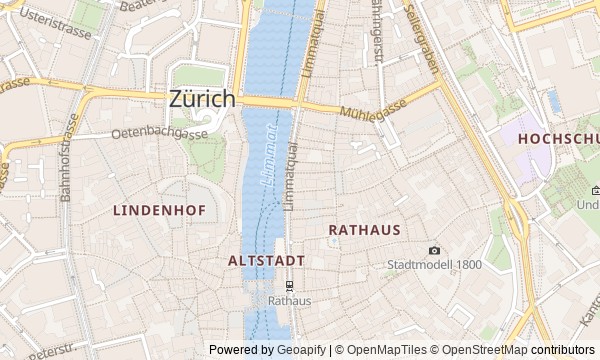
You will begin on Bahnhofbrücke, on the direct route from the station into Zurich on the right bank. From here, the road leads deep into the Old Town, to Zähringerplatz, then down to Grossmünster, across the Limmat, and up through Münsterhof and St. Peter's Church to Lindenhof.
This is a walk through places where major changes had very down-to-earth consequences. Why were wine presses installed in a church? Why did bread and wine end up among the parishioners? What led one woman to hand an entire convent estate over to the city? And why did a cobbler's workshop operate above an enormous clock face?
The story will stay close to documents, surviving details, and honest caveats where legend begins. By the end, you will recognize Old Zurich by its mismatches: a library in a church choir, a city tower above parish bells, and a new bridge on old foundations.
Why this order
First, you will cross Bahnhofbrücke and arrive on the right bank—the very bank the crossing was built to connect. From there, the route leads to Prediger Church: after the city's infrastructure, you will see how the council used a church building. Then the road heads south to Grossmünster, because that is where the decisions began whose consequences you have already encountered at Prediger Church. The bridge between the churches then brings you to Fraumünster: on the other bank, the same Protestant Reformation becomes the story of transferring monastic power. Nearby, at St. Peter's Church, the church theme gives way to everyday city service in a tower with a separate owner. The climb to Lindenhof completes the route above both banks and brings the conversation from managing buildings back to defending the whole city.
Those who want to understand Old Zurich through decisions and human actions Those who value verifiable facts and caveats about legends Those who enjoy a mix of waterfronts, church squares, and climbs
Those looking only for an overview of famous facades without historical stories Those not interested in church and city power Those who need a walk without a climb to the final stop
Before you go
The route's main scenes can be understood from the street, so the walk does not depend on access to church interiors. If doors are open, go inside only where this does not disturb a service, concert, or private prayer; treat the possibility of climbing a tower as a separate option, not part of the route.
The Old Town's surface is uneven in places, and there is a climb to Lindenhof. On the bridge and near busy streets, listen away from tram tracks and the main flow of people. Save a few quiet minutes for the end: the view from the hill works as the conclusion to the whole walk.
When to go
About an hour and a half for the full route with exterior viewing. If you go into one or two churches and take your time at Lindenhof, allow about two hours.
Backup plan
If churches are closed, keep the same order: every key turn in the story has an exterior anchor—the bridge and the Limmat, the Gothic choir of Predigern Parish, the towers of Grossmünster, the square and monument at Fraumünster, the clock faces of St. Peter's Church, and the fountain and parapet at Lindenhof. If a tower climb or access to archaeological remains is not possible, nothing needs replacing: the route is not built around those visits. In rain, listen to longer passages under available shelter, and take in viewpoints briefly without lingering on slippery cobblestones.
Route conditions
Surface. Paved — 2.4 km (data covers 98% of the route)
Stairs. Flights: 4, 29 m in total
Access. Wheelchair — no; stroller — limited (stairs)
Facilities. Toilets — 8; drinking water — 34
Elevation. Ascent — 40 m; descent — 25 m
OpenStreetMap extract of June 23, 2026: database data, not a check on the ground. Data © OpenStreetMap contributors, ODbL licence
Walk plan
Open in maps ↗- 1
Bahnhofbrücke
Here begins the story of how the railroad forced the city to reconnect the station with the right bank. - 2
Prediger Church and Zähringerplatz
This stop will show how church spaces successively served prayer, wine, grain, and books. - 3
Grossmünster
Here it will become clear how a sermon became a decision of the city council and changed the rite itself. - 4
Fraumünster and Münsterhof
The square is needed for the route to show the Protestant Reformation as a personal bargain over power, protection, and the future. - 5
St. Peter's Church
The tower will show how, before the telephone became widespread, the city detected fires and kept time. - 6
Lindenhof
The final stop connects the city’s topography with the legend of an armed formation on the hill.
Route features
Everything you need stays in the browser
Progress, saves and your trip plan are stored on this device.
Add Guide On Map to your home screen so the walk opens outside the browser.
How we handle sources, maps and corrections: our editorial standards