 Guide On Map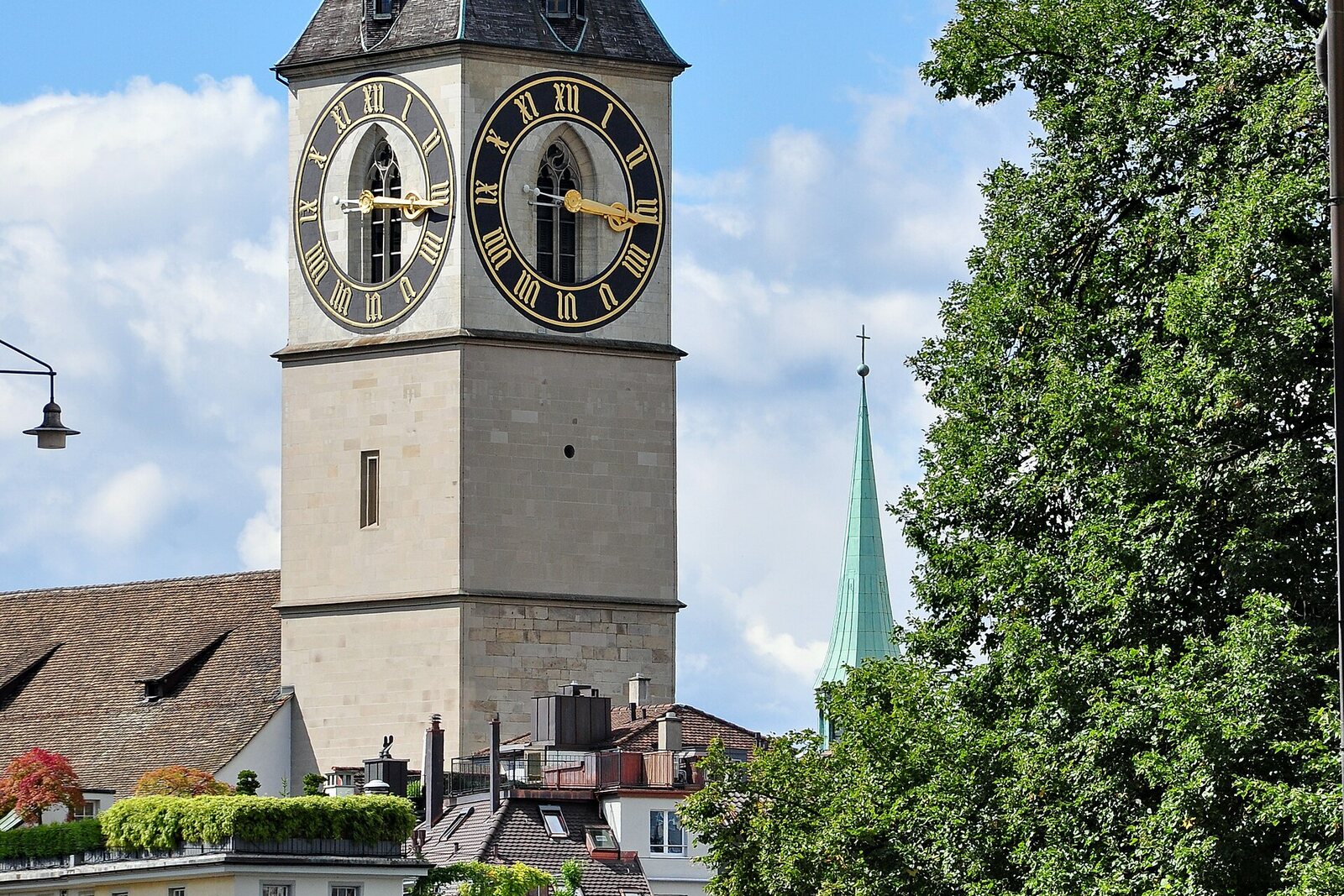
Look around first
What to notice
- Tower
- Huge clock faces
- Windows of the watchman's room
- Nave
The story of the place
The church hall and bell frame of St. Peter's Church belong to the Reformed congregation, while the city manages the tower with its large circular clock faces. Beneath the present church, archaeologists discovered remains of a church from the eighth or ninth century. Later, the site was associated with St. Peter's courtyard, and the name remained when the parish became Reformed. Services, weddings, funerals, and concerts still take place in the church hall today; the bells hang where the church-owned part of the building gives way to the city-owned tower.
The last fire watchman on this tower was named Hermann Esslinger. His workplace was a small room above the clock faces, forty meters up. Every fifteen minutes, Esslinger went to the windows and surveyed the city in all four directions. From this hill, he could see the rooftops of Zurich on the left bank: a fire had to be spotted before the flames could reach neighboring houses.
When he discovered flames, the watchman sounded a horn. Then he placed a red marker in the appropriate window: a flag by day, a lantern at night. People below received both an alarm and directions on where to run. The city had kept such an observer at St. Peter's Church since thirteen forty.
Between his rounds, Esslinger repaired shoes. One salary was not enough for his large family, so the watch room also served as a shoemaker's workshop. His wife and older children took turns replacing him at his post. Esslinger also kept watch over the tower clock: it showed official Zurich time, by which the city's other public clocks were set.
When the telephone became widespread, fires could be reported from the street more quickly. The city abolished the post; Esslinger was about seventy at the time. The watch room remained at the top, while the municipality retained the tower. That is why the building still has two owners: the stone tower with its clock faces belongs to the city, while the nave, bells, and bell frame belong to the Reformed congregation.
The congregation occupies Zurich's oldest parish church. Beneath the present building, archaeologists found remains of a church from the eighth or ninth century, and a document from eight fifty-seven already refers to the associated St. Peter's courtyard. Peter was a disciple of Jesus and one of the apostles; early Christians dedicated this church to him. The documents do not say who chose the patron saint or why. After the Protestant Reformation, the parish kept its old name.
Today, Reformed services, weddings, funerals, and concerts take place beneath the huge clock faces. Above them is still the room from which Hermann Esslinger watched for fire, and the city-owned tower begins directly above the bells belonging to the parish.
Useful on site
Officially: Mon–Fri 9:00–18:00, Sat 9:00–15:00, Sun 9:00–16:00; free entry, subject to changes due to services and events.
Checked: June 30, 2026. Check the official source before visiting.To appreciate the size of the clock, step back into the square and look at the whole tower. Look for the plaque outside; entering the church is not necessary to understand this stop.