 Guide On Map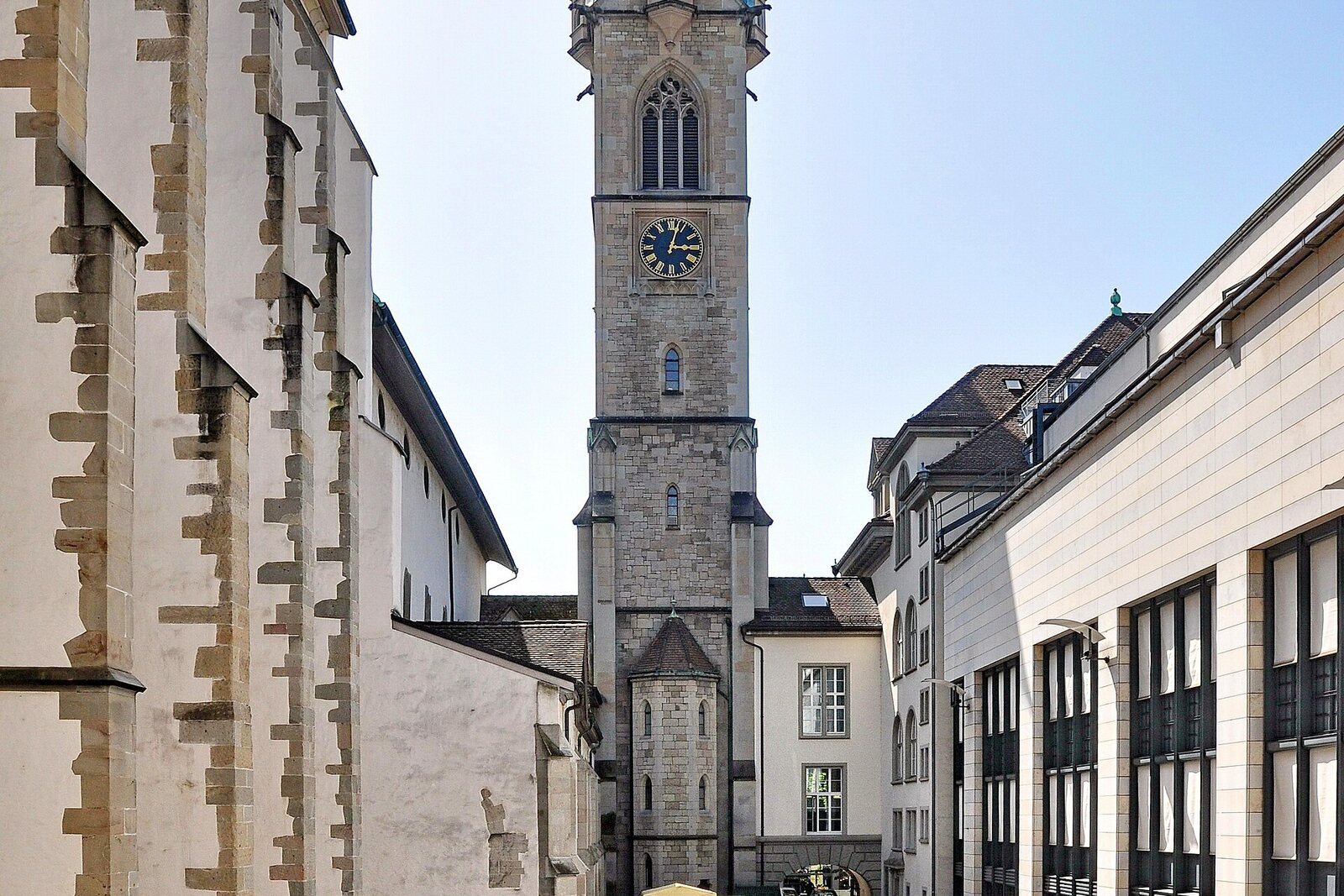
Look around first
What to notice
- Facade of Prediger Church
- Building of Zurich Central Library
- Gothic choir
- Zähringerplatz
The story of the place
The Order of Preachers built its church near Zähringerplatz for urban sermons. In German, the brothers were called Prediger, and this nickname became attached to the names around the square. The facade of Prediger Church faces Zähringerplatz, and Zurich Central Library stands nearby, built on the site of the burned monastery buildings. The Gothic choir contains reading rooms for the music and map collections, and the wall still separates the choir from the church hall.
Zähringerplatz is named after Berthold V of Zähringen, the last duke of the dynasty, who exercised imperial rights in Zurich until his death in twelve eighteen. However, the first institution on this site is associated with his father, Berthold IV of Zähringen. The exact date of its foundation is unknown, but a papal bull from twelve oh four already places under protection the Hospital of the Holy Spirit built by a Zähringen duke.
The duke hoped that this donation would serve the salvation of his own soul. The hospital took in those who could not pay for shelter: the sick, the poor, and travelers. It was run by a brotherhood of laypeople and supported by donations. For a medieval person, the word “hospital” meant at once a shelter, an almshouse, and a place where the sick were cared for.
About a quarter of a century later, the Order of Preachers settled nearby. The order’s full name was the Order of Preachers; in German, they were called Prediger. They lived on alms and needed a permanent urban audience. In twelve thirty-one, the brothers began building a large church here, intended for preaching to the inhabitants of all Zurich. The names Prediger Church, Predigerplatz, and Predigern Parish came from these people.
The hospital and monastery stood side by side for centuries, until Zurich City Council forcibly joined them. In fifteen twenty-four, during the Protestant Reformation, the council dissolved the mendicant orders. The last members of the Order of Preachers were transferred to the former Franciscan monastery, their income and buildings were given to the hospital, and services ceased.
For the hospital, this meant new premises. For the church, it meant dismantling piece by piece. A wall was built between the hall for parishioners and the monastic choir. Wooden floors were installed in the choir, and grain was stored there; a hospital chapel was left below. Five large wine presses were installed in the former church hall. People from Niederdorf came to pray in the cramped chapel on one side of the wall while grapes were pressed on the other.
In sixteen oh seven, Zurich City Council decided to return the hall to the people of Niederdorf. The presses were removed, the space was rebuilt, and in sixteen fourteen an independent Reformed parish church opened here. The Order of Preachers was no longer there, but its urban nickname remained with the parish.
The hospital occupied the neighboring buildings until it moved to a new building in eighteen forty-two. The former monastery then served as a shelter for the chronically ill and housing for the poor, until the buildings burned down in eighteen eighty-seven. By nineteen seventeen, Zurich Central Library had been built on their site. By that time, the Gothic choir had also been given over to books.
In nineteen eighty-nine, the residents of the canton decided whether the choir should be cleared and reunited with the church hall. Supporters of library use won by about three votes to two. The medieval boundary therefore remained: beyond the wall, Predigern Parish is active, while the reading rooms of Zurich Central Library’s music and map collections are located in the former monastic choir.
Useful on site
Officially: Mon 12:00–17:00, Tue–Sun 10:00–17:00; free admission, short-term changes, services, and events are possible.
Checked: June 30, 2026. Check the official source before visiting.First walk around the choir from the outside: the architectural compromise is easier to read from the walls. If the church is open, keep quiet; do not regard the library rooms as a freely accessible part of the visit.