 Guide On Map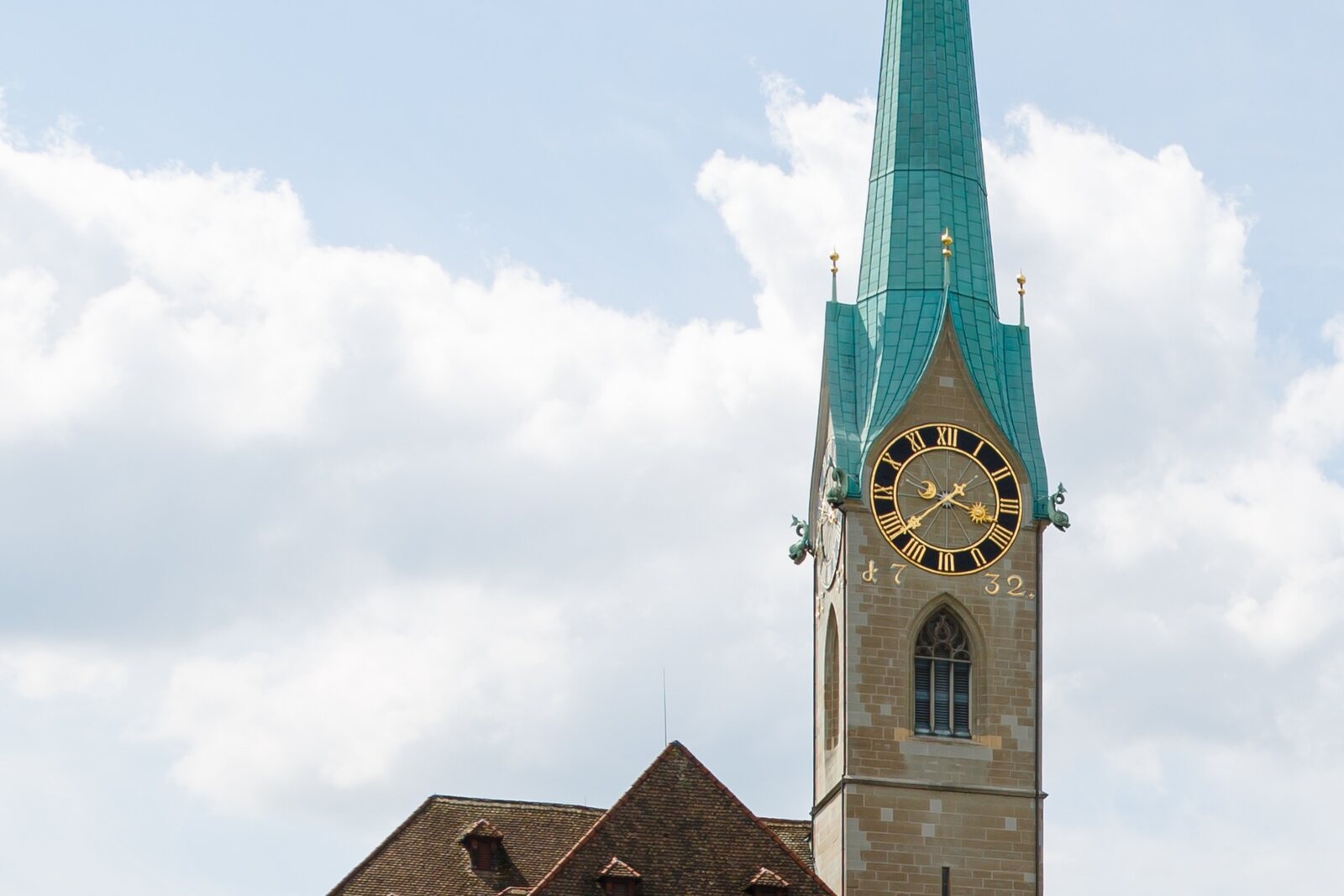
Look around first
What to notice
- Fraumünster
- Münsterhof
- Cloister
- Copper blocks in the floor
The story of the place
The name Fraumünster preserves the memory of a women's convent whose abbess controlled lands and revenues, took part in appointing city officials, and for a time oversaw Zurich coinage. The church beside Münsterhof served the noblewomen of the community, while the square gathered those with whom the convent had to conduct city affairs. In the cloister between the church and city hall, thirty-seven copper slabs are set into the floor: they are dedicated to the last abbess, whose reliable portrait has not survived.
City archaeologists found dense rows of medieval graves, the remains of houses, and a round St. James's Chapel beneath Münsterhof. Around thirteen hundred, judging by the excavation results, one of the abbesses ordered that only a narrow strip of the cemetery along the church be left, while the chapel and several houses were demolished. This is how Münsterhof appeared—a courtyard in front of the cathedral and, at the time, the only large square in old Zurich. Here, the abbess was the first to meet the arriving king before the townspeople and his retinue.
Fraumünster means “women's minster.” In eight hundred fifty-three, King Louis the German gave the convent to his daughter Hildegard so that she could live here with other noblewomen. Later, the head of this community held the title of imperial princess: she governed large landed estates, took part in appointing city officials, and for a time controlled the minting of Zurich coinage. She needed the square for public ceremonies precisely because the convent also handled city affairs.
The last abbess was Katharina von Zimmern. She led Fraumünster for twenty-eight years and, by the beginning of the Protestant Reformation, remained the formal lady of the city and the administrator of a rich estate with villages, farms, lands, and revenues. On Fridays, when a market was held on Münsterhof, Zwingli preached in this church as well: peasants came to trade and also heard the new teaching. His supporters and opponents tried to win Katharina over to their side, while the Zurich City Council hoped to transfer convent property to the city administration.
In December fifteen twenty-four, forty-six-year-old Katharina voluntarily handed the council the abbey, church, lands, dependent people, old rights, and the entire economic administration. In the council record, her own reason is worded cautiously: she wanted to spare Zurich and herself “turmoil and misfortune.” The later claim that this act certainly prevented a civil war cannot be proved. But the consequences of the transfer are known exactly. The council created a special office for the former convent's property, gained the ability to dissolve the city's other religious houses, and Fraumünster changed from the church of a women's community into the city's Reformed church.
Katharina lost her office, centuries-old privileges, and the support of her Catholic relatives. She stipulated the terms of her own life in the same agreement. The council admitted her among the townspeople, promised protection, and left her without a male guardian—for a woman of the sixteenth century, this meant a rare opportunity to manage property independently. For life, she was entitled to a house with a vegetable garden and a garden, firewood, grain, oats, wine, and three hundred fifty-three Zurich pounds each year.
A year later, Katharina married Eberhard von Reischach, a mercenary commander and diplomat who had been expelled from Zurich. Because of his exile, the spouses left for Schaffhausen; there Katharina gave birth to a son and a daughter. The son died young, and Eberhard was killed at the Battle of Kappel in fifteen thirty-one. Katharina returned to Zurich and lived here for another sixteen years as a widow with her daughter, receiving the promised maintenance. Until her death, city records continued to call her “the abbess.”
In the cloister between Fraumünster and city hall lies a rectangle of thirty-seven copper blocks dedicated to her. There is no depiction of Katharina on it: not a single reliable portrait of her has survived. Set into the floor beside the blocks are words about “turmoil and misfortune” from the document by which the last abbess ended the history of the women's convent.
Useful on site
Seasonal hours: 1 March–31 October 10:00–18:00; 1 November–28 February 10:00–17:00; last entry 15 minutes before closing. On Sundays, usually from 12:00 for visitors; exceptional hours are possible.
Checked: June 30, 2026. Check the official source before visiting.View the church and the monument as a single scene: inside is the memory of the abbey; outside is the continuing dispute over the mayor. Visiting the interior is not required and depends on access on site.