 Guide On Map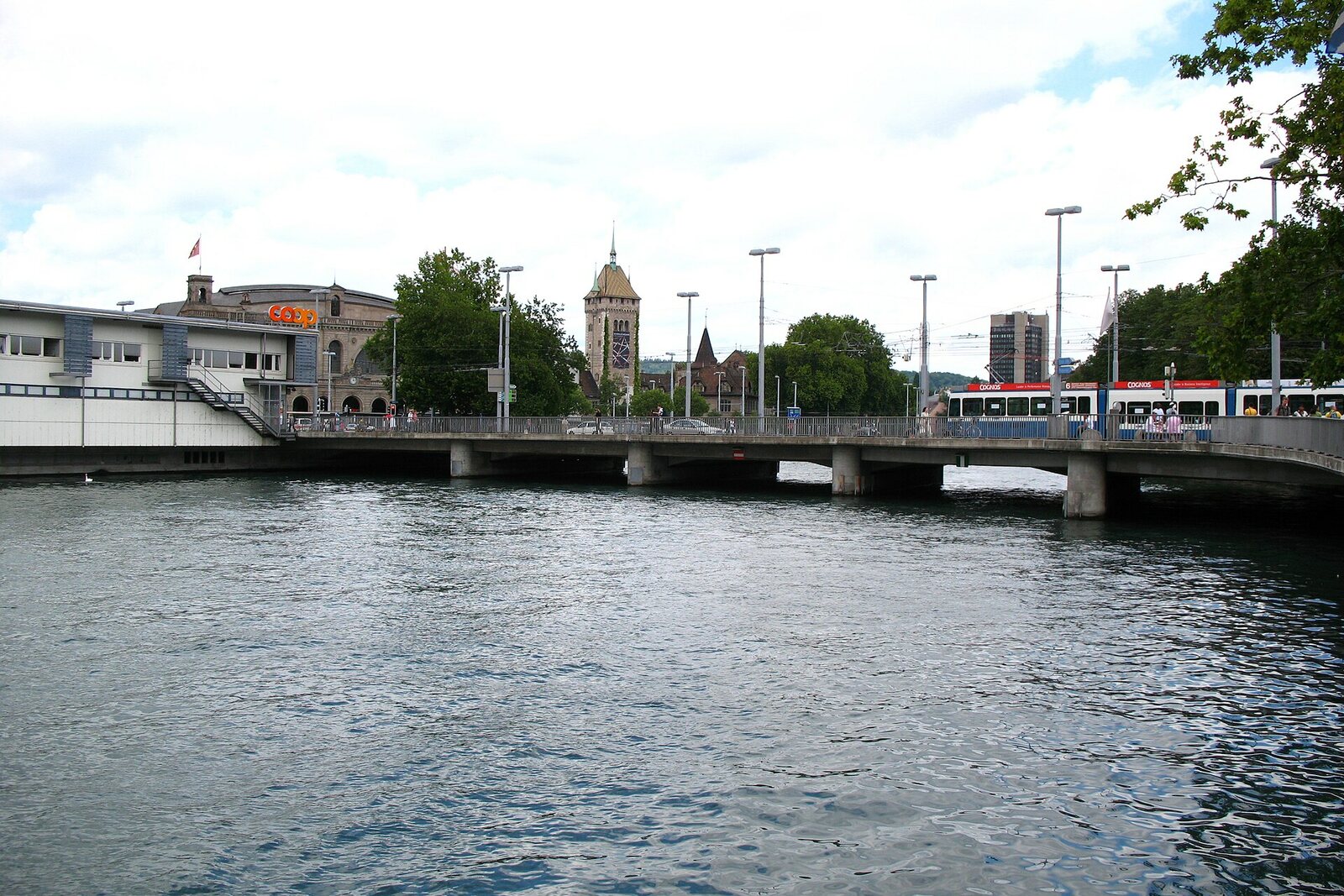
Look around first
What to notice
- Bridge deck
- Tram tracks
- Limmat
- Central
The story of the place
Trams, cars, and pedestrians cross the Limmat on a wide concrete slab; the present crossing is shorter and wider than the stone bridge that stood here before. The old arches were dismantled, but the foundations of the former piers were preserved beneath the new structure. Near Central, one of those arches still lies under the fill made for the tram stop. The name Bahnhofbrücke preserves the connection between this route, Zurich Main Station, and the right-bank neighborhoods.
When the first railroad arrived in Zurich in eighteen forty-seven, the station was placed on the same site as today's Zurich Main Station. The location was more convenient for passengers than for the city itself: the tracks lay beyond the old built-up area and former fortifications, on the stretch between the Sihl and the Limmat. There was no direct road from here to the center.
It was especially difficult for those traveling from the right bank. The wooden seventeenth-century Lange Brücke could carry pedestrians, but not heavy carts. Carters had to make a detour via Rathausbrücke. When the private Swiss Northeastern Railway decided to keep the station in the same place and bring new lines to it, the temporary inconvenience became permanent.
In eighteen sixty, the city hired twenty-seven-year-old Arnold Bürkli as a staff engineer specifically to create new connections to the station. His twenty-two years of city service began with this job. Bürkli received an engineer's salary, but he was to be responsible for a structure that passengers, carters, and merchants would use every day.
The project was approved by the building board—a commission of city officials and private citizens. Before this, the officials had already saved on the width of the neighboring quay, and it almost immediately proved too narrow. They did not want to repeat the mistake: the bridge had to be built with future generations in mind. Bürkli laid stone arches across the river channel and the island of Papierwerd, while the contractor Ludwig Pestalozzi took on the construction. At the end of eighteen sixty-three, carts were allowed onto the bridge; the following spring, the sidewalks, railings, and lamps were completed. The old Lange Brücke was then dismantled.
The name confirmed the purpose of the new crossing: Bahnhofbrücke means “Station Bridge.” The flow between Zurich Main Station and the right-bank city, for which it was built, still passes here—now on foot, by car, and by tram.
The extra width was still not enough. Thirty-six years later, the bridge was widened, and in nineteen forty-eight the townspeople approved construction of the present crossing. The old arches were dismantled piece by piece and replaced with a wide concrete slab. At the same time, the builders preserved the foundations of Bürkli's piers.
On the side of present-day Central, then called Leonhardplatz, the bank was filled in for a tram stop. A buried arch of the former bridge remains beneath the square. Near the station, part of the river channel was drained for a road passing under Bahnhofquai. This is why the present Bahnhofbrücke is wider and shorter than its predecessor, but it still rests on a foundation designed by the twenty-seven-year-old city engineer.
Useful on site
The city bridge and the view of the Limmat are accessible without a ticket; ordinary restrictions due to traffic, construction work, or events are possible.
Checked: June 30, 2026. Check the official source before visiting.For the story, step away from the rails and the passenger walkway. The stop's content is revealed from the bridge; there is no need to look for the hidden old arch beneath the square.