 Guide On Map
Memory on the National Mall and at the Tidal Basin
From the Washington Monument to the Franklin Delano Roosevelt Memorial

Guide On Map on your phone
Open the walk like a regular app
It takes about 10 seconds to install. No app store needed.
The whole path
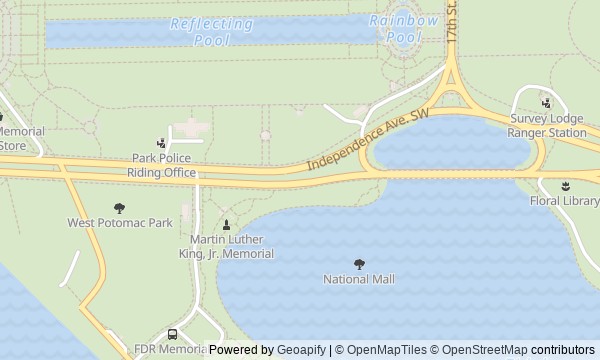
Route map
About the walk
You will walk from the white obelisk to the granite ring of a war memorial. Then a long waterside view will lead you to the steps of the Lincoln Memorial. From there, you will turn toward three monuments where names, figures, and inscriptions speak about who was included in shared memory—and how. The route ends at the Tidal Basin, among the open rooms of the Franklin Delano Roosevelt Memorial.
Along the way, you will notice the boundary between two shades of marble, personal belongings at a black wall, and an empty place where words were once carved. There will also be a chair that at first was almost kept out of sight.
The story rests on small human actions and their long consequences. By the end, you will be able to lead a friend from the two-tone obelisk to two different figures of Franklin D. Roosevelt and explain why the National Mall never became a collection of monuments finished once and for all.
Why this order
The Washington Monument sets the straight perspective for the whole walk, and the boundary in its marble immediately shows that even the capital’s central symbol was built with interruptions. Farther down the same line stands the National World War II Memorial: after the story of a long government construction project comes a memorial that began with a private initiative. Its western exit leads straight to the Lincoln Memorial Reflecting Pool, where an official memorial view meets an unrealized city project.
The path along the water naturally ends at the steps of the Lincoln Memorial—a space that became a stage precisely because other venues were closed. From Lincoln, the route first heads to the northern wall of the Vietnam Veterans Memorial, where memory took the form of names and personal belongings, then crosses the forecourt to the Korean War Veterans Memorial on the southern side. Together, these two stops show different ways of returning an individual person to the history of war.
After the war memorials, the path turns toward the Stone of Hope: the connection with Lincoln continues through the fight against segregation and a dispute over the accuracy of words. The final stretch along the Tidal Basin leads to the Franklin Delano Roosevelt Memorial, where the question of whom we are allowed to see in full finds its visible conclusion.
For a first introduction to the National Mall For those who care about the human stories behind official monuments For lovers of architecture, urban history, and debates about memory
For those looking only for a short photo walk For those who find long conversations about war and social conflict difficult For those who dislike extended routes through open space
Before you go
Most of the route is outdoors, so bring water, sun protection, and comfortable shoes; in summer, it is best to avoid the middle of the day. Check National Park Service notices the day before: ceremonies, repairs, security perimeters, and water conditions can sometimes change the usual approaches. The stop at the Washington Monument is designed for viewing from the ground—if you want to go inside, plan that separately and check visiting rules in advance. At Lincoln, the exterior and the main hall are enough for this route; the additional museum spaces are optional. Leave time to look for names and read inscriptions: these stops do not reward rushing.
When to go
Allow about three hours for the outdoor walk without long stops. With time to read names and inscriptions and rest quietly by the water, it can take up to four. Morning brings less heat and fewer people; late afternoon offers softer light, but plan the finish before fatigue sets in.
Backup plan
If time or energy is short, keep this sequence: Washington Monument → National World War II Memorial → edge of the Lincoln Memorial Reflecting Pool → Lincoln Memorial → Vietnam Veterans Memorial. Even this section shows the shift from a state symbol to personal memory. In hot weather, take a long break at Lincoln and walk the southern section by the Tidal Basin separately in the evening. If the central path between the monument and Lincoln is closed, do not piece the route together from random detours: postpone the walk or choose only the independent Martin Luther King, Jr. Memorial → Franklin Delano Roosevelt Memorial pair along the water.
Route conditions
Surface. Paved — 3.5 km (data covers 98% of the route)
Stairs. Flights: 4, 24 m in total
Access. Wheelchair — no; stroller — limited (stairs)
Facilities. Toilets — 6; drinking water — 21
Elevation. Ascent — 9 m; descent — 16 m
OpenStreetMap extract of June 18, 2026: database data, not a check on the ground. Data © OpenStreetMap contributors, ODbL licence
Walk plan
Open in maps ↗- 1
Washington Monument
Here, it becomes clear how an unfinished construction project left a legible boundary on the main obelisk. - 2
National World War II Memorial
This stop will show how a veteran’s private question became a shared memorial. - 3
Lincoln Memorial Reflecting Pool
Here, the ceremonial vista gives way to the story of how city residents wanted to use the pool in winter. - 4
Lincoln Memorial
The steps connect the memorial to the president with the struggle against segregation in Washington itself. - 5
Vietnam Veterans Memorial
The wall will show how a list of names became a place for letters and personal items. - 6
Korean War Veterans Memorial
This stop continues the conversation about military memory through a man who worked to have names appear on the memorial. - 7
Martin Luther King, Jr. Memorial
Grooves in the stone will show that a dispute over memory can end in the removal of words. - 8
Franklin Delano Roosevelt Memorial
The finale will compare two images of one president and two decisions about what to conceal.
Route features
Everything you need stays in the browser
Progress, saves and your trip plan are stored on this device.
Add Guide On Map to your home screen so the walk opens outside the browser.
How we handle sources, maps and corrections: our editorial standards