 Guide On Map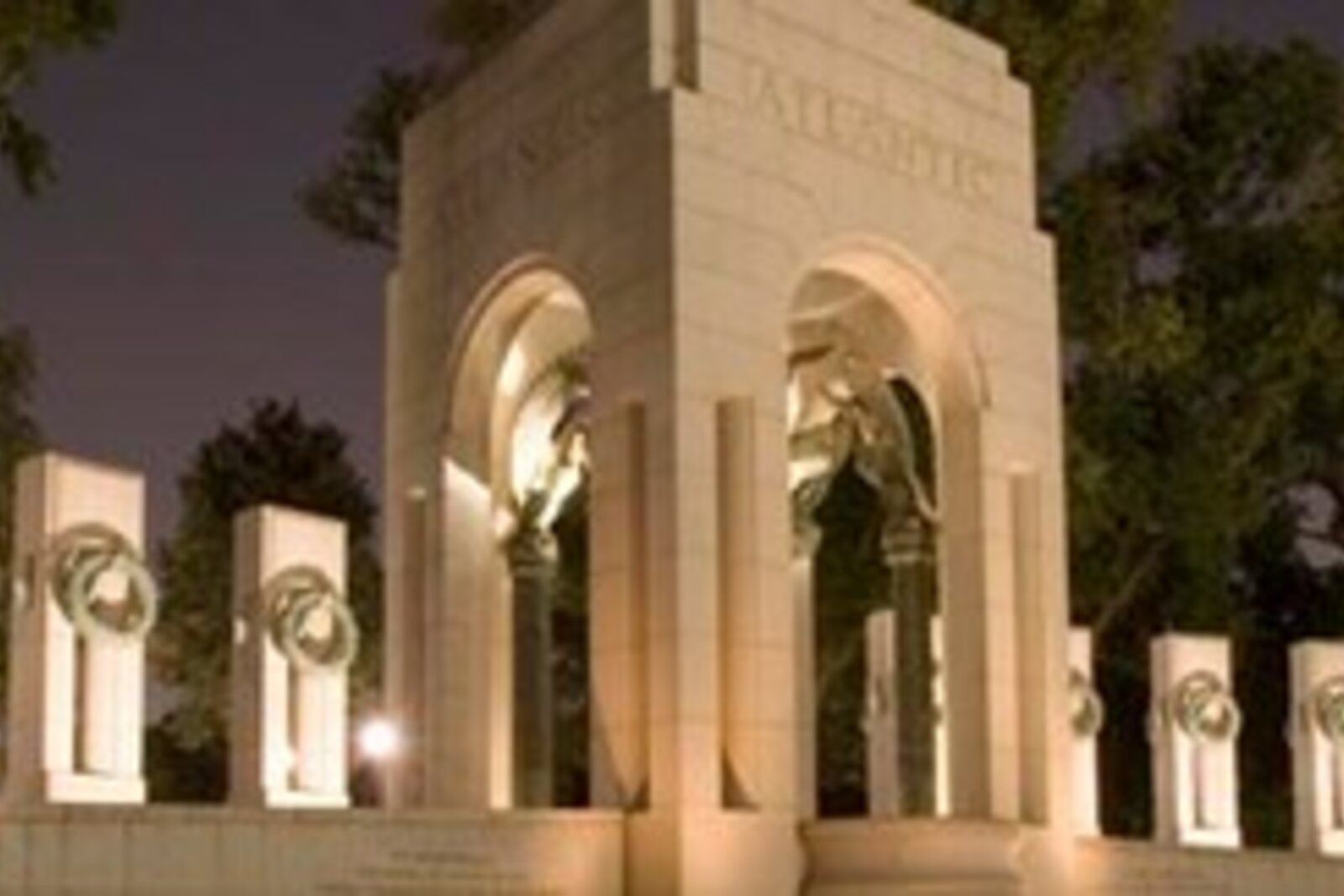
Look around first
What to notice
- Rainbow Pool
- Granite columns
- Two granite arches
- Wall with gilded stars
The story of the place
Fifty-six granite columns form a circle around the Rainbow Pool and bear the names of the wartime states, the federal district, and the territories. At its edges stand two granite arches for the Atlantic Theater and the Pacific Theater, while four thousand forty-eight gilded stars on the Freedom Wall mark the dead. The site between the Washington Monument and the Lincoln Memorial was lowered below the lawn so as not to block the view between them; the former pool was rebuilt and retained at the center. Here, sixteen million who served, millions of people on the home front, and four hundred five thousand three hundred ninety-nine who died are remembered.
On Veterans Day in nineteen ninety-five, Roger Durbin stood here, by the Rainbow Pool. The present granite ring was not yet there. Veterans scattered soil brought from sixteen American military cemeteries overseas. A flag was raised above the site, then folded and handed to Durbin. He wept and told his wife, Marion Durbin, that he wanted to be buried with that flag.
During the war, Durbin served as a tank mechanic in the Tenth Armored Division and took part in the Battle of the Bulge. After returning to Ohio, he became a rural mail carrier. In nineteen eighty-seven, at a dinner for local officials, Durbin called out to his representative in the United States Congress, Marcy Kaptur. He wanted to bring his grandchildren to Washington and asked where he could show them a memorial to all of World War II.
Kaptur thought such a monument already existed and named the U.S. Marine Corps War Memorial, with its flag raising on Iwo Jima. Durbin objected: it was dedicated to one branch of the armed forces and one campaign. He needed a place for everyone who fought in Europe and the Pacific, died, returned home, or worked in wartime production.
Kaptur introduced a bill in the United States Congress. The first attempt came to nothing; then she tried twice more. Only the fourth bill passed, and in nineteen ninety-three President Bill Clinton authorized the creation of the memorial. The Rainbow Pool, between the Washington Monument and the Lincoln Memorial, was chosen for it. The site was lowered below the lawn to preserve the direct view between the two earlier monuments, while the old pool was rebuilt and retained at the center.
Durbin saw the site dedication, but not the start of construction. He died of cancer in February two thousand and was buried with the flag he received here. Four more years later, Kaptur spoke at the memorial’s opening before the assembled veterans and their families. Seventeen years had passed since her first conversation with the rural mail carrier.
The fifty-six columns around the pool are named for the forty-eight wartime states, the federal district, and the territories. Two granite arches mark the Atlantic Theater and the Pacific Theater. The memorial is dedicated to sixteen million Americans who served in the armed forces, millions of people who supported the war on the home front, and four hundred five thousand three hundred ninety-nine who died. On the Freedom Wall, they are represented by four thousand forty-eight gilded stars—one for every hundred deaths.
Today’s Rainbow Pool stands where Durbin received the folded flag. The flag itself remained with him at Wolffinger Cemetery in Ohio.
Useful on site
The memorial is usually open around the clock as an outdoor site. As of early July 2026, the western axis and memorial areas were subject to temporary holiday restrictions; check access again on the day of your walk.
Checked: July 1, 2026. Check the official source before visiting.Walk around the memorial and approach the stars closely: the overall pattern and its human count are perceived from different distances.