 Guide On Map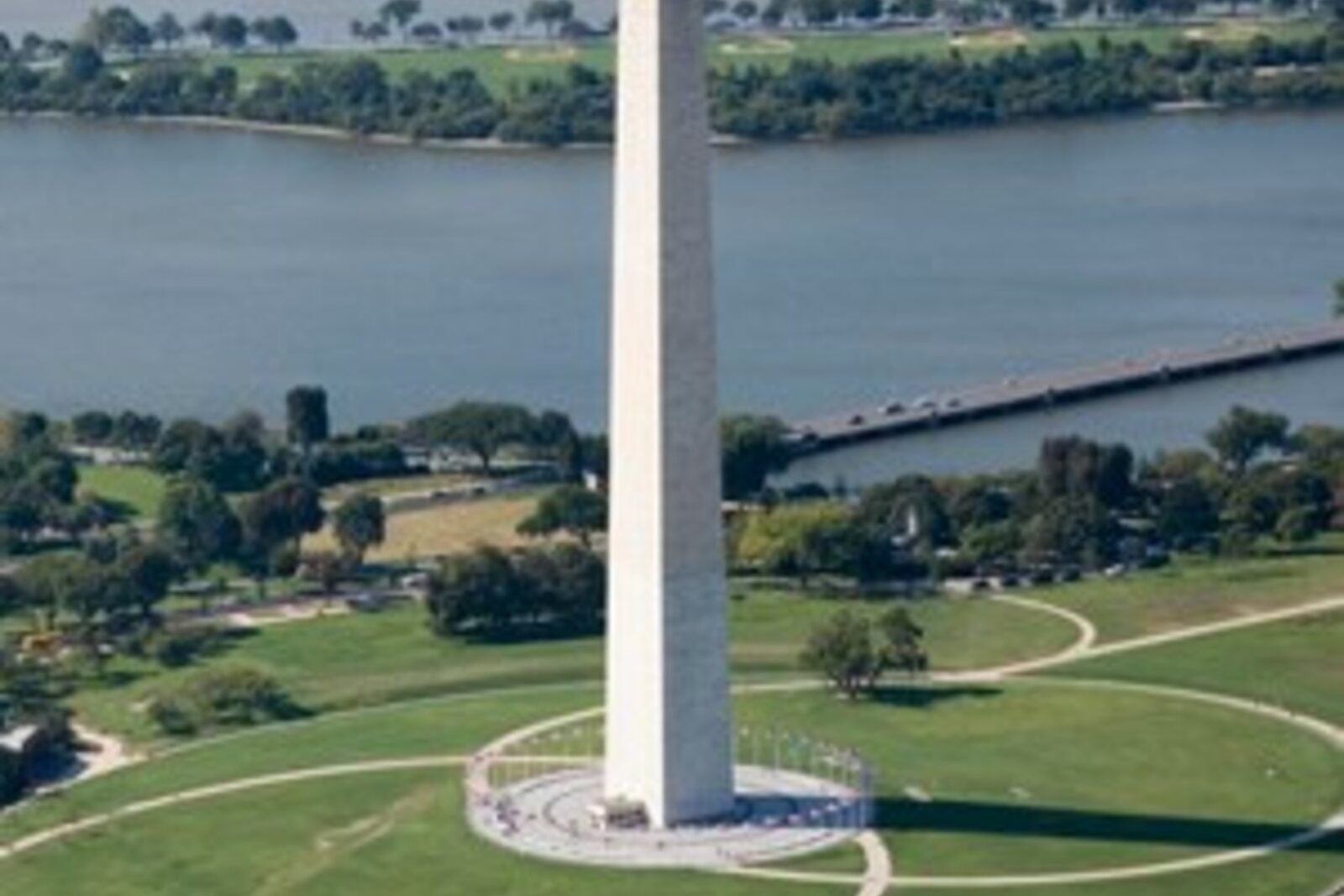
Look around first
What to notice
- Dark marble on the lower section
- Light marble on the upper section
- The boundary between the shades
The story of the place
The main axes of the federal capital converge at this white stone needle: the intersection of lines from the White House and the United States Capitol was set aside for it, but the heavy tower had to be moved slightly southeast because of unreliable ground. The obelisk rises almost one hundred seventy meters, and stones sent by states, cities, associations, and foreign donors are set into its interior walls. The lower part of the marble cladding is darker than the upper part, and the change in shade is clearly visible on its smooth faces. Through it, the stone still preserves a trace of different times.
The white obelisk is dedicated to George Washington—the commander of the army that won independence for the United States and the country’s first president. After two presidential terms, he stepped down voluntarily. United States Congress promised to erect an equestrian statue for him as early as seventeen eighty-three, during Washington’s lifetime, but the promise outlived him by several decades.
The site was chosen because of the city’s plan. Washington selected the area for the future capital on the Potomac River and commissioned the French engineer Pierre L'Enfant to lay it out. L'Enfant set aside for the monument a point at the intersection of a line from the White House and a line from the United States Capitol. The ground there proved too weak for a heavy stone tower, so the builders moved the site slightly southeast. The obelisk thus stands almost at the intended intersection, but not exactly on it.
In eighteen thirty-three, Chief Justice of the Supreme Court of the United States John Marshall decided to counter United States Congress’s inaction with private donations. The society he created collected money across the country; at first, one person could give no more than one dollar a year. To cut costs and allow different communities to take part in construction, the society accepted commemorative stones for the interior walls. States, cities, professional associations, and foreign donors sent their own blocks. One piece of marble was donated by Pius IX.
For members of the Know Nothing Party, nicknamed the Know Nothings, this gift was unacceptable. They opposed Catholics and immigrants and wanted to decide for themselves whom to regard as a true American. In March eighteen fifty-four, several members of the movement stole the papal stone from the construction site. No one was arrested. According to a widespread version, the block was smashed and thrown into the Potomac River; there is no indisputable confirmation of this part of the story.
The Know Nothings then held fraudulent elections and took over the society’s leadership. United States Congress withdrew the promised two hundred thousand dollars, and private donations almost stopped. The new leaders managed to lay only a few courses of poor masonry. By eighteen fifty-eight, the movement had lost influence and returned the documents to the former board, but there was no money left. A stone tower about forty-six meters tall stood here for nearly two decades. During the American Civil War, the surrounding site was set aside for drill exercises and a pen for government livestock.
Only in the year of the centennial of independence did United States Congress agree to take over the unfinished monument and pay for its completion. Lieutenant Colonel Thomas Lincoln Casey, a career officer in the U.S. Army Corps of Engineers who built fortifications during the American Civil War, was responsible for the work. His professional reputation now depended on the calculations beneath the enormous stone mass. Casey found that the old foundation would not support the completed obelisk. The engineers widened the support beneath the tower already standing, and the masonry laid by the Know Nothings was dismantled.
By then, the former quarry had become unavailable, so the upper part was built from marble from two other deposits. In December eighteen eighty-four, Casey oversaw the installation of the top stone and the aluminum pyramid. The obelisk reached approximately one hundred sixty-nine meters and for several years became the tallest structure in the world.
Today, the lower third of the monument is noticeably darker than the upper part: the boundary between the shades runs where private construction ended and Casey’s work began after a long break. In nineteen eighty-two, a new marble block bearing the inscription “From Rome — to America” was installed inside. It is approximately one hundred four meters above the ground. The original gift of Pius IX is not in the monument.
Useful on site
The plaza around the monument is usually accessible as an open area. Entry inside is allowed only with a ticket for a specific time and through security screening; interior visits are closed on July 4, December 25, maintenance days, and in hazardous weather. As of early July 2026, the approaches were also affected by temporary holiday restrictions.
Checked: July 1, 2026. Check the official source before visiting.Listen to the main account outside, standing far enough away to see the monument in full. Going inside is not required; if you want to go up, plan it as a separate visit.