 Guide On Map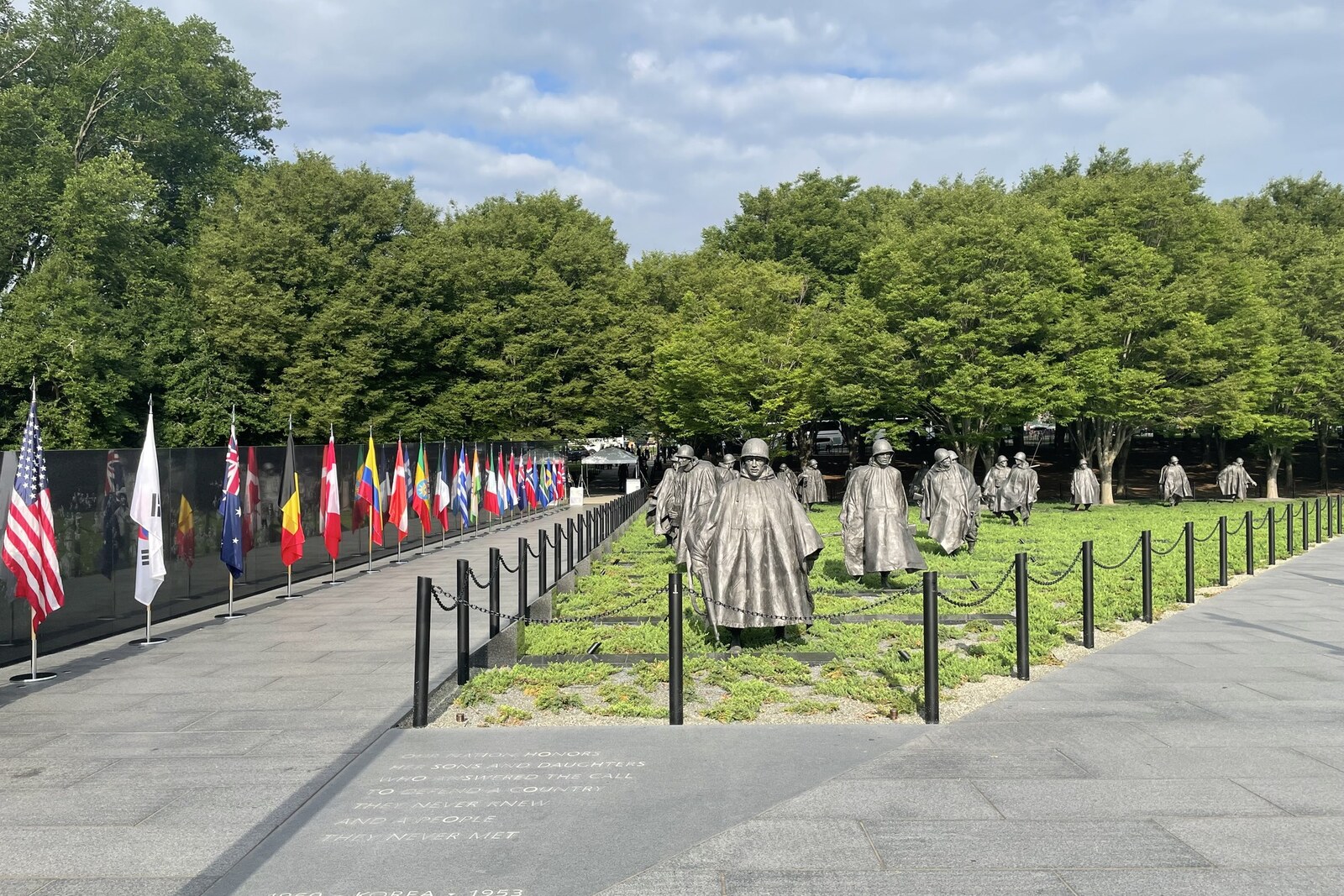
Look around first
What to notice
- Nineteen steel figures
- Black granite wall
- Reflections of the figures
- Wall with names
The story of the place
South of the Lincoln Memorial, a steel patrol of nineteen figures moves across an uneven strip of ground around the pool. A black granite wall catches their reflections, and in it the soldiers become thirty-eight—the number of the parallel that divided the Korean Peninsula before the war. Here are gathered images of American men and women who served in ground forces, the navy, aviation, medicine, and communications; the faces on the granite were transferred from thousands of archival photographs. The site was placed opposite the Vietnam Veterans Memorial, linking the two wars with one crosswise line by the Lincoln Memorial.
First along the path leading from the Lincoln Memorial comes a soldier with a rifle—the patrol commander's assistant. The sculptor Frank Gaylord, who was commissioned to depict American military personnel in Korea, gave this figure the features of William F. Weber.
In February nineteen fifty-one, Captain Weber commanded a company of paratroopers near Wonju, South Korea. His men were to take a height held by the enemy. On the night of February sixteenth, a grenade shattered Weber's right arm. He continued to command. A few hours later, a second wound cost him his right leg. The company completed its task, and only then was the captain evacuated.
Over the course of a year, Weber underwent surgeries and rehabilitation, then secured a return to the army. At that time, he was the only American officer with two amputations on active duty. The pay of a career military man remained his income: he served for nearly three more decades and retired as a colonel.
In nineteen eighty-seven, Weber was appointed to the veterans' council that was to select a memorial design, raise donations, and see construction through to completion. A site south of the Lincoln Memorial was set aside for it, opposite the Vietnam Veterans Memorial on the other side of the main path. The designers used this symmetry: the two military memorials formed a crosswise pair by the Lincoln Memorial.
Nineteen steel figures depict a patrol moving across uneven Korean ground. They are reflected in a black granite wall and become thirty-eight—the number of the parallel along which the border between North and South Korea ran before the war. In June nineteen fifty, North Korean troops crossed this line; the United States entered the war as part of the United Nations forces. The armistice halted the main combat operations on July twenty-seventh, nineteen fifty-three. On the anniversary of that date, in nineteen ninety-five, the memorial was dedicated.
The veterans named here are American men and women who served in that war: infantrymen, sailors, airmen, medics, communications personnel, chaplains, and drivers. The statues show a ground patrol, while the faces on the granite were transferred from thousands of archival photographs of those who supported its movement.
Weber nevertheless considered the memorial unfinished. There were nameless faces on the granite, general numbers of the dead, wounded, missing, and captured by the pool, but a visitor could not read the names of the fallen. After the dedication, Weber helped establish a memorial foundation and spent many years advocating for a wall with names.
Construction began in the spring of two thousand twenty-one. Weber attended the groundbreaking, but died on April ninth, two thousand twenty-two. The wall was dedicated on July twenty-seventh—three and a half months later. It bears the engraved names of fallen American service members and South Korean soldiers assigned to American units during the war.
The figure created in the likeness of the young Weber holds a rifle with both hands. Behind it, names encircle the pool—the names whose dedication the older Weber did not live to see.
Useful on site
The memorial is usually open around the clock. At the beginning of July 2026, the area may have been subject to temporary holiday restrictions on the western axis; check access before heading out.
Checked: July 1, 2026. Check the official source before visiting.View the figures from the edge of the path and do not walk among them: the distances and the direction of their gazes are part of the composition. The names on the new wall require a separate, slow walk around.