 Guide On Map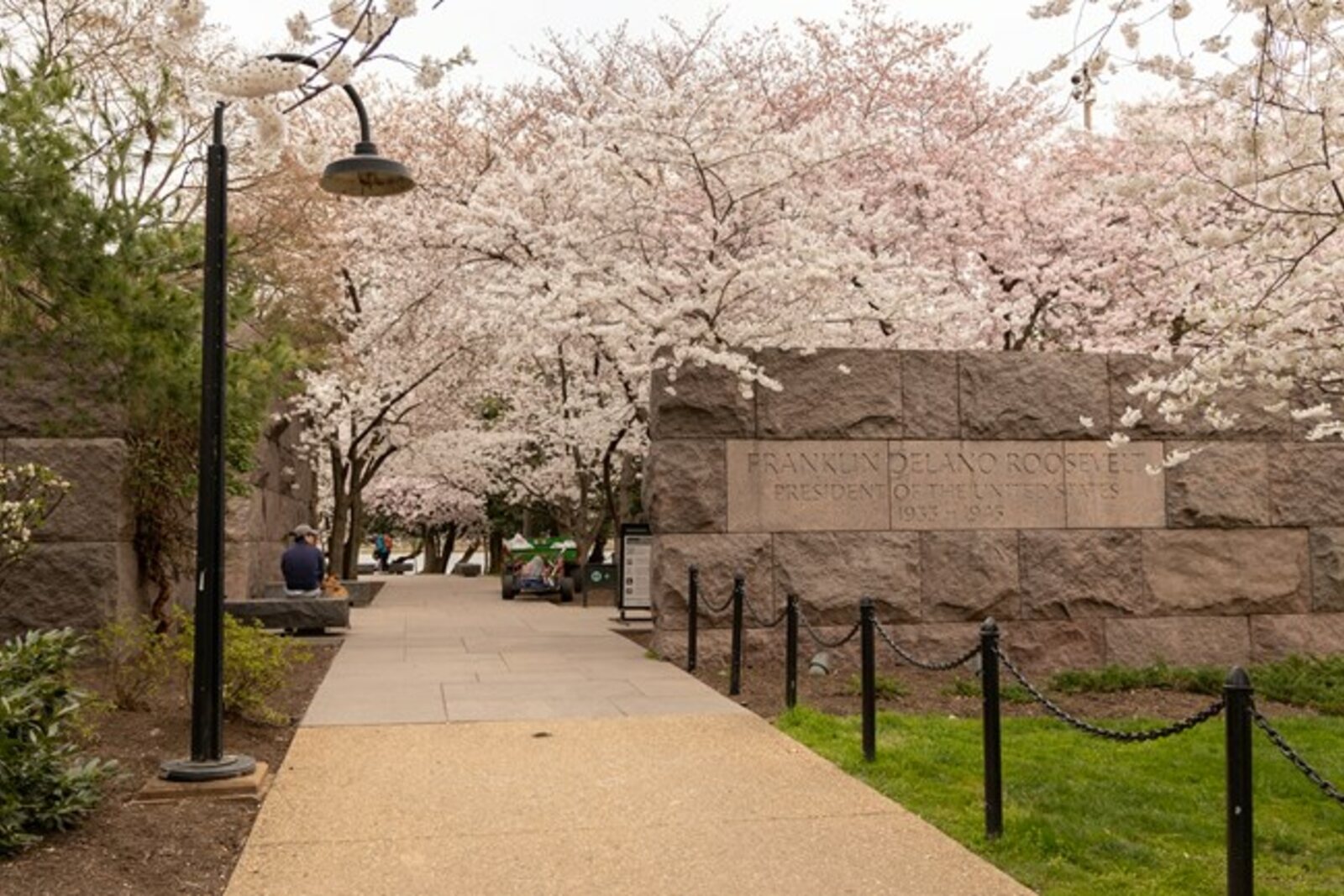
Look around first
What to notice
- The statue of Roosevelt in a wheelchair
- Four open rooms
- A bronze figure in a long cloak
- Small wheels behind the chair
The story of the place
In the prologue room, Franklin D. Roosevelt sits in a narrow wheelchair. He was the thirty-second president of the United States: he won four elections, led the country during the Great Depression and for most of World War II. After an illness that doctors considered polio, thirty-nine-year-old Roosevelt almost lost the ability to move his legs.
The diagnosis was no secret. Roosevelt concealed how heavily he depended on other people's help. He feared voters would mistake an inability to walk for an inability to lead. Before speeches, aides seated him at the lectern in advance; then the president rose, holding on to disguised railings. Photographers were asked not to photograph the chair or the people carrying Roosevelt. That was the price he paid for the familiar image of a strong candidate.
In nineteen seventy-four, architect Lawrence Halprin was commissioned to create a large memorial by the Tidal Basin. Four open rooms were meant to tell, in sequence, the story of Roosevelt's four presidential terms. Halprin planned wide passageways and ramps even before a federal law required public places to be accessible. But he decided to show the president himself as Roosevelt had presented himself to the public during his lifetime.
An enlarged bronze figure of Roosevelt in a long cloak appeared in the third room. He sits in an ordinary chair; the small wheels are hidden behind it. At the opening on May second, nineteen ninety-seven, it was this barely noticeable detail that recalled the president's paralyzed legs.
Michael DeLand, chairman of the National Organization on Disability and a wheelchair user himself, pushed for a different image. Before that, he had headed the Council on Environmental Quality at the White House and knew how to move a demand through federal agencies. For DeLand, the dispute was not about a medical detail: the completed memorial showed that disability could be removed from a biography even when a person had lived with it throughout a presidential career.
More than fifty organizations and sixteen of Roosevelt's grandchildren joined the campaign. On the eve of the opening, the United States Senate approved a decision on a new image; in summer, the United States Congress passed a law. It required a permanent addition to the memorial, the involvement of people with disabilities in the project, and payment for construction through private donations.
DeLand joined the committee that chose the form and location of the new sculpture. Halprin took part as well: instead of reworking the four rooms, he added a prologue before them. Sculptor Robert Graham portrayed Roosevelt in a wheelchair of Roosevelt's own design—a modified kitchen chair with wheels from a tricycle. The figure was made life-size, placed at ground level, and set away from the wall so that it could be approached from any side.
On January tenth, two thousand one, the prologue opened. The first statue was not removed. It still stands farther on, in the room of the third term: the cloak falls almost to the floor, and the wheels are concealed behind the chair. The chronological route through the memorial now begins with an image that was not here on opening day—Roosevelt in a wheelchair.
Useful on site
The memorial is open around the clock as an open space. In early July 2026, access could change because of temporary holiday restrictions on the western axis. The pavement by the water may be slippery; restrooms are available at the beginning and end of the complex.
Checked: July 1, 2026. Check the official source before visiting.Do not look for a single main viewpoint: walk through the rooms in sequence and listen to how the water changes. You can approach the bronze figures without blocking the narrow sections of the path.